Best Media Player for TV: Top Picks for Seamless 4K Playback and Smart Home TV Use
The following article highlights five top media players that expand a TV’s capabilities by enabling 4K playback, USB/SD card support, and reliable media organization. This guide compares key features across popular models to help American shoppers choose a reliable, easy-to-use option for home entertainment, digital signage, and multi-room setups. The selections focus on devices that support modern codecs, offer varied outputs, and provide straightforward playback control.
Overview of chosen products:
| Product | Brand | Key Benefit | Output/Format Highlights |
|---|---|---|---|
| Micca 4K Ultra-HD Digital Media Player | Micca | Compact all-in-one media player with 4K support | 4K HDMI, USB/SD, H.265/HEVC, MP4/MKV, JPG, MP3 |
| 4K HD Digital Media Player | fnetic | High-res 4K playback with dual USB | HDMI, Optical, H.265/HEVC, 2x USB, FAT32/exFAT/NTFS |
| 4K Ultra HD Media Player & HDD Enclosure | JLZNLC | Integrated media player with HDD support | 4K HDMI, HDD support, AUTO playback, looping |
| Roku Ultra | Roku | Premium streaming with HDR and voice remote | 4K HDR10+/Dolby Vision, Wi‑Fi 6, voice remote |
| Micca G3 2K Quad-HD | Micca | Slim player with 2K upscaling to 4K | 2K upscaling, USB/SD, H.265/HEVC, MP4/MKV |
Micca 4K Ultra-HD Digital Media Player

The Micca 4K model provides a compact, budget-friendly option for expanding a TV’s capabilities. It supports playback from USB drives and MicroSD cards, making it easy to access personal media without a computer. Its 4K HDMI output ensures compatibility with modern TVs and projectors, while composite AV output enables use with older displays or a stereo system. The device emphasizes ease of use, with auto play and resume features that keep viewing uninterrupted. File system support covers FAT, exFAT, and NTFS, offering broad compatibility with removable drives up to large capacities.
In practice, this player is well-suited for family rooms, small offices, or hospitality settings where straightforward media playback is valued. It supports common formats like MP4, MKV, MP3, and JPG, enabling a simple, all-in-one entertainment solution without needing a smart TV. Its small footprint helps hide the player away while still delivering a robust media experience.
4K HD Digital Media Player
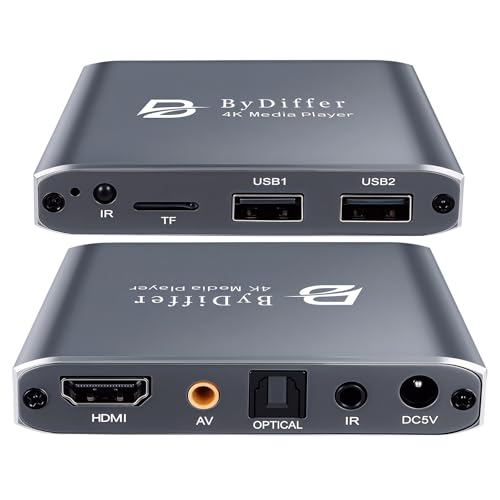
This model emphasizes 4K HDR-compatible playback with advanced H.265/HEVC decoding. It connects via HDMI for high-quality visuals and provides an optical output to support high-fidelity sound systems, including 7.1-channel setups. The two USB ports enable the use of separate drives or devices, though only one drive at a time is read. Supported file formats include common video, music, and photo types, with FAT32, exFAT, and NTFS file systems to maximize drive compatibility. It suits home theaters where audio quality and 4K performance are priorities.
Users should consider whether dual USB access aligns with their storage needs and whether they require MAC-formatted drive compatibility. As a dedicated media player, it functions well for home entertainment, education demonstrations, or small-business digital signage where straightforward playback from external storage is essential.
4K Ultra HD Media Player & HDD Enclosure

This 2-in-1 unit blends media playback with dedicated HDD enclosure support, making it convenient for digital signage, menu boards, and in-store promotions. It handles H.265/HEVC and H.264/AVC video formats, with the ability to upscale to 4K at 60fps over HDMI. Auto playback, resume, and looping are built in, along with flexible output rotation options for diverse display layouts. Subtitles, media formats, and video constraints are designed for versatile playback across commercial and home environments.
The device is a practical choice for venues that want a simple, plug-and-play solution that stores media locally. Its compact design lowers cabinet clutter, while the enclosure capability enables easy expansion of a library with larger drives. When used for digital signage, reliability features like looping and resume help ensure uninterrupted content delivery.
Roku Ultra

Roku Ultra represents a premium streaming solution with 4K HDR (HDR10+, Dolby Vision) and immersive sound through Dolby Atmos. It delivers quick, responsive performance with a user-friendly interface designed for apps, live TV, and on-demand content. The included rechargeable Voice Remote Pro adds backlit buttons and voice control, along with convenience features like a remote finder. While primarily a streaming interface, Roku Ultra also supports private listening through mobile devices and a wide app ecosystem, making it a strong choice for cord-cutters and households that want a central streaming hub.
When evaluating Roku Ultra, consider the importance of streaming breadth versus purely local media playback. It excels in app variety, ecosystem compatibility, and overall performance, but for users prioritizing local USB/SD playback from external drives, a dedicated media player may offer simpler local playback without relying on streaming services.
Micca G3 2K Quad-HD

The Micca G3 brings a compact, budget-conscious option that upscales 2K content to UHD 4K/60Hz via HDMI output. It shares the same emphasis on USB and microSD card playback, plus support for H.265/HEVC, MP4, MKV, MP3, and JPG formats. Its compact form factor is ideal for bedroom TVs, dorm rooms, or secondary displays. The dual USB/SD compatibility ensures flexible media loading, while the resume and auto-play features help maintain a smooth viewing experience across sessions.
For setups requiring a smaller device that still delivers solid 4K-equivalent upscaling with local media playback, the G3 is a pragmatic choice. It’s particularly attractive for multi-room entertainment where a consistent, affordable player is needed at several TVs.
Buying Guide: Key Purchase Considerations
When choosing a media player for TV use, several core factors determine long-term satisfaction and performance across different living spaces and setups.
- Video and audio codecs: Look for H.265/HEVC, H.264/AVC, and support for 4K or 2K playback to ensure broad compatibility with downloaded or stored files. Optical or HDMI outputs affect audio fidelity and compatibility with AV receivers.
- Storage and media sources: Consider devices with USB and microSD support, plus options to read external HDDs. If you plan to use large libraries, verify file-system compatibility (FAT32, exFAT, NTFS) and drive size limits.
- Auto playback, resume, and looping: Features that automatically start media, resume where you left off, and loop playback help in signage or educational contexts where continuous playback is required.
- Output options and display compatibility: HDMI remains standard for modern TVs, but some devices offer analog AV for compatibility with older displays. Check 4K@30Hz versus 4K@60Hz support and HDR capabilities if you use HDR-capable TVs.
- Remote control and ease of use: A simple interface, responsive remote controls, and optional air-mouse compatibility can significantly affect daily use, especially in shared living spaces or classrooms.
- Signage and dedicated use cases: For digital signage, features like auto-start, loop, and rotation can simplify deployment. For home entertainment, app availability and streaming performance become more relevant.
- Reliability and support: Firmware updates, troubleshooting resources, and brand reputation influence long-term reliability and compatibility with new video formats.
In summary, the top pick depends on your priorities. If you want robust local playback with solid 4K compatibility and a compact design, models like Micca and JLZNLC offer strong value. If streaming breadth and a polished ecosystem are essential, Roku Ultra provides a premium experience. For multi-device signage or small business environments, the 2-in-1 devices offer expanded deployment flexibility. Always align device capabilities with your primary use cases to maximize satisfaction.