Best USB to RCA Dac for Clean Computer or Phone Audio
Answering the search intent directly: these USB to RCA DAC cables and adapters convert digital audio from USB-enabled devices into high-quality analog stereo signals for home audio systems, amps, or speakers. They’re ideal for laptop users, mobile device enthusiasts, and home theater setups looking to upgrade sound without complex gear. The top picks below cover built-in DAC performance, compatibility with USB-C and USB-A devices, and practical connectivity. Each option is best for a different setup, from desktop workstations to mobile devices and turntables. A quick summary table follows to help compare core strengths at a glance.
| Product | Best For | |
|---|---|---|
| Cubilux USB to RCA Audio Cable with 384KHz/24-bit DAC | PC or laptop audio upgrades with built-in DAC | 384KHz/24-bit |
| LiNKFOR USB to SPDIF Coaxial RCA + 3.5mm | Multi-output setups with optical or coaxial needs | USB to Optical/Coaxial/Analog |
| Fosi Audio Q6 Mini DAC | Compact desktop stereo or headphone amp integration | 32bit/768kHz, DSD512 |
| UGREEN USB C to RCA Audio Cable | Type-C devices to RCA audio without adapters | 16bit/48kHz |
| Qubilux USB C to RCA Audio Cable | Mac/USB-C devices to home audio with hi-res DAC | 192KHz/24-bit |
The following sections detail five carefully chosen options. Each product is described with who it’s best for, why it was selected, and a practical caveat to consider.
Cubilux USB To RCA Audio Cable With Built-In DAC

This cable combines a built-in DAC with USB A to two RCA outputs, simplifying setups that require a direct PC to stereo connection. It’s best for computer-driven listening where a single cable should carry both data and analog output. The 384KHz/24-bit DAC supports high-resolution audio streams to reduce noise and preserve clarity. The design uses oxygen-free copper and 24K gold-plated connectors to optimize signal transfer, making it suitable for desk setups or compact stereo systems. A note: compatibility can depend on operating system and driver availability, so users should confirm device support before use.
Who it’s best for: Windows or Mac users needing a straightforward USB-to-RCA path for hi-res music without extra adapters. Why this selection: built-in DAC and premium conductors for clear stereo sound in a simple 1-cable setup. Caution: ensure your host device supports 384KHz/24-bit output and that your amplifier expects RCA L/R inputs.
LiNKFOR USB To SPDIF Coaxial RCA Converter
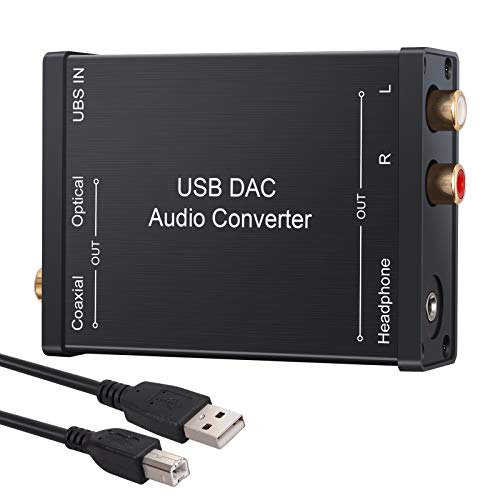
This multi-output converter takes USB audio and provides digital optical, coaxial, and analog RCA L/R outputs. It also can function as an external sound card. This makes it a good choice for systems that require several output formats or a quick upgrade for a TV soundbar, PC, or game console. The device emphasizes PCM or LPCM output for compatibility with common home theater devices. Limitations include potential 5.1 channel compatibility considerations and setup steps that may vary by OS or device.
Who it’s best for: users needing flexible digital/analog outputs from a single USB source. Why this selection: broad output options and the ability to use it as an external sound card. Caution: verify PCM/LPCM settings on your specific setup to avoid unexpected audio formats.
Fosi Audio Q6 Mini Desktop DAC

The Q6 Mini is a compact desktop DAC designed for home stereo and headphone amplification. It uses a high-quality AKM DAC and XMOS processing, offering PCM up to 32bit/768kHz and DSD512. The device provides optical and coaxial inputs along with USB, and RCA plus Sub-Out outputs, making it a versatile hub for a small home audio system. The choice suits users who want a more feature-rich DAC in a compact form, especially when matching a streamer, CD player, or TV to an amplifier or powered speakers. A caveat is that some users may desire more than two RCA outputs depending on their setup.
Who it’s best for: desktop listeners seeking high-resolution audio and multiple input options. Why this selection: premium DAC capabilities in a small form factor. Caution: ensure you have sufficient space for placement and consider output needs beyond two RCA connections.
UGREEN USB C To RCA Audio Cable

This Type-C to RCA cable is built to connect newer devices with USB-C or Thunderbolt 3 directly to RCA inputs. It’s particularly convenient for modern laptops and phones that lack traditional USB-A ports. The DAC supports 16bit/48kHz output, delivering clean, low-noise stereo sound to home audio systems, car stereos, soundbars, or turntables. It’s a practical pick for users prioritizing a simple, direct USB-C to RCA path without extra adapters. However, the 16/48kHz ceiling means it may not satisfy audiophiles seeking higher-resolution formats.
Who it’s best for: users with USB-C devices who want a straightforward RCA connection. Why this selection: eliminates extra adapters and works with a wide range of Type-C devices. Caution: expect 16bit/48kHz performance; higher-resolution needs may require a different model.
Cubilux USB C To RCA Audio Cable

This USB-C to RCA cable features a built-in DAC that supports up to 192KHz/24-bit, aiming to deliver crisper, studio-like stereo sound from USB-C devices to RCA-equipped speakers. It’s designed for MacBooks, iPads, and other Type-C devices, with oxygen-free copper and 24K gold-plated connectors to minimize interference. The selection is best for users who need a high-res path from modern USB-C devices to traditional RCA audio gear without dongles. Limitation includes DAC performance ceiling that may not satisfy enthusiasts seeking beyond 192KHz/24-bit.
Who it’s best for: Type-C device users seeking higher-resolution PCM audio in a direct RCA path. Why this selection: strong DAC performance and robust build for long-term use. Caution: confirm your source’s supported sample rate to match expectations.
Buying Guide
What to consider when choosing a USB to RCA DAC
Audio source and device compatibility matter. USB-A and USB-C models cover different device ecosystems, from PC desktops to modern smartphones. Consider the DAC’s supported sample rates and bit depth (for example, 24-bit/192kHz or 24-bit/384kHz) to ensure your music library can be fully utilized. If you require multiple outputs (optical, coaxial, RCA), choose a model designed for versatile formats.
Do you need a built-in DAC?
A built-in DAC simplifies setup and reduces extra components. It’s a strong choice for users who want to minimize cables and improve noise performance in a single device pathway. If you already have a premium external DAC, a simple USB-to-RCA without a DAC may suffice, but you’ll need compatible devices and drivers.
What about output quality and connectors?
Gold-plated connectors and oxygen-free copper wires help preserve signal integrity. Dual RCA outputs make it easy to connect to stereo receivers or powered speakers. If you’re wiring to a car stereo or a home theater system, verify compatibility with the specific RCA color coding and input types on your amp.
Is portability a factor?
Compact, bus-powered DACs are convenient for laptops and portable use. If you travel with gear, consider the build quality and cable length. Longer cables may introduce impedance and potential signal loss, so balance length with performance needs.
Platform and OS considerations
Some adapters require driver support or specific OS configurations. Windows, macOS, and Linux handles vary, so check for plug-and-play behavior or any required software steps before purchasing.
Summary of top picks by scenario
- Best for simple PC-to-stereo: Cubilux USB To RCA Audio Cable With Built-In DAC
- Best for multi-output versatility: LiNKFOR USB To SPDIF Coaxial RCA Converter
- Best for compact desktop setups: Fosi Audio Q6 Mini DAC
- Best for USB-C devices without adapters: UGREEN USB C To RCA Audio Cable
- Best for USB-C to high-resolution RCA: Cubilux USB C To RCA Audio Cable (192KHz/24-bit)
Frequently Asked Questions
- What is a USB to RCA DAC used for?
It converts digital audio from a USB source into analog stereo output for RCA-connected speakers or receivers.
- Do I need a DAC with a built-in amplifier?
Some setups require a separate amplifier; a DAC alone forwards a line-level signal, which may need amplification before speakers.
- Can USB-C to RCA cables work with iPhones?
Yes, with compatible USB-C devices or adapters, but iPhones typically require a USB-C or Lightning adapter setup compatible with their audio output.
- Is 24-bit/192kHz necessary for casual listening?
For most casual listening, 16-bit/44.1kHz or 24-bit/96kHz is more than sufficient; higher resolutions benefit critical listening.
- Will these cables fix low-quality headphones?
They improve source signal quality but do not upgrade the headphones themselves. Pair with suitable headphones or a proper amplifier for best results.
- Do these cables require drivers?
Many are plug-and-play, but some setups may require minimal driver configuration depending on OS and device compatibility.