Best 500 Watt 2-Channel Amp for Clear Car Audio Performance
Find the right 500 watt 2-channel amplifier to boost your car stereo with clean, powerful sound. This guide highlights 5 solid options, explains who each is best for, and notes practical trade-offs. Ideal buyers include daily drivers seeking loud, clear imaging, weekend riders chasing better sub integration, and entry-level installers aiming for straightforward setup.
| Product | Max Power | Channels | Best For | Notes |
|---|---|---|---|---|
| Pioneer GM-A3702 | 500 W max total | 2-channel | Best for balanced daily listening | Bridgeable; Class AB efficiency balance |
| Crunch Ground Pounder GP-1000.2 | 1,000 W total; 2×500 W @ 2 Ω | 2-channel | Best for higher-volume setups | Bridgable; strong at low impedance |
| Skar Audio RP-75.4AB | 500 W RMS (2 Ω per pair) | 4-channel | Better for full-range rear fills | Compact A/B design; 4-channel versatility |
| BELVA BXA5002 | 250 W x 2 @ 2 Ω | 2-channel | Efficient, compact power | Class A/B; MOSFET; strong protection |
| Timpano TPT-500.4 | 500 W total (4×125 W @ 2 Ω) | 4-channel | Small installs needing 4 channels | Brazilian Class D tech; high efficiency |
Below, each product section provides a concise overview, how it aligns with different buyers, and practical notes to help you compare quickly. All links point to the official Amazon listing for convenience and reference.
Disclaimer: This article uses product features as provided in the listings. No warranties or guarantees are implied.
Pioneer GM-A3702 2-Channel Car Amplifier

Best for: daily drivers who want reliable mid-range loudness with clean signal handling. This 2-channel Class A/B amp delivers up to 500 watts max, with 60 watts RMS per channel at 2 ohms in bridged mode (190 watts RMS x 1). The design prioritizes efficiency and cool operation, making it a solid balance between performance and heat management.
Why it’s selected: It offers a straightforward 2-channel setup with a bridge option to push more power when needed, and built-in high-/low-pass filters for easy tuning.
Caution: In bridged mode, ensure your speaker wiring and sub configuration are compatible with the resulting impedance to avoid overstress.
Crunch Ground Pounder GP-1000.2

Best for: enthusiasts seeking higher power headroom in a 2-channel format, especially when driving a pair of midrange speakers or a bridged mono sub configuration. It provides 2×500 W at 2 Ω and 2×250 W at 4 Ω, plus a mono bridged option at 4 Ω.
Why it’s selected: The GP-1000.2 emphasizes strong low-impedance performance and a bridgeable design, enabling flexible system builds.
Caution: At 2 ohms, heat can rise quickly; ensure adequate ventilation and proper mounting.
Skar Audio RP-75.4AB 500W 4-Channel
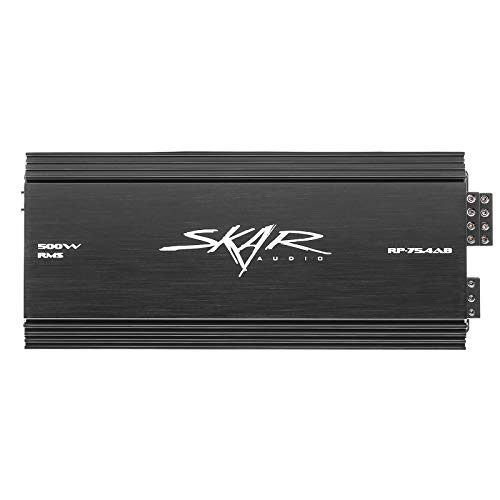
Best for: installers wanting a four-channel setup with robust per-channel power for front and rear channels, while keeping a compact footprint. It delivers 125 watts x 4 at 2 Ω and 75 watts x 4 at 4 Ω.
Why it’s selected: The 4-channel configuration provides flexibility for multi-voice setups, including front stage and rear fill, or bridged options for subwoofers in some configurations.
Caution: This is a four-channel amp; you’ll need multiple channels to use its full potential, which may add complexity for pure two-channel systems.
BELVA BXA5002 500W 2-Channel

Best for: compact, efficient two-channel power with strong protection features for smaller builds or budget-conscious installations. It delivers 4 ohms: 125 W x 2 and 2 ohms: 250 W x 2.
Why it’s selected: The Class A/B design balances efficiency with low distortion, while three-way protection circuitry helps improve longevity of the system.
Caution: The 2-ohm rating provides higher power potential but can stress the heat management in small enclosures without cooling.
BOSS Audio Systems R3002 Riot Series

Best for: users who want a robust two-channel option with bridgable capability and multiple input methods for integration with different head units. It delivers up to 300 W x 2 @ 2 Ω and supports 4 Ω operation as well.
Why it’s selected: The R3002 provides practical power for a 2-channel setup and adds versatility with low/high level inputs and flexible crossover options.
Caution: Power figures are configuration-dependent; ensure your speaker and subwoofer choices align with the impedance and channel configuration you select.
Buying Guide
What defines a “500W” 2-channel amplifier?
“500W” typically refers to peak or total power across both channels rather than per-channel sustained output. Look for RMS (continuous) ratings per channel to gauge real-world performance. A 2-channel amp rated around 60-125 W RMS per channel at 2 Ω or 4 Ω is common in this class, paired with a bridgeable option for more power when needed.
Key considerations for 2-channel amps
- Impedance: Check the speaker impedance you’ll drive (2 Ω vs 4 Ω) and ensure the amp supports that load for both channels.
- Bridging: If you intend to run a sub, bridging the channels can double power into a single load. Verify the recommended minimum impedance for bridged operation.
- Efficiency and heat: Class AB designs balance efficiency with distortion. Proper cooling and ventilation reduce thermal throttling.
- Filters and crossovers: Built-in high-pass/low-pass filters simplify tuning and help protect speakers from bass frequencies they can’t handle.
- Installation: Consider mounting space, wiring gauge (top quality power and ground cabling), and fuse protection for safety and reliability.
How to choose based on use case
- Daily commuting with upgraded front speakers: a compact 2-channel amp with solid RMS per channel and easy tuning is ideal.
- Bridgable subwoofer setup: pick a 2-channel amp with explicit bridged mode support and a suitable impedance range.
- Rear-seat or multi-amp installs: a 4-channel model can simplify wiring for front and rear channels while allowing a separate sub amp later.
Installation tips for best results
- Use a high-quality amplifier install kit with proper gauge wiring and an appropriately rated fuse.
- Mount away from heat sources and ensure adequate airflow around the amp.
- Match the amp’s input sensitivity to your head unit’s output to maximize signal-to-noise ratio.
Frequently Asked Questions
- What does “2-channel” mean in amps? It means the amplifier has two separate output channels to power two separate speakers or a bridged single channel for subwoofers.
- Is higher wattage always better? Not necessarily. Real-world performance depends on RMS power, impedance, efficiency, and how well the amp is matched to the speakers.
- Should I bridge a 2-channel amp? Bridge mode can double power into a single load, but verify impedance limits and speaker compatibility first.
- What is RMS power? RMS is the continuous, real-world output an amplifier can sustain without overheating or clipping, unlike peak or max power figures.
- Do I need a dedicated subwoofer amp if I have a 2-channel amp? If your goal is powerful sub bass, you might consider a dedicated mono amplifier or bridge the 2-channel to drive the sub, depending on your chosen model and impedance.
- How important are built-in crossovers? Built-in high-pass/low-pass filters help protect speakers and simplify tuning, especially in budget or compact installs.