Best 24 Channel Audio Interface Options for Studio and Live Use
Looking for a 24-channel audio interface that fits studio and live workflows? This guide highlights five solid options, explaining who each is best for and why. The selections emphasize flexible channel counts, robust preamps, and mix/route capabilities suited for tracking, monitoring, and multi-mic setups. Ideal buyers include project studios needing expansive I/O, live engineers seeking integrated mixers, and professionals who require reliable AVB/USB/ADAT connectivity.
| Product | Type | Key Benefit |
|---|---|---|
| Behringer UMC1820 Audiophile | USB Audio/MIDI Interface | 18 inputs / 20 outputs with ADAT I/O |
| Behringer X AIR XR18 | Digital Mixer / Audio Interface | 18 inputs with built-in Wi‑Fi control |
| Mackie Onyx Series Onyx24 | Analog Mixer with USB Multitrack | 24-channel analog routing with USB and SD recording |
| Soundcraft Ui24R | Digital Rack Mixer | 24 inputs with integrated processing and remote control |
| Behringer UMC404HD | USB Audio/MIDI Interface | 4×4 with high-resolution conversion for smaller setups |
Note: Each product offers different strengths, from standalone digital mixing to pure I/O expansion. The following sections break down who benefits most from each model and why it was selected for this guide.
Behringer UMC1820 Audiophile 18×20 Interface

Best for project studios needing extensive I/O and compatibility with common DAWs. This 18×20 USB 2.0 interface includes ADAT I/O, enabling expansion with external preamps or converters. It delivers 24-bit/96 kHz audio, suitable for multi-mic sessions and instrument recording. Compatible with popular software such as Pro Tools, Ableton Live, and Cubase, it suits users who want reliable, budget-friendly expansion without a full mixer.
Who it’s best for: Home studios and small project studios that need many input channels and ADAT expansion without adding a separate mixer.
Why selected: High channel count in a compact unit, solid Behringer preamps, and broad DAW compatibility.
Caution: Driver support can vary by OS; ensure your computer and DAW are confirmed compatible with USB 2.0 interfaces.
Behringer X AIR XR18 18-Channel Digital Mixer
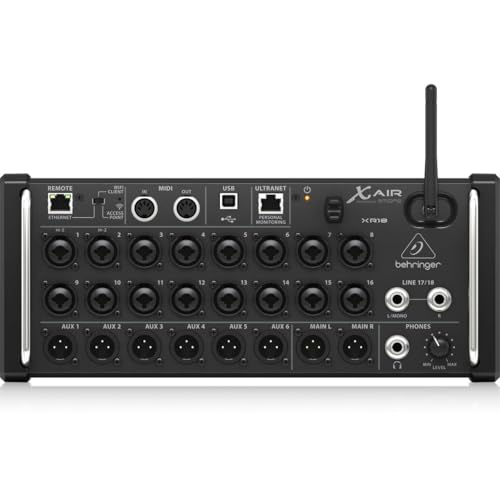
Best for live and mobile setups needing wireless control. The XR18 is a fully programmable digital mixer with 16 MIDAS-designed preamps and built-in Wi‑Fi for direct operation via tablet or phone. It functions as an 18-input mixer and USB audio interface, allowing on-the-fly routing and effects without a separate computer mixer. The integrated Wi‑Fi router simplifies stage setups where external routers are impractical.
Who it’s best for: Live sound engineers and compact studios that want a mixer-enabled interface with remote control from tablets.
Why selected: Integrated control surface, robust preamps, and convenient wireless operation.
Caution: Requires a compatible tablet or phone for full control; troubleshooting can be more involved if Wi‑Fi connectivity is unstable in certain venues.
Mackie Onyx Series Onyx24

Best for studios that prioritize high-end analog feel with multi-track USB recording. The Onyx24 features high-resolution 96 kHz/24-bit USB multitrack recording, plus direct SD card stereo recording and playback. Its renowned Onyx preamps deliver up to 60 dB of gain and the classic Perkins British-style EQ with a sweepable midrange. A strong choice for engineers who want tactile control with solid digital routing.
Who it’s best for: Projects that benefit from analog warmth and a familiar mixer workflow with USB multitrack options.
Why selected: Combines classic analog preamps with modern USB multitrack capability and an extensive EQ section.
Caution: Analog-centric design may require more space and a longer setup time compared to compact digital models.
Soundcraft Ui24R Rack-Mount Digital Mixer

Best for remote control and integrated processing in a single rack unit. The Ui24R combines 24 inputs with onboard signal processing and an intuitive control surface accessible via laptop, tablet, or smartphone. Its remote operation makes it suitable for venues and studios where the engineer needs to adjust levels from the FOH or a backstage area. The description notes this unit is sold through authorized Soundcraft North American dealers with warranty.
Who it’s best for: Venues or studios needing a compact, remotely controllable digital mixer with built-in processing.
Why selected: Strong remote control capabilities and comprehensive onboard processing that reduce external gear needs.
Caution: Warranty details are specifically tied to authorized dealers in the US; verify dealer status before purchase.
Behringer U-PHORIA UMC404HD

Best for compact setups needing solid 4×4 performance with premium preamps. The UMC404HD provides 4 inputs and 4 outputs with Midas preamps and 24-bit/192 kHz conversion. It is compatible with common DAWs, making it a practical choice for small studios or mobile rigs that still require clean, high-fidelity audio for multiple sources.
Who it’s best for: Solo producers, podcasters, and small studios seeking reliable, high-quality conversion in a portable package.
Why selected: A balance of price, performance, and compatibility in a compact footprint.
Caution: Fewer inputs than the other options; may require external expanders for larger sessions.
Buying Guide
What should you consider when choosing a 24-channel interface?
Channel count and routing flexibility matter most. Decide between a dedicated I/O-expansion model (like ADAT-enabled interfaces) and a built-in mixer/DAW controller (like the XR18 or Ui24R). Consider whether you need wireless/remote control, on-board processing, or standalone recording to meet your workflow.
Why choose analog vs. digital mixing in this category?
Analog mixers (like the Mackie Onyx24) can offer tactile control and classic EQ characteristics, while digital mixers (Ui24R, XR18) provide recallable scenes and extensive routing through a single interface. Digital options are often more versatile for hybrid studio/live environments.
Connectivity and expansion considerations
ADAT I/O lets you add preamps or converters as your needs grow. USB interfaces suit DAW-centric studios, while built-in Wi‑Fi (XR18) enables flexible stage or venue setups. Check compatibility with your DAW and operating system before purchase.
What is the best choice for live performance?
If you need on-stage control, consider XR18 or Ui24R for remote operation and consolidated processing. For road-ready reliability, prioritize models with robust preamps and straightforward audio routing.
Durability and warranty considerations
For professional use, verify warranty terms and ensure you purchase from authorized dealers when warranty coverage is important (as with Soundcraft Ui24R listing). Durable metal chassis and stable drivers reduce on-site failures.
Bottom-line comparison
- Most inputs and expandability: Behringer UMC1820 or XR18.
- Best analog feel with USB multitrack: Mackie Onyx24.
- Remote control and built-in processing: Soundcraft Ui24R.
- Compact, budget-friendly option: Behringer UMC404HD.
Frequently Asked Questions
- What is the advantage of ADAT I/O in these interfaces?
ADAT I/O allows expanding input channels without a heavy USB bandwidth burden, enabling more microphones or instruments to be captured simultaneously.
- Can I use these interfaces with multiple DAWs?
Yes. All listed models support common DAWs such as Pro Tools, Ableton Live, and Cubase, ensuring flexible software compatibility.
- Do digital mixers require external control devices?
Many do not; devices like the XR18 and Ui24R offer direct tablet/phone control, reducing the need for a separate controller.
- Is there a difference between 96 kHz and higher sample rates?
Higher sample rates (like 192 kHz) can offer lower latency and potentially better fidelity, but real-world improvements depend on the source material and monitoring setup.
- Should I prioritize preamp quality or channel count?
Evaluate your typical session: large multi-mic drums benefit from more preamps and optical expansion, while solo or small-band setups may prioritize a compact interface with excellent preamps.