Best Car HUD Head Up Display Options for Safer Driving in 2026
Answering the needs of drivers who want instant, glanceable speed and vehicle data, these car HUD head up displays provide digital speed, engine metrics, and warnings projected onto your windshield. They’re best for drivers who want to keep eyes on the road rather than dashboard buttons, commuters who value quick speed checks, and tech enthusiasts looking for dual-system data (GPS with OBD2). The following five products stand out for real-time readouts, ease of installation, and practical safety features. A quick summary table is included below for easy comparison.
| Product | Best For | Key Benefit | Limitations |
|---|---|---|---|
| KUOWEIHUD K1-White | Daily drivers | Dual GPS+BDS with auto brightness | Requires USB power |
| wiiyii OBD2 Gauge Display | Car owners wanting OBD2 data | 16+ data metrics including RPM, temp | OBD2 compatibility varies by vehicle |
| AZIJYV M22 HUD | All-vehicle use | GPS speed with compass and over-speed alert | Compass needs satellite lock |
| MH Head Up Display | Vehicles needing dual-system view | OBD2 plus GPS, broad metrics | Complex setup for first-time users |
| MAIMEIMI OBD2 HUD | Drivers wanting turn indication | Turn signals projected onto HUD | App setup required for some features |
KUOWEIHUD K1-White Car HUD

The KUOWEIHUD K1-White uses dual GPS and BDS technology with a 10Hz refresh rate, connecting to up to 32 satellites for fast, stable speed updates. It projects speed directly into the driver’s line of sight, reducing the need to look away from the road. An auto-brightness sensor adjusts display brightness for daytime visibility and nighttime comfort. Best for daily drivers who want a reliable, glare-free heads-up projection. A limitation is that it relies on USB power for operation, so installation should consider power accessibility.
Who it’s best for: Commuters and family vehicle users who prioritize clear, eye-level speed readouts and simple plug-and-play power.
Why selected: Combines accurate GPS speed with adaptive brightness in a single unit and maintains a low-profile display that minimizes distraction.
wiiyii OBD2 Gauge Display Heads Up Display (P6)
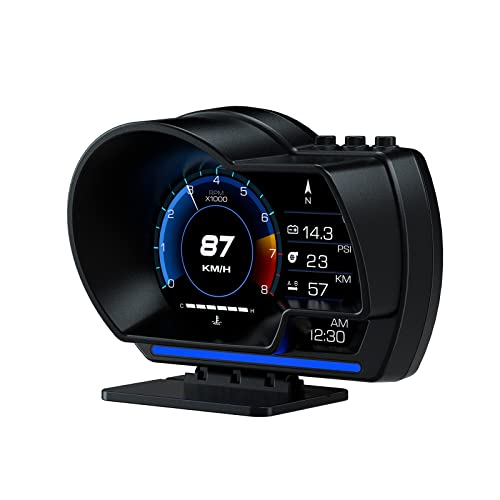
wiiyii’s P6 HUD emphasizes safety-first design, letting drivers read speed at a glance without looking down. It offers 10 interface options, a clear fault code readout, and both dashboard and windshield mounting. The device supports both OBD2 and GPS modes, enabling flexible data presentation such as speed, RPM, water temperature, and more. Best for drivers who want a wide data set at a glance and flexible mounting. Limitation: some information relies on vehicle compatibility, and setup can require careful alignment for best readings.
Who it’s best for: Vehicle owners who want a broad set of metrics plus easy diagnostic indicators.
Why selected: The dual-mode capability and multiple interfaces provide a customizable driver experience while staying focused on the road.
AZIJYV Windshield Speedometer (M22 HUD)

AZIJYV’s M22 HUD is a GPS-based speedometer designed as a windshield projector. It displays speed, clock, travel time, and distance traveled, with an over-speed alarm and a GPS compass for direction. It supports MPH and KM/H and can be tuned in settings. Best for those who want a distinct, color-contrasted HUD with alarms to promote safe driving. Caution: compass functionality requires satellite lock, so performance improves on open roads with steady signal.
Who it’s best for: Drivers who value a clear speed readout along with directional data and a speed alert.
Why selected: The dedicated over-speed alert and compass add practical safety layers for highway driving and urban commutes.
MH Head Up Display (OBD2 + GPS)

MH offers a dual-system HUD that can switch between OBD2 data and GPS data, displaying 15+ metrics including speed, RPM, fuel usage, water temperature, drive time, and more. It includes fault diagnosis and automatic data analysis, with a broad array of indicators such as altitude and voltage. Best for tech-minded drivers who want integrated vehicle diagnostics and a wide performance view. Limitation: the setup can be more involved, and some vehicles may require careful calibration for accurate data alignment.
Who it’s best for: Owners seeking a comprehensive data center in one unit, with robust diagnostics.
Why selected: The dual-system capability provides redundancy and a broader data stream, useful for advanced monitoring.
MAIMEIMI OBD2 Heads Up Display

MAIMEIMI’s OBD2 + GPS HUD emphasizes turn indication projection, providing RPM, water temperature, and other metrics alongside alert features. The device merges OBD2 data with GPS data for a broader, more reliable readout. It’s best for drivers who want turn cueing on the HUD to assist navigation and safety. Limitation: some features may require app setup or firmware updates to access full functionality.
Who it’s best for: Drivers who value turn indication alongside standard HUD readouts.
Why selected: The combination of turn indication with conventional HUD data makes it a practical choice for urban driving and long trips.
Buying Guide: Key Considerations For Your Car HUD
What data do you need on your HUD? Many units offer speed, RPM, and temperature, while some provide GPS-based distance, travel time, and compass. Choose a device that matches your vehicle’s capabilities (OBD2 compatibility, GPS reliability) and your driving style (highway, city, or mixed).
How will you power and install it? USB-powered units are simple to install but may require a dedicated car USB port. Some models offer plug-and-play installation, while others need dashboard or windshield mounting. Consider mounting ease, glare reduction, and cable routing when planning installation.
Is dual-system data important? Devices that combine OBD2 with GPS deliver both engine metrics and satellite-based speed data. If you want raw diagnostics and performance monitoring, choose a dual-system HUD. If you only need speed and basic data, a GPS-only HUD can be lighter and simpler.
What about alerts and alarms? Over-speed and fault codes can promote safer driving, especially for long trips. Check whether the HUD offers configurable alerts, and whether the alarm audibility aligns with your driving environment.
Which features are must-haves vs nice-to-haves? Auto brightness improves visibility, but you may prioritize turn indication, compass data, or multiple interfaces. Consider climate, typical lighting, and your vehicle’s glass for effective projection.
FAQ
- What is a car HUD head up display?
It projects essential driving data onto the windshield so you can read it without looking away from the road. - Do HUDs work with all cars?
Most work with many vehicles via GPS or OBD2 data, but some require vehicle-specific compatibility checks. - Can HUDs cause glare or distraction?
Quality displays are designed to minimize glare, and automatic brightness helps reduce distraction in varying light conditions. - Is dual-system data better than GPS-only data?
Dual-system HUDs provide both engine metrics and speed data, which can be more informative for maintenance and safety. - Do I need professional installation?
Many are plug-and-play, but some setups benefit from professional mounting or wiring to ensure accurate projection. - Can HUDs display turn indications?
Some models offer turn indication projection, which can assist in lane changes and navigation awareness.