Best 5.1 Surround Sound Preamps and Processors for Home Theater
When shopping for a 5.1 surround sound preamp or processor, prioritize models that clearly outline input options, channel configuration, and real-world usability. This guide highlights five solid choices for American buyers seeking cinematic audio without Dolby Atmos or DTS formats. The selections range from compact soundbar systems with built‑in processing to standalone preamps and equalizers that tailor sound for a home theater or computer setup. Each option is described with who it’s best for, why it stands out, and any notable limitations.
| Product | Best For | Key Strength |
|---|---|---|
| Hiwill-Audio 5.1.2 System | Everyday entertainment fans who want a solid wood, multi-driver setup | Discrete spacious sound with 11 drivers and four surround speakers |
| Paramax IM3 5.1 Amplifier | Home theater enthusiasts needing high power routing | High total power with dedicated sub and satellite channels |
| Douk Audio EQ5 Tone Preamp | Audio tuners who want precise 5-band EQ control | Independent band processing and real-time VU meters |
| Acoustic Audio AA5170 5.1 System | Budget-conscious buyers seeking full 5.1 with multiple inputs | Integrated Bluetooth and 6 RCA inputs for flexible sources |
| RAINEVERRY 5.1 Surround Bar | TV-equipped living rooms needing compact 5.1 with wireless sub | 5.1 channel DSP and wireless rear speakers for easy setup |
Hiwill-Audio 5.1.2 Surround Sound System

This 5.1.2 setup uses four surround speakers plus a 5.25″ down-firing subwoofer inside solid wood cabinets and 11 premium aluminum‑magnesium drivers. It relies on Discrete Spatial Expansion Technology to widen the soundstage. It is best for buyers who want a cinematic feel without Atmos or DTS formats, emphasizing clear dialogue and immersive interaction with everyday TV and music.
Who it’s best for: entertainment seekers who value solid materials and a larger soundstage over immersive object-based formats. Why selected: the 11-driver design and wood enclosure differentiate it from plastic-bar setups. Limitation: it does not support Dolby Atmos or DTS formats.
Paramax IM3 5.1 Amplifier

This model is an all-in-one amplifier/receiver with a 5.1 channel layout and a sub-woofer output. It is designed for users who seek high power delivery in a compact footprint, with a total 2000 Watts available for system drive and a 5 x 300 Watt per-channel spec on the main channels. Choose this if you need robust power distribution for a dedicated home theater environment.
Who it’s best for: fans who need substantial amplification for larger rooms. Why selected: strong power ratings and integrated DSP potential. Limitation: specific rear-channel processing details aren’t listed in the product description.
Douk Audio EQ5 Tone Preamp

This 5-band EQ preamp offers independent processing for each frequency band and a real-time VU meter display. It also supports Bluetooth 5.0 for wireless streaming and offers precise sound shaping to compensate for room acoustics or speaker mismatch. This is ideal for those who want to tailor sonic character beyond fixed preamp gains.
Who it’s best for: audiophiles and DIY enthusiasts who want precise tone control. Why selected: the independent band processing and visual VU meters provide actionable sound adjustments. Limitation: it is a tone preamp, not a full 5.1 processor or receiver, so you’ll need additional hardware for full surround routing.
Acoustic Audio AA5170 5.1 System

This 5.1 Bluetooth-enabled system offers 700 watts of total power and six RCA inputs to accommodate multiple sources. It includes a powered subwoofer and surround satellites to deliver a complete home theater experience. It’s well suited for multi-source use in smaller to medium rooms.
Who it’s best for: budget-conscious buyers who want a wired-surround setup with flexible inputs. Why selected: multiple inputs and a built-in amplifier simplify installation. Limitation: overall system power is lower than some higher-end options, which may affect very large rooms or deep bass needs.
RAINEVERRY 5.1 Surround Sound Bar
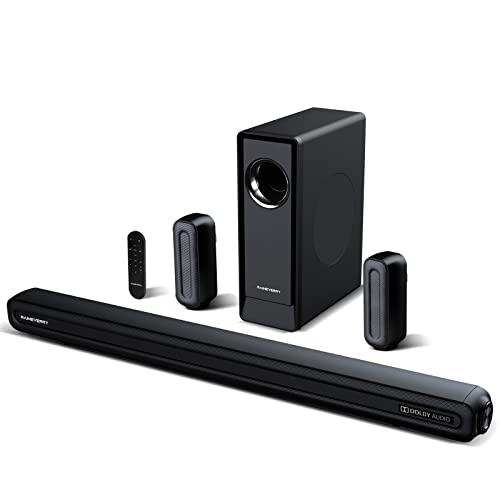
This 5.1 channel sound bar integrates Dolby Digital Plus with DSP processing and a 400W system power rating. It includes wireless rear speakers and a 16″ wireless subwoofer to deliver room-filling bass and a modern, space-saving design. It is suitable for TV rooms looking for a compact yet immersive setup.
Who it’s best for: TV-focused homes needing an all-in-one, easy-to-place 5.1 system. Why selected: wireless rear speakers simplify placement and reduces wiring complexity. Limitation: speaker positioning may depend on room layout to achieve optimal surround effect.
Buying Guide
- What is a 5.1 preamp/processor and why you need one: A 5.1 preamp/processor routes multiple input signals to five satellite channels and a subwoofer, enabling better control over balance, phase, and room acoustics than a basic soundbar.
- Space and compatibility: Consider whether you want a standalone receiver, integrated amplifier, or a soundbar with rear surrounds. Check input types (HDMI, optical, RCA) and whether your TV or players provide reliable outputs for those inputs.
- Power and room size: Higher wattage generally supports larger rooms and louder playback but may be unnecessary in small spaces. Match power to room size and listening distance.
- Sound tuning features: Look for EQ controls, DSP modes (Movie, Music, News), and real-time VU meters. These help tailor sound to your room and preferences.
- Format support: If you rely on Dolby or DTS, confirm supported formats. Some options focus on classical 5.1 with DSP rather than object-based formats like Atmos.
- Ease of setup: Wireless rear speakers or integrated subwoofers reduce cable clutter and simplify placement. Ensure the included remotes or apps provide straightforward control.
Frequently Asked Questions
- What is the difference between a 5.1 preamp and a 5.1 receiver? Answer: A 5.1 preamp focuses on routing and processing inputs, while a 5.1 receiver includes amplification and speaker outputs.
- Do I need a dedicated subwoofer with a 5.1 system? Answer: Yes, the subwoofer handles low-frequency bass, completing the surround experience.
- Can 5.1 systems work without Dolby Atmos or DTS? Answer: Yes. Many 5.1 systems deliver strong surround without Atmos or DTS, using traditional channel-based processing.
- What should I consider for small rooms? Answer: Lower power, compact form factor, and easy placement for rear surrounds improve imaging and avoid overdriving the space.
- Are wireless rear speakers worth it? Answer: They reduce wiring but may require careful placement to maintain consistent imaging across the room.
- Is room treatment important for 5.1 sound? Answer: Yes. Acoustic panels, rug placement, and furniture placement can dramatically improve clarity and imaging.