Best Acoustic Electric Guitar Amplifier Options for Every Player
If you’re looking for an acoustic-electric guitar amplifier, you want a model that delivers clear tone, reliable portability, and flexible input options. This guide highlights five strong choices, each suited to different needs—from practice-focused amps to small-venue performers. The top picks emphasize portability, battery life, built-in effects, and easy-to-use controls for both beginners and intermediate players.
The table below compares the selected models at a glance, highlighting who each amp is best for and key strengths to consider.
| Product | Best For | Key Strengths | Notes |
|---|---|---|---|
| Fender Frontman 10G | Beginner practice at home | Classic Fender tone, built-in overdrive, compact | Lightweight and simple; consider for blues-rock practice |
| Flatsons FBA-10 | Versatile practice with multiple tones | Analog sound, clean/drive modes, USB-C recharge | Great for home or travel; battery option adds flexibility |
| Flatsons Crush20 | Singer-songwriters and small performances | Dual channels, built-in reverb, rechargeable battery | Open-air suitability; battery life is strong |
| Fender Acoustasonic 40 | Small venues and acoustic-electric gigs | Dual 6.5″ speakers, built-in reverb | Higher power; portable PA-style features |
| Fender Mustang LT25 | Learning presets and exploration | 30 presets, color display, user-friendly | Ideal for beginners expanding tonal palette |
Fender Frontman 10G Electric Guitar Amplifier

The Fender Frontman 10G is a compact practice amp designed for solo players and small spaces. Its 10-watt output and 6″ Fender Special Design speaker deliver a classic mid-60s Fender vibe with modern convenience. Best for beginners or players who want a simple, no-fruss setup for daily practice. The built-in overdrive offers a tube-like edge for blues and rock tones, while the headphone jack enables silent practice. A potential limitation is the modest power level, which may not satisfy larger practice rooms or live performances.
Flatsons FBA-10 Guitar Amp

The Flatsons FBA-10 emphasizes analog clarity with a broad 100Hz-20kHz response, a clean and drive dual-tone setup, and USB-C recharge. It’s well-suited for players who want a portable option with a real-analog feel and flexibility for home practice or light gigs. The 10W output covers intimate spaces well, but may be underpowered for louder rooms or outdoor use without a PA system. It’s a good pick for players who value precise tone shaping and flexible input options.
Flatsons Crush20 Acoustic Guitar Amp

The Flatsons Crush20 targets singer-songwriters with dual channels for guitar and vocals, plus built-in reverb for a stage-ready effect. Its 20W power and a 5.5″ full-range speaker provide ample volume for small venues or outdoor practice. A notable caveat is that the amp’s portability is balanced with its need for a power source; battery operation is not stated. This model is best for performers who need independent vocal and guitar controls with a simple effect suite.
Fender Acoustasonic 40 Acoustic Guitar Amplifier

The Acoustasonic 40 is a portable, 40-watt solution with dual 6.5″ speakers and built-in reverb, making it suitable for small venues or as a compact PA. It’s designed for acoustic-electric guitars and microphones, helping performers deliver clear vocal and instrument tones together. Choose this if you need more power and a PA-style role in a compact package; it may be overkill for strictly bedroom practice.
Fender Mustang LT25 Guitar Amplifier

The Mustang LT25 is aimed at beginners who want a versatile floor-mount modeling amp. With 25 watts, 30 presets, and a color display, it offers an approachable interface to explore tones and effects. Best for students or casual players building a tonal library without external gear. Boundary conditions include its focus on presets over live-voice performance features, which may limit deep customization for some players.
Fender Acoustasonic 15 Acoustic Guitar Amplifier
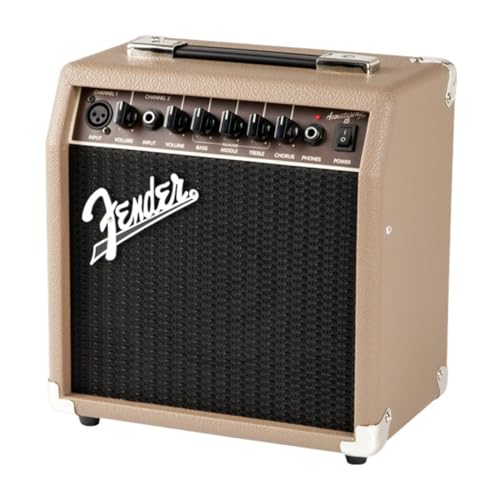
The Acoustasonic 15 provides a compact 15-watt option with dedicated instrument and microphone channels and a chorus-like high-frequency response. It’s ideal for small gatherings or busking where you need two channels with simple controls and a light footprint. It may not deliver the full power of larger models but excels in portability and straightforward setup.
Buying Guide: How to Choose Your Acoustic Electric Guitar Amplifier
- Power versus space: For home practice, a 10–20W amp is often enough; for small gigs, aim for 20–40W or consider a PA system with a dedicated monitor.
- Channel configuration: Look for separate instrument and vocal channels if you perform with singing or need clear balance controls.
- Speaker size and type: Larger or multiple drivers improve body and projection; specialty “acoustic-design” speakers help preserve natural tone for acoustic-electric guitars.
- Built-in effects and tone shaping: Built-in reverb, EQ, and drive/overdrive can reduce the need for external gear, but ensure they don’t overshadow your guitar’s natural timbre.
- Inputs and outputs: Confirm instrument and microphone inputs, plus headphone and AUX if you practice silently or with backing tracks.
- Power source and portability: Battery-powered options offer flexibility for open-air practice, busking, or travel; note battery life and charging practicality.
- Durability and warranty: For frequent travel or outdoor use, prefer rugged construction and a reliable warranty to protect your investment.
FAQ
- What’s the difference between an acoustic-electric and a standard electric guitar amplifier?
An acoustic-electric amp emphasizes natural resonance and vocal compatibility for acoustic strings, often with dedicated input channels for microphones, and a speaker system designed to preserve acoustic tone. - Is a built-in reverb necessary?
Reverb helps add space and depth, especially for acoustic performances, but it’s not essential for practice. Consider your needs and other effects in your signal chain. - Can these amps be used outdoors?
Some amps offer battery power or long-lasting efficiency, but outdoor use often requires higher wattage and a PA or outdoor-friendly power setup for stronger audience reach. - Do I need multiple channels?
If you regularly sing or use a monitor mix, a dual-channel amp is advantageous. For solo guitar practice, a single-channel amp may suffice. - How important is speaker size?
Speaker size affects projection and fullness. Larger speakers provide more bass while smaller ones excel in compact spaces; match to room size and volume needs. - Should I prioritize built-in effects or external pedals?
Built-in effects can simplify setups for beginners; however, true tone sculpting with external pedals may offer more precise control for experienced players.