Best 2000 Watt Monoblock Amp Options for Car Subwoofers in 2026
Looking to power a true 2,000-watt monoblock subwoofer amplifier? This guide highlights five strong choices, each offering robust Class D performance, MOSFET power supply, and stable operation for demanding subwoofers. Best for building high-output systems in cars, trucks, or vans, these amps balance power, efficiency, and heat management. The top picks vary in RMS ratings, impedance stability, and onboard controls, helping you match your subwoofer and electrical setup. The table below compares core specs to help you decide quickly.
| Product | Max RMS (1 Ohm) | Stable Ohms | Key Feature |
|---|---|---|---|
| Skar Audio RP-2000.1D | 2,000 W | 1 Ohm | On-board Bass EQ (+6/ +12 dB at 45 Hz) |
| AUDIOZERONE ZE1000.1 | 1,000 W RMS @1 Ohm | 1 Ohm | 2000 W max; compact Class D |
| Orion Cobalt CBA2000.1D | 2,000 W Max | 1/2/4 Ohm | Bass boost; MOSFET power |
| CT Sounds CT-2000.1D | 2,000 W RMS @1 Ohm | 1 Ohm | Compact footprint; efficient design |
| Stinger MT20001 | 2,000 W RMS | 1/2/4 Ohm | Remote bass knob; HEXFET MOSFET |
Skar Audio RP-2000.1D Monoblock
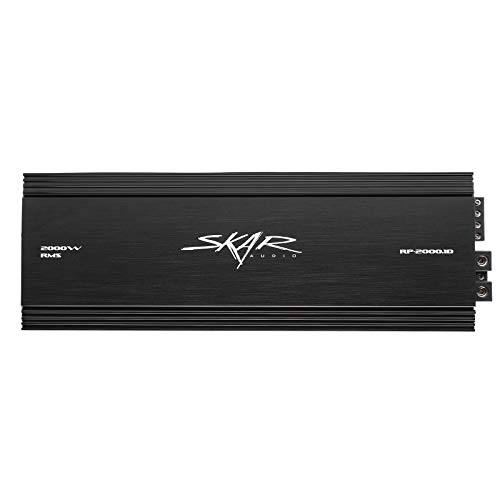
The Skar RP-2000.1D is a Class D MOSFET monoblock amplifier with a peak of 2,800 watts at 1 ohm and 2,000 watts RMS at 1 ohm. It includes an on-board Bass EQ switch offering +6 or +12 dB boost at 45 Hz. This makes it a solid pick for those who want additional bass control without external processors. Best for power-hungry subwoofers in compact vehicle installs where space and efficiency matter.
Best for enthusiasts who want strong, controllable bass from a compact unit. Caution: heat management and electrical supply must support sustained high-power operation to avoid thermal shutdown during extended loud sessions.
AUDIOZERONE ZE1000.1 2000W Mono

The ZE1000.1 provides 1,000 W RMS at 1 ohm with a 2,000 W maximum capability. It’s a Class D MOSFET-powered mono amplifier designed to be efficient while delivering solid low-end punch. It supports 1–4 ohm loads and includes a low-pass operation framework, making it a practical choice for budget-conscious builds seeking strong bass response with a smaller footprint.
Best for budget-minded builds needing reliable bass power without oversized heat sinks. Limitation: RMS headroom at 1 ohm sits around 1,000 W, which is less than pure 2,000 W RMS units, though peak capability remains high for dynamic bass.
Orion Cobalt CBA2000.1D

The Orion Cobalt CBA2000.1D is a 1-channel Class D amplifier rated for up to 2,000 W max with 500 W RMS at 1 ohm. It’s rated for 1/2/4 ohm stability and features a bass boost control plus a MOSFET power supply. This unit suits setups that require robust bass with flexible impedance options and a simple remote accessibility in-cabin tuning.
Best for users who need a strong mono amp with versatile impedance support. Caution: precise thermal management remains essential to sustain peak output in hotter climates or long play sessions.
CT Sounds CT-2000.1D

The CT Sounds CT-2000.1D delivers 2,000 watts RMS at 1 ohm, with a compact footprint ideal for tight installations. It’s engineered for efficiency, enabling more usable power from the vehicle’s electrical system. The amp is designed to drive subwoofers with solid bass response and reliable performance in a small package.
Best for installations where space is a premium yet high-power output is required. Limitation: while compact, users should ensure the vehicle electrical system can support sustained high-current demands.
Stinger MT20001 Compact Mono

The Stinger MT20001 is a compact digital Class D monoblock delivering 2,000 W RMS. It features a remote control bass knob, HEXFET MOSFET design, and a low-pass crossover plus a subsonic filter for refined bass handling. This unit is suitable for tight builds where remote tone control is a priority for tuning the sub-bass in real-time.
Best for users who want hands-on bass control from the driver’s seat. Caution: ensure the amplifier’s dimensions fit your vehicle’s mounting space and that the subwoofer impedance aligns with the amp’s stability range.
Buying Guide: Key Purchase Considerations
What power level do you need? For many subwoofers, 1,000–2,000 W RMS at 1 ohm provides ample headroom. Check the RMS rating at your intended impedance rather than peak power promises to avoid mismatched expectations.
Which impedance will your subwoofer require? Most 2000 W class D amps offer 1, 2, or 4 ohm stability. Pick an amp that matches your sub’s voice coil configuration and your vehicle’s electrical capacity.
Is onboard bass boost or tone shaping important? Some models include bass EQ, low-pass filters, and bass boost controls, which can simplify setup but may not substitute for a dedicated processor in complex systems.
How compact is the amplifier? If space is tight under seats or behind panels, a compact chassis with efficient Class D design can simplify installation without sacrificing output.
What about heat and electrical draw? High-power amps can add significant current demand. Ensure your alternator, battery, and wiring are sized for sustained operation to prevent thermal or electrical issues.
What remote features matter? For tuning on the fly, units with remote bass knobs or level controls offer quick bass adjustments without accessing the head unit or amp interior panels.
FAQ
- Q: Do I need a 2,000 W RMS amplifier for all subwoofers? A: Not necessarily. Choose an amplifier that provides sufficient RMS power at your sub’s impedance and matches your system’s headroom needs.
- Q: Is more peak power better than higher RMS? A: RMS power reflects continuous capability, which is more relevant for daily listening and long sessions than peak ratings.
- Q: Can I use a 2-ohm sub with a 1-ohm stable amp? A: Some amps are multi-impedance and can drive 2-ohm loads, but verify stability and power delivery at that impedance.
- Q: Do onboard bass controls replace a separate bass management system? A: They can supplement tuning, but for complex systems, a dedicated processor may still be beneficial.
- Q: What installation considerations matter for monoblock amps? A: Consider mounting space, heat sinking, wiring gauge, fuse sizing, and proximity to the subwoofer for optimal signal integrity.
- Q: How important is the remote bass knob? A: It is convenient for on-the-fly adjustments while driving, especially in a shared cabin space or variable listening environment.