Best Subwoofer With XLR Input for Clear, Balanced Bass
When shopping for a subwoofer with an XLR input, you want a model that delivers clean, controlled bass without adding noise or distortion. This guide focuses on options that provide balanced connectivity for professional setups, home studios, and live performance environments. The top picks below are selected for clear low-end extension, robust power, and ease of integration with mixers and audio interfaces. Best for small studios, live sound, and home theaters, these units help you achieve precise bass while preserving overall mix clarity.
The following table compares the key traits of the chosen products to help you decide at a glance.
| Product | Best For | Key Feature |
|---|---|---|
| PRORECK PR18 | DJs, live events, and venues needing strong bass | Balanced XLR combo input |
| Rockville APM10D | Home studios and small rooms | RCA and XLR inputs, front-firing design |
| Rockville RBG10S | Portable PA and mobile setups | Compact 10″ design with built-in amp |
| Yamaha HS8 Sub | Professional studios and nearfield work | 8″ driver, 22 Hz – 150 Hz range |
| Klipsch R-120SW | Home theaters and music lovers | 12″ woofer, wide bass range |
PRORECK PR18 18 Inch Subwoofer
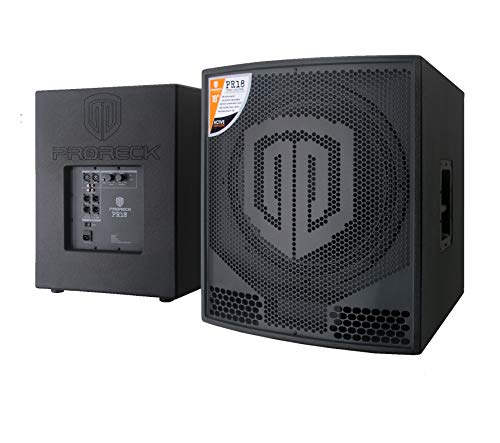
The PRORECK PR18 is an 18-inch powered subwoofer designed for high-impact bass with a 2000-Watt peak and 60oz magnet. It offers a balanced XLR combo input to ensure reliable signal capture from mixers or audio interfaces. Best for DJs, clubs, and large venues that require strong, deliverable bass without compromising the main mix. The dual input options help maintain channel integrity when routing multiple sources. A potential limitation is its size and weight, which may affect transport and setup in smaller spaces.
Who it’s best for: DJs, event venues, and bands needing deep, club-like bass with straightforward, balanced inputs.
Why selected: Its high power, flexible input options, and robust bass output make it a standout for applications where consistent low-end performance is critical.
Rockville APM10D Active Studio Subwoofer

The Rockville APM10D delivers 400W peak and 200W RMS with an 10″ woofer and a front-firing port. It provides RCA and XLR inputs, making it suitable for home studios and project rooms where balanced connectivity matters. This model is best for those who want precise, low-distortion bass with easy integration into consumer and pro-grade systems. Caution: front-firing designs can interact with desk placement; ensure adequate space to avoid boundary effect on the bass response.
Who it’s best for: Small studios, home producers, and project setups needing a compact, balanced-input subwoofer without sacrificing bottom-end extension.
Why selected: The combination of balanced inputs and strong output makes it a practical choice for accurate bass in controlled environments.
Rockville RBG10S Powered PA Subwoofer

The Rockville RBG10S is a compact 10″ powered sub designed for DJs and small parties. It features a built-in amplifier and a limited footprint, making it easy to deploy in mobile setups. While a direct mention of XLR inputs is not provided in the feature list, its built-in amplification and general PA utility position it as a good option where space is constrained and a simple, reliable signal path is desired. Best for portable gigs and quick setups where you want to minimize extra gear.
Who it’s best for: DJs and mobile performers needing dependable bass in a small, portable package.
Why selected: Its compact design and integrated amplifier simplify transport and operation for on-the-go performances.
Yamaha HS8 Studio Subwoofer

The Yamaha HS8 Studio Sub is a compact yet capable 8″ bass-reflex sub with a frequency response of 22 Hz to 150 Hz and a high-power 150W amplifier. It is well-suited for nearfield studio work and precise low-end monitoring. Best for producers and engineers who require tight, predictable bass to complement their nearfield monitors. A limitation is the smaller woofer size, which may limit very deep bass extension compared with larger subs in the same class.
Who it’s best for: Professional studios and nearfield listening environments seeking accurate bass without overemphasized lows.
Why selected: Its studio-focused design and calibrated performance help achieve reliable, transparent mixes with sub-bass control.
Klipsch R-120SW Subwoofer

The Klipsch R-120SW features a 12″ high-excursion woofer and a bass range from 29 Hz to 120 Hz. With 400 watts of power, it offers strong, deep bass for home theater and music playback. It’s a robust choice for listeners who want impactful low-end without needing professional-grade balanced inputs in every setup. A potential limitation is the lack of explicit XLR input details in the product summary, so verify your signal path needs before purchase.
Who it’s best for: Home theater enthusiasts and music lovers who want substantial bass with straightforward integration.
Buying Guide: Key Purchase Considerations
Input options and compatibility
- Look for balanced XLR or XLR/¼” combo inputs to preserve signal integrity from mixers and audio interfaces.
- Check available input types (RCA, XLR, ¼” TRS) and ensure your gear matches.
Power and headroom
- Higher wattage generally enables cleaner headroom at louder playback levels; match power to room size and usage (studio vs. live sound).
- Consider peak vs RMS ratings to understand real-world performance.
Driver size and enclosure
- Larger drivers (12″ or 18″) deliver deeper bass; smaller drivers are more tight and accurate for nearfield monitoring.
- Front-firing vs. down-firing enclosures affect placement and room interactions; plan placement accordingly.
Application and environment
- Studio use benefits from precise, low-distortion bass and flat response.
- Live sound and DJs may prioritize higher SPL, durable build, and easy transport.
Size, weight, and setup
- Consider room constraints, isolation, and whether you need a compact model or a floor-standing unit.
- Check whether the sub has calibrated crossover controls and phase adjustments to integrate with existing speakers.
Frequently Asked Questions
- Do all subwoofers with XLR inputs support stereo sources? Most models with XLR inputs support mono LFE or stereo via dual inputs; confirm the specific channel configuration in the product manual.
- Is a bigger woofer always better for bass? Not necessarily. Bigger woofers extend lower and can produce deeper bass, but room acoustics and enclosure design also determine perceived performance.
- Can I use a subwoofer with a home theater receiver? Yes, many subs with XLR or RCA inputs pair with AV receivers using LFE or line-level outputs for clean bass.
- Should I choose a front-firing or rear/floor-sub design? Front-firing subs are generally easier to place near walls or desks; rear/down-firing subs can require different room placement to avoid unwanted resonances.
- Do these subs require professional installation? Most can be set up with standard audio cables; however, precise calibration may benefit from studio gear or a professional for large rooms.
- What is a balanced input advantage? Balanced inputs reduce noise and hum over longer cable runs, improving signal integrity in professional environments.