Best Micro 4 Channel Amp for Small Car Audio Setups and Tight Spaces
Answering the search for compact four-channel car amplifiers, this guide highlights options that fit tight dashboards and power small to mid-size speaker systems. Ideal buyers include installers working in compact cars, boats, or motorcycles, and enthusiasts building a discreet, high-efficiency setup. Below is a quick summary table of the five products chosen for detailed comparison, followed by in-depth section-by-section analysis.
| Product | Brand | RMS Power (4Ω) | Bridge Capable | |
|---|---|---|---|---|
| Timpano TPT-500.4 | Timpano | 125W x4 @ 2Ω | Yes | Small, high-efficiency systems |
| Taramp’s TS 400×4 | Taramp’s | 100W x4 @ 2Ω | Yes | Balanced multi-channel power |
| NVX VADM4 v2 | NVX | 80–125W x4 (2–4Ω) | Yes | Ultra-compact, marine-ready |
| PRV QS400.4 | PRV AUDIO | 100W x4 @ 2Ω | Yes | Efficient, compact Class D |
| Fosi CA30 | Fosi Audio | 200W x4 @ 4Ω | Yes (bridge mode) | Hi-Fi car audio on a budget |
The following sections provide detailed comparisons, highlighting who each amplifier is best for and potential limitations to consider before purchasing.
Timpano TPT-500.4 2 Ohm 400 Watt 4 Channel Car Amplifier
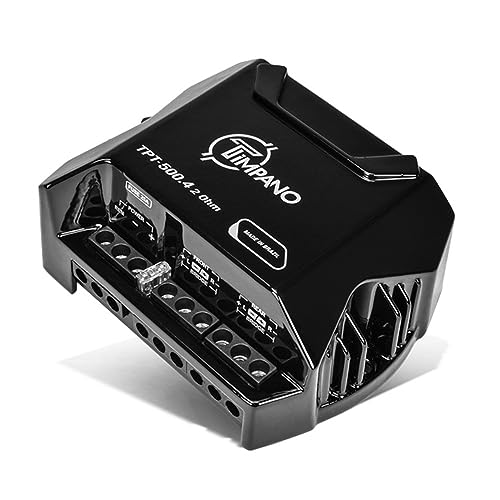
Best for compact, high-efficiency power in a four-channel package. This amplifier uses Brazilian Class D technology and a compact heatsink, delivering 500 Watts dynamic RMS across four channels, or 2 x 225 Watts when bridged. With up to 87% efficiency, it minimizes battery drain while maintaining solid output. Best for small cars or tight installs where space and heat are concerns. Caution: as a bridged option, impedance should meet minimum 4 Ohms per bridged channel to avoid strain.
Taramp’s TS 400×4 400 Watts RMS 4 Channels
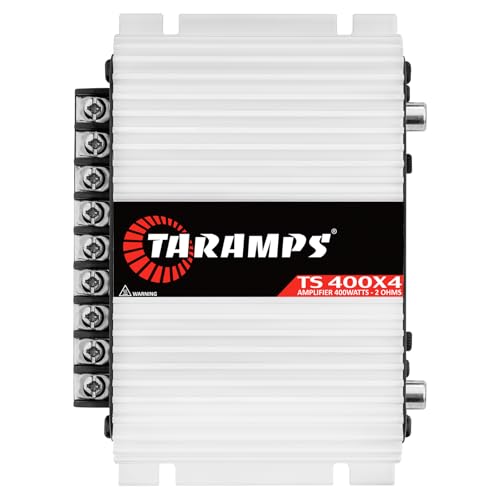
Better for users seeking robustness and a versatile 4-channel platform. The TS 400×4 delivers 400 Watts RMS total with 4 x 100 Watts at 2 Ohms and supports bridging for higher output. It’s a strong choice for multi-speaker configurations and systems that require flexible channel wiring. Limitation: some users may need to manage a slightly more involved wiring setup to maximize bridging options.
NVX VADM4 v2 Model 4-Channel

Best for space-constrained installations with marine-grade durability. The VADM4 v2 uses Micro Class D technology, delivering 80–125 Watts per channel depending on load, with a compact 6.49″ x 3.3″ footprint. It’s marine-certified, making it suitable for boats and other harsh environments. Caution: verify compatibility with your head unit’s signal levels to ensure clean input and avoid noise, particularly in noisy vehicle environments.
PRV Audio QS400.4 2 Ohm Mini

Choose this if you want a compact, efficient Class D amplifier with four channels at 2 Ohms. The QS400.4 is designed to deliver 400 Watts RMS total with stable operation at 2 Ohms, ideal for powering multiple speakers or a bridged sub setup. Best for cost-conscious buyers seeking reliable efficiency, with the understanding that small form-factor units may require careful heat management in hot climates. Limitation: some users might prefer higher per-channel headroom for premium component sets.
Taramp’s TS 400×4 2 Ohms Black

Best for high flexibility and ease of integration. This model offers 400W RMS across four channels at 2 Ohms with a built-in crossover and dual inputs for high-level or RCA connections. It supports two bridged channels for more power when needed and provides simple gain and crossover control. Caution: ensure your vehicle’s electrical system can support peak power demands, especially in older cars with limited alternator capacity.
Fosi Audio CA30 4 Channel

Best for budget-conscious buyers seeking Hi-Fi car audio with compact size. The CA30 supports 200W x 4 @ 4Ω or 400W x 2 @ 4Ω in bridge mode, offering clear sound with low distortion. It’s suitable for full-range setups and as a subwoofer amp when bridged. Caution: heat dissipation can be a concern in very small compartments; ensure adequate ventilation in the installation space.
Buying Guide
What to consider when choosing a micro 4-channel amp:
- Power needs: Match RMS power to your speaker wattage and impedance. If you run a 4-speaker setup, ensure each channel has enough headroom to avoid clipping.
- Impedance and bridging: If you plan to bridge channels for a sub or higher output, confirm the minimum impedance per bridged channel and ensure compatibility with your speakers.
- Size and heat: Compact dimensions help in tight installs, but verify heat dissipation and mounting space. Class D amps typically run cooler and more efficiently.
- Inputs and integration: Look for both RCA and high-level inputs if you’re integrating with older head units or via aftermarket adapters.
- Marine or vehicle use: If exposure to weather or salt air is possible, choose a marine-grade or conformal-coated circuit board amp for longevity.
Frequently Asked Questions
- How many channels does a 4-channel amp have? – It provides four output channels designed to drive four speakers in a system.
- Can a 4-channel amp power a subwoofer? – Yes, using a bridged configuration or dedicated sub-amp channel, depending on the model’s bridge capability.
- Is Class D better for small cars? – Generally yes, due to higher efficiency and less heat in compact spaces.
- What is RMS power? – Root-Mean-Square power is a continuous power rating indicating real-world performance, not peak output.
- Do I need a high-level input? – High-level inputs help when connecting to factory head units without preamp outputs.
- Are marine amps weatherproof? – Marine-grade amps are designed to resist moisture, salt, and vibration for boats and harsh environments.