Best Capo for 12 String Guitars: Top Picks for Stable Intonation and Easy Playability
Answering the buyer’s question: these capos are designed to fit 12-string guitars with even tension, minimize buzz, and stay in tune across the neck. The selections below suit players who perform live, record at home, or practice with octave-string pairs. Each product is evaluated for fit on 12-string necks, ease of use, and how well it preserves intonation. The table summarizes key choices for quick comparison.
| Product | ||
|---|---|---|
| Kyser Quick-Change KG12BA | Live players seeking fast changes | Optimized for 12-string guitars |
| Shubb C3 Standard 12-String | Reliability and ease of use | Set it and forget it lever |
| G7th Newport 12 String | Precision tuning and quick release | Compensated string pad technology |
| D’Addario Pro Plus | All-around performance | FlexFit for various radii |
| Paige 12-String Capo | Durability and octaves alignment | Made in USA, thicker tubing |
Notes: Product availability and exact models vary. The following sections detail each option’s strengths, target players, and trade-offs to help you choose the best capo for your 12-string guitar.
Kyser Quick-Change 12-String Capo – KG12BA

The Kyser KG12BA is the classic quick-change capo designed with 12-string fit in mind. It emphasizes speed and narrow removal/attachment, making it well-suited for players who switch keys frequently during performances. Best for: live players and rehearsal sessions where quick key changes matter. Caution: ensure even clamping on both octave courses to avoid buzzing on certain necks.
Shubb C3 Standard 12-String Capo

The Shubb C3 offers a trusted, long-standing design with an easy “set it and forget it” lever. This model is favored for stable, consistent pressure across strings and a simple lock-and-release operation. Best for: players who value reliability and minimal adjustment with every use. Caution: some users may prefer a more adjustable tension system for varied string gauges across non-traditional 12-string setups.
Shubb C3B 12-String Capo – Brass

The C3B Brass version preserves the same set-it-and-forget-it concept with a brass aesthetic. It shares Shubb’s core ease of use and a simple locking mechanism. Best for: players who value durability and a classic design. Caution: brass construction can be heavier than basic alloys, which may be a minor consideration for long practice sessions.
G7th Newport 12 String Capo
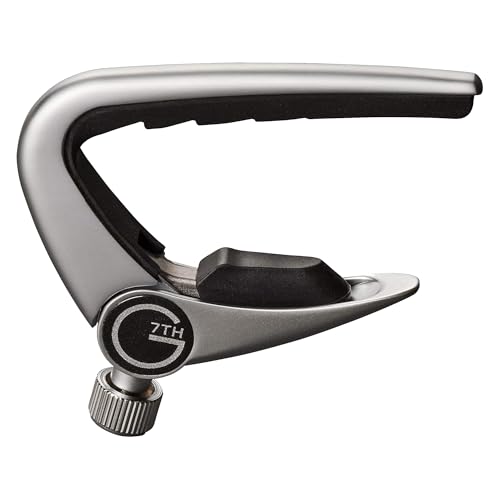
The G7th Newport uses patented compensated string pad technology to balance tension across all 12 strings. It also features a refined quick-release mechanism for smooth attachment and removal. Best for: players seeking precise tuning stability and even pressure across octave pairs. Caution: the premium design may be overkill for casual players who rarely switch keys.
Paige 12-String Capo – Adjustable Tension

The Paige capo is built specifically for 12-string necks, with thicker tubing to accommodate octave string pairs. It is made in the USA from nickel-plated steel for durability and smooth operation. Best for: players who want a durable, purpose-built 12-string capo with reliable alignment. Caution: more pronounced tubing may feel stiffer during rapid changes for some players.
Buying Guide: 12-String Capo Considerations
How to choose: look for a capo that evenly presses all strings, provides stable tension, and fits your 12-string neck profile. Consider the locking mechanism: quick-release capos save time on stage, while set-it-and-forget-it designs prioritize consistent performance. Material matters: brass and premium alloys can add durability; silicone pads should accommodate octave-string pairs without muting notes. Weight, ergonomics, and ease of transport also influence long sessions.
What makes a capo good for 12-string guitars?
A good 12-string capo evenly distributes pressure across all strings, including octave pairs, to avoid buzzing and fretting inconsistencies. It should maintain tuning stability when you move up and down the neck and be easy to reposition during performances or practice.
Should you choose a compensated capo?
Compensated capos adjust for varying string gauges and neck radii. They help keep all strings in tune across fret positions, which is especially helpful on 12-string guitars with octave strings that can pull sharp or flat if pressure is uneven.
Is a universal capo enough for 12-string players?
Universal capos can work but may require careful positioning or pressure adjustment. For frequent key changes or high-string-count necks, a capo designed specifically for 12-string guitars often yields better intonation and quicker setup.
What is the trade-off between quick-release and fixed capos?
Quick-release capos save time and improve live performance flow but may offer slightly less consistent pressure than classic, fixed designs. If you play aggressively or need strict intonation, test several to determine which maintains stability best for your guitar.
Maintenance tips for 12-string capos
Wipe silicone pads clean to prevent residue buildup. Inspect the locking mechanism for smooth operation. Check that the capo sits evenly on the fretboard and reinstall as needed to maintain even pressure across all strings.
FAQ
- Q: Are compensated capos necessary for 12-string guitars? A: They help balance tension across multiple string gauges, improving intonation on 12-string necks.
- Q: Which capo is best for fast key changes on stage? A: A quick-release model like the Kyser or G7th Newport is advantageous for rapid transitions.
- Q: Can any 12-string capo fit all models? A: Not always; some are neck-specific. Check fretboard radius and octave-pair spacing before buying.
- Q: Do capos affect tuning stability after repositioning? A: Yes, improper pressure can cause detuning; choose a model with precise pressure control.
- Q: Is a brass or brass-colored capo better than aluminum? A: Brass variants can offer durability and a different weight balance; choose based on feel and balance with your guitar.