Best Acoustic Guitar Direct Box Solutions for Stage and Studio
Direct boxes (DI boxes) are essential for clean, interference-free guitar and bass signals on stage or in the studio. This guide focuses on passive DI boxes that transform instrument signals into balanced, mic-level or line-level outputs suitable for PA systems and mixers. The best picks here balance signal integrity, portability, and affordability for different settings, from small gigs to home studios. This buyer’s guide highlights five top options and explains who benefits most from each model.
Summary of selected products:
| Product | Best For | Key Benefit |
|---|---|---|
| Radial Pro DI Passive Direct Box | Professional stages, studio setups | Rugged construction with a custom transformer |
| LR Baggs Para Acoustic D.I. | 5-band EQ and phase control | |
| Whirlwind IMP 2 | Inline transformer for compact setup | |
| Donner Special-Ⅰ Passive DI Box | Ultra-flat response with hum/buzz elimination | |
| Bolanle Passive 1-Channel DI | Built-in hum eliminator and dual-mode options |
Radial Pro DI Passive Direct Box

The Radial Pro DI is a professional-grade passive direct box designed for reliable stage and studio use. Its rugged I-beam construction and custom transformer deliver a balanced XLR output from a high-impedance instrument source. Best for performers and engineers who need dependable performance in demanding environments. Caution: The unit relies on passive circuitry; active pickups will not gain additional drive from the DI input.
Who it’s best for: touring players and studio engineers who value durability and a clean, transparent signal path. Why selected: the Radial Pro DI’s robust build and renowned transformer technology minimize noise and ground-loop issues in live and studio settings.
Limitations: No built-in EQ or tone shaping; use a separate preamp or the venue’s desk for tone control if needed.
Passive Di Direct Box 1/4″ Instrument to Balanced & Unbalanced XLR

This passive DI box from Yovus provides straightforward 1/4″ instrument input with XLR output, suitable for quick setups. It’s a simple tool for turning guitar or bass signals into balanced lines for PA systems or recording gear. Best for players who want a no-fuss DI with predictable performance. Caution: Fewer tone-shaping options means you may need external EQ to tailor your sound on stage.
Who it’s best for: performers who prioritize ease of use and affordability. Why selected: compact design and direct 1/4″ input/Output keep signal routing simple in small gigs or practice spaces.
Limitation: Limited tonal adjustment and no ground-lift switch in some models may require additional gear for problematic rigs.
Pyle Premium Direct Injection Audio Box

The Pyle Premium DI Box offers a compact solution for live sound and studio work. It includes an impedance transformer with buzz and hum cancellation, and an input/output arrangement suitable for connecting guitars, keyboards, or other processors to a main PA or mixer. Best for budget-conscious players who still need clean DI performance. Caution: Heavier users might prefer a model with more rugged construction for frequent transport.
Who it’s best for: entry to mid-level performers needing reliable DI without high cost. Why selected: practical features for clean signal transfer and hum reduction make it a solid value pick.
Limitation: Fewer advanced features (no built-in EQ) compared with higher-end models.
Donner Special-Ⅰ Passive DI-Box

The Donner Special-Ⅰ is a professional-level passive DI box designed for both stage and studio use. It emphasizes ultra-flat frequency response, impedance matching, and noise isolation. Best for users who require accurate signal translation and a quiet studio or stage environment. Caution: Some users may want additional tone shaping at the destination due to the flat response nature.
Who it’s best for: players and engineers who demand clean, uncolored DI performance for critical mixes. Why selected: the LAB-S1 transformer helps minimize hum and ground-loop artifacts, making it a solid choice for complex rigs.
Limitation: Absence of built-in EQ means you’ll rely on external processing for tonal adjustments.
LR Baggs Para Acoustic D.I.

The LR Baggs Para Acoustic D.I. is tailored for acoustic guitars and other acoustic instruments. It features adjustable gain for both passive and active pickups, a 5-band EQ with a tunable notch, and midrange controls, plus phase inversion for feedback control. Best for acoustic players who want onboard tone flexibility and robust feedback management. Caution: The tone controls require careful adjustment to avoid phase conflicts in some setups.
Who it’s best for: acoustic players and studio engineers seeking more tonal control directly from the DI. Why selected: integrated EQ and phase options provide precise feedback management and tonal shaping at the source.
PYLE-PRO Premium Direct Injection Audio Box
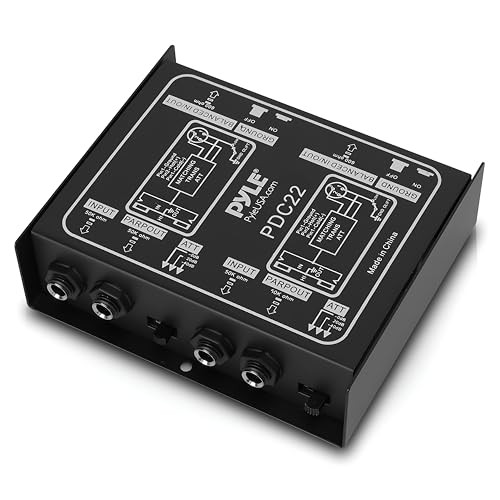
The PYLE-PRO Premium DI Box is a straightforward passive DI option with a ¼” device connector and XLR output. It aims to deliver clean signal transfer to a PA or recording mixer while offering buzz and hum cancellation benefits. Best for simple, reliable DI needs in budget-focused environments. Caution: Lacks advanced EQ or active features found in higher-end units.
Who it’s best for: musicians and technicians who require a cost-effective DI with dependable isolation. Why selected: solid basic performance without unnecessary complexity makes it a practical choice for small gigs and practice spaces.
Buying Guide
What should you consider when choosing a guitar DI box?
- Signal path: Do you need a simple passive DI or a model with onboard EQ and tone shaping?
- Impedance and output: Ensure the DI matches your guitar’s output and the input of your mixer or PA.
- Ground loop and hum: Look for ground-lift options or hum elimination features in the presence of long cable runs.
- Build and portability: For live use, prioritize rugged enclosures and compact designs.
- Live vs studio: Acoustic guitars and instruments with high-fidelity demands may benefit from DI boxes with EQ and phase controls.
- Budget vs features: Higher-end models provide more tone shaping and isolation — weigh benefits against cost.
Practical comparison questions
- Is built-in EQ necessary, or can you rely on stage or studio processing?
- Will you primarily use the DI for acoustic guitars or electric instruments?
- Do you need extra protection against hum from long cable runs?
- How important is rugged construction for transport and frequent setup?
Frequently Asked Questions
- What is a direct box used for? It converts an unbalanced instrument signal to a balanced output for reliable transmission to mixers and PA systems.
- Should I choose a passive or active DI? Passive DI boxes are simple and reliable, while active models can provide gain and handle very weak signals.
- Can a DI box affect tone? A well-designed DI aims to preserve tone; some models add minimal coloration, while others are transparent.
- Do I need a DI box for stage performances? For many setups, a DI box helps prevent hum, ground loops, and impedance mismatches, especially with long cables.
- What’s the advantage of a DI with EQ? It allows shaping tone before sending to the mixer, reducing the need for extensive desk processing.
- What issues signal the need for a ground lift? Ground loops causing hum or buzz are common issues that ground-lift features help mitigate.