Best Antenna for Stereo Receiver: Improve FM/AM Reception and Audio Quality
Looking for an antenna to improve FM and AM signals for a stereo receiver? This guide focuses on practical, plug-and-play options that work with common home theater and stereo systems. The listed picks suit different buyers—from casual radio fans to home audio enthusiasts who want clearer stations and fewer dropouts. The top picks below cover indoor dipole antennas, magnetic-base solutions, and loop antennas, with notes on best uses and potential limitations.
Buyer snapshot:
– Best for simplicity and solid FM reception on a mid-range stereo system: indoor dipole antennas.
– Best for flexible placement and stable mounting on metal surfaces: magnetic-base models.
– Best for broad AM and FM coverage in compact spaces: combined AM/FM antennas and loop designs.
– Best for budget-conscious setups that still seek noticeable signal gains: entry-level 75 Ohm antennas.
Summary table of selected products
| Product | Best For | Key Benefit | Potential Limitation |
|---|---|---|---|
| Bingfu FM Radio Dipole Antenna for Stereo Receiver | Indoor stereo setups | 75 Ohm, easy installation, universal connectors | May require adapters for some receivers |
| Ancable 300 Ohm FM Antenna T Shape Dipole | Tabletop or desk setups | Longer coax, versatile placement | Requires 300 Ohm compatibility on receiver |
| CHHLIUT FM Antenna with Magnetic Base | Metal surfaces and flexible placement | Magnetic base, retractable cable | May be less effective away from metal |
| Fancasee FM Antenna Indoor 75 Ohm | Budget-friendly indoor listening | Plug-and-play, stable reception | Limited long-range improvement |
| eifagur 75/300 Ohm Magnetic Base Antenna | Versatile signal reception | Dual-ohm compatibility, telescopic reach | Setup complexity for 300 Ohm devices |
Bingfu FM Radio Dipole Antenna for Stereo Receiver

Best for: Indoor use with a wide range of receivers including Pioneer, Onkyo, Yamaha, Marantz, Bose, and more. This 75 Ohm UNBAL dipole antenna includes multiple adapters for compatibility with different interfaces, making it a versatile choice for many home setups.
Why selected: The 10-foot (3 m) coaxial extension plus a variety of adapters simplifies integration with different tuner inputs. The dipole design tends to provide reliable FM reception in indoor environments where external antennas aren’t feasible.
Limitations: Some receivers may need the TV female or different adapter to achieve ideal fit. The performance can vary based on room layout and proximity to electronics that cause interference.
Ancable 300 Ohm FM Antenna T Shape Dipole
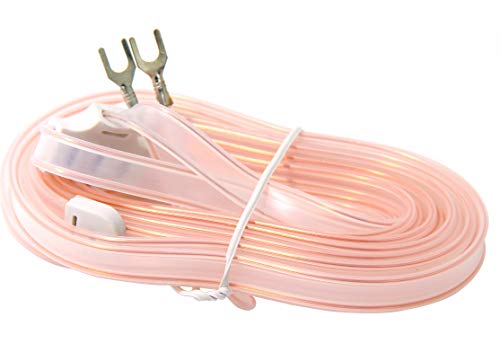
Best for: Desk or tabletop stereo receivers that support 300 Ohm inputs, with a longer coax to position the antenna for better reception. This model is well-suited for users who want a fixed, easy-to-adjust placement in a home office or living room.
Why selected: The T Shape dipole and extended cable help access more stations and improve clarity. It is particularly useful when you want to “stretch” the antenna away from interference sources and toward a window or balcony.
Limitations: Requires a 300 Ohm connection or a bridge/adapter to fit some modern receivers that rely on 75 Ohm inputs. Placement strategy is important for best results due to indoor signal variability.
CHHLIUT FM Antenna with Magnetic Base

Best for: Home theater systems or stereo setups where the antenna can be mounted on a metal surface for stable placement. The retractable design and magnetic base make it easy to position for optimal signal.
Why selected: Enhanced FM reception with a dedicated coaxial cable length supports flexible placement. The magnetic base minimizes movement, helping maintain consistent signal quality in rooms with furniture rearrangements.
Limitations: Magnetic mounting works best on metal surfaces; if placed on wood or non-metallic areas, stability and reception may vary. Some rooms may still require repositioning to find the strongest signal.
Fancasee FM Antenna for Stereo Receiver Indoor

Best for: Budget-friendly setups that still seek improved FM reception for table-top or small home theater receivers. This 75-ohm coaxial cable solution is designed for easy plug-and-play installation.
Why selected: The 4.9-foot length provides reasonable reach for indoor placement without clutter. It’s a straightforward option for users who want a noticeable step up in signal quality without complex setup.
Limitations: Because it emphasizes affordability, the gain may be modest compared with higher-end models. Room layout and RF environment will influence results.
Eifagur 75/300 Ohm Magnetic Base Antenna
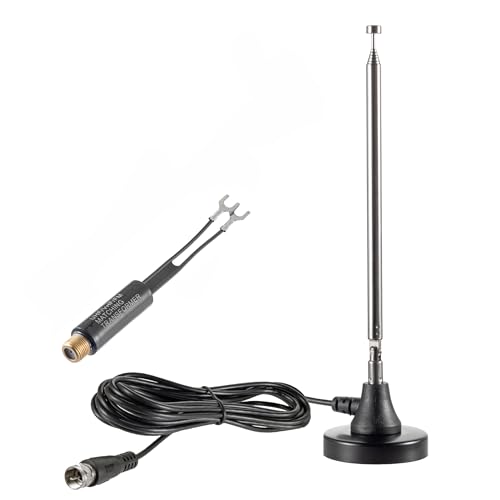
Best for: Users needing dual-compatibility for both 75 Ohm and 300 Ohm systems, with a magnetic base and a 10-foot coax extension. Versatile for various receivers and room layouts.
Why selected: The telescopic design helps capture the best signal height, while the magnetic base provides stable mounting on metal surfaces. Includes a 25-foot equivalent of extension options via the two connectors included (F Type and 300 Ohm adapter).
Limitations: If your receiver uses a nonstandard input interface, you may need adapters. The 300 Ohm path can add setup steps for some users.
Buying Guide: Antenna Options For Stereo Receivers
What signal needs should you consider?
If you mostly listen to FM radio, prioritize 75 Ohm FM antennas designed for dipole or simple coax connections. For broader coverage that includes AM, look for antennas advertised as AM/FM or dual-band with a loop or magnetic-base design.
What about placement?
Indoor antennas work well when placed near a window or elevated surface. Magnetic-base models excel on metal surfaces like a radiator or a speaker stand. For the best FM reception, aim for line-of-sight to the broadcasting direction and minimize obstructions.
Compatibility considerations
Check your receiver’s connector type (F Type, 75 Ohm, or 300 Ohm). Some modern units use 75 Ohm F-type jacks; older models may require 300 Ohm twin-lead connections. Adapters are common, but confirm compatibility before purchasing.
Cable length and performance
Longer coaxial cables can help position the antenna for optimal reception but may introduce more signal loss. Choose a model with a cable length that offers flexibility without excessive clutter in your setup.
Which type to choose?
- Dipole 75 Ohm antennas: Great all-around, easy to install, good for most living rooms.
- Magnetic-base antennas: Best for stable placement on metal surfaces and flexible positioning.
- AM/FM combined or loop antennas: Helpful for enthusiasts seeking broader AM coverage and more robust reception in challenging environments.
Practical tips for better reception
- Experiment with antenna height and angle for FM stations facing different directions.
- Avoid placing antennas near strong electronics that cause interference (TVs, routers, computers).
- Keep the antenna away from heating vents and large metal cabinets if possible.
What if you still have weak signals?
Consider combining a high-quality FM antenna with a dedicated AM loop antenna for broader coverage. Some receivers have dedicated AM and FM inputs that can be optimized separately for best results.
FAQ: Antennas For Stereo Receivers
- Which antenna type gives the best FM reception indoors? Dipole antennas operating at 75 Ohm are typically reliable for indoor FM reception and compatibility with most modern stereo receivers.
- Do I need adapters for these antennas? Yes. Many models include adapters for different interfaces (F Type, 3.5 mm plugs, TV sockets). Verify compatibility with your receiver before buying.
- Is a magnetic-base antenna better than non-magnetic? Magnetic bases provide stable placement on metal surfaces, which can improve reception in rooms with furniture or obstructions.
- Can I use an AM loop antenna with my FM receiver? Some models are designed to work with both AM and FM inputs, but check your receiver’s capabilities and the antenna’s listed compatibility.
- Will a longer coax win me better signals? Not always. Longer cables can help reach a better position, but excessive length may introduce more signal loss. Balance length with placement options.
- What is the difference between 75 Ohm and 300 Ohm antennas? 75 Ohm is standard for many modern receivers and coax-based connections; 300 Ohm is older twin-lead style. Some receivers may require adapters to fit either type.