Best Guitar Pedal Daisy Chain Options for Clean, Stable Power
Answering the question “which guitar pedal daisy chain should I choose?” this guide highlights five reliable power-daisy options. Each pick is suited for different setups, from compact boards to larger pedal rigs. The top choices are best for guitarists aiming to reduce hum, simplify power distribution, and keep pedals load-balanced over a single supply. This article notes who benefits most from each product and points out practical trade-offs to consider when wiring your pedals.
Product Quick Look
- Godtone 1 to 8 Way Daisy Chain Cable Guitar Effect Pedal Power Supply — Best for large pedal boards needing many pedals powered from one source.
- Donner DPA-1 5-Way Daisy Chain Cable — Best for compact setups seeking multiple pedals with reliable, low-noise power.
- JOYO DC 9V 1.2A Guitar Pedal Power Supply with 5 Way Daisy Chain Cables — Best all-in-one option for mid-sized pedal rigs.
- Pigtone 1 to 3 Way Daisy Chain Cable — Best for small pedalboards or when only a few pedals need power from one supply.
- SATUY 2Pcs 1 to 2/1 to 3 Way Daisy Chain — Best value pair option for mixed pedal configurations.
Godtone 1 to 8 Way Daisy Chain Cable Guitar Effect Pedal Power Supply

The Godtone 1 to 8 Way Daisy Chain provides a single power source for up to eight pedals. It uses a copper inner core for better conductivity and aims to minimize noise. The maximum distance between plugs is designed to keep pedals on a board neatly powered. This option is best for players with larger pedalboards who want a centralized, organized power solution. Best for: players with eight or more pedals or those who want one cable to power multiple devices on stage or in the studio.
Best for: large pedal rigs that need consolidated cabling and stable supply. Choose this if your board layout benefits from a single, tidy daisy chain. Caution: installation may require carefully planning cable routes to avoid tension on connectors.
Donner DPA-1 9V DC 1A Power Supply Adapter
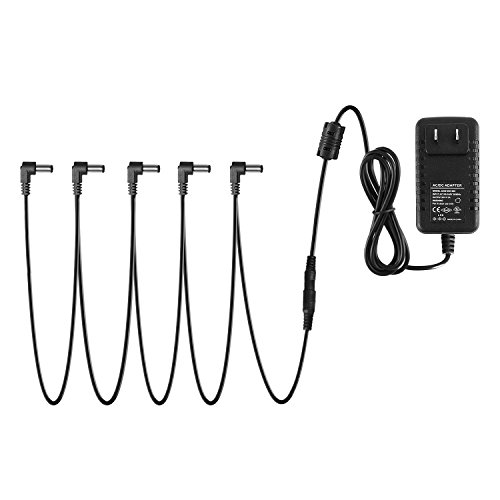
The Donner DPA-1 offers a 5-Way Daisy Chain Cable for powering multiple devices from a single unit. Designed for keyboards, digital pianos, MIDI controllers, and guitar pedals, it emphasizes stable power delivery and a clean signal path. Best for: players who need a flexible, multi-device power solution in a compact footprint. Limitation: you’ll want to verify compatibility with non-standard pedal power connectors before committing to a particular setup.
SATUY 2Pcs 1 to 2/1 to 3 Way Daisy Chain

SATUY offers two cables in one listing: a 1-to-2 Way and a 1-to-3 Way power chain. The design uses PVC sheathing with a copper core for sound stability and noise isolation. The 3-prong connector design helps prevent accidental disconnections. Best for: players who want versatility within a single purchase and plan to power a mix of two or three pedals simultaneously. Caution: check the cable lengths to ensure compatibility with your pedal board spacing.
Cheerock 1-to-2 Guitar Pedal Power Cable

The Cheerock daisy chain is built with a copper core for durability and reliable power delivery. It’s designed to power 9V guitar pedals and helps keep your board organized. Best for: small to mid-sized sets where only a couple of pedals need separate power paths. Limitation: confirm compatibility with all pedal power jacks before purchasing to avoid fit issues on some models.
JOYO DC 9V 1.2A Guitar Pedal Power Supply with 5 Way Cable
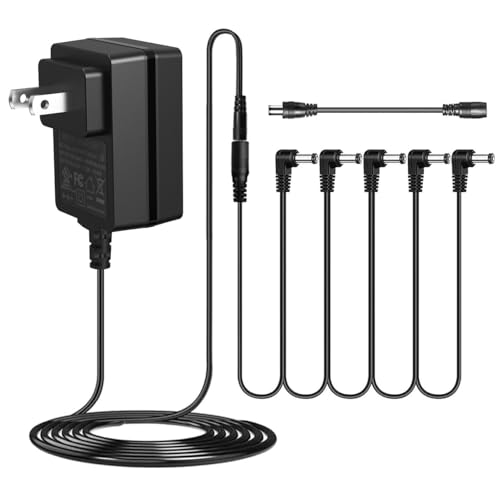
This JOYO power supply provides 9V DC at 1.2A with a total 5-way daisy chain. Its tip-negative design aligns with many common pedal requirements. Best for: mid-sized pedal boards that require simultaneous powering of up to five pedals. Caution: the supply’s total current should be monitored if adding pedals with higher draw to prevent overload.
Buying Guide: How To Choose The Right Pedal Daisy Chain
- Number of pedals: Match the number of pedals you plan to power with the number of outlets in the daisy chain. Larger boards benefit from 6–8 outlet units.
- Current requirements: Check each pedal’s current draw. Ensure the daisy chain can deliver enough total current without overheating.
- Polarity compatibility: Most pedals use a negative tip design. Confirm polarity (tip negative vs. center negative) to avoid damage.
- Cable length and layout: Measure your board and stage setup to choose cables with appropriate reach and minimal clutter.
- Noise considerations: Choose cables with high-conductivity copper cores and well-shielded construction to minimize hum and interference.
- Durability and build: Look for PVC or rugged sheathing and robust connectors for long-term use on tour or in-studio environments.
- Value vs. flexibility: If you frequently rewire, a 2-in-1 or modular option provides flexibility without committing to a single configuration.
FAQ
- Q: Do I need a separate power supply for each pedal? A: No. A properly rated daisy chain can power multiple pedals from a single supply, reducing cabling clutter.
- Q: What is “tip negative” and why does it matter? A: Tip negative refers to the polarity of the power connector; many guitar pedals expect negative on the tip. Check your pedals’ power ports to avoid damage.
- Q: Can I use a daisy chain with power-hungry pedals like power pedals or digital delays? A: It depends on current draw. Ensure the total current remains within the supply’s limit and consider a higher-capacity unit if in doubt.
- Q: Are daisy chains universal for all pedals? A: Most 9V pedals use standard barrel connectors, but always confirm plug size (e.g., 5.5×2.1mm) and polarity before purchasing.
- Q: What’s the difference between 1-to-2, 1-to-3, and 5-way cables? A: These numbers indicate how many pedals can be powered from a single source; choose based on your board’s size and power needs.
- Q: How do I reduce hum when using a daisy chain? A: Use well-shielded cables, keep power cables away from signal cables, and consider a dedicated isolated supply for noisy pedals if needed.