Best 1000W 4-Channel Amplifiers for Car Audio Enthusiasts
Looking for a 1000W four-channel car amplifier to power a robust multi-speaker setup? This guide highlights top 1000W 4-channel amps, detailing who each is best for and why. Ideal buyers include budget-conscious installers, performance-focused listeners, and those bridging to subwoofers. Below is a concise comparison to help you choose quickly.
| Product | Best For | Key Benefit |
|---|---|---|
| Skar Audio RP-150.4AB | All-around daily drivers | True 1000W class A/B with solid 2/4 ohm ratings |
| Pioneer GM-A6704 | Balanced sound with customization | Bridgeable, high/low-pass filters |
| CT Sounds CT-150.4D | Compact installs requiring efficiency | Class D with solid heat dissipation |
| Crunch PX 1000.4 | Flexible channel usage | 4/3/2-channel operation with RCA daisy chaining |
| Taramp’s TS 1200×4 | High-performance multi-speaker rigs | RMS 1200W total with versatile inputs |
Skar Audio RP-150.4AB 1,000 Watt 4-Channel Amp
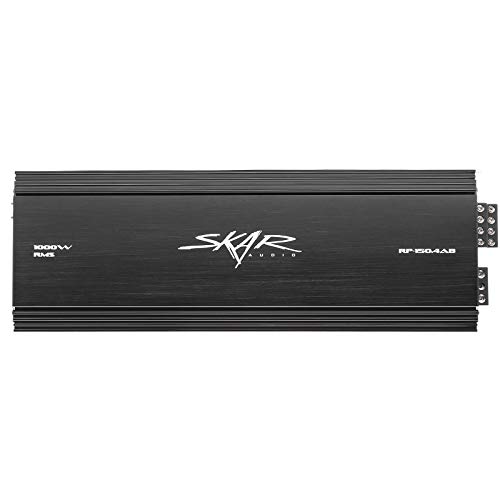
The Skar RP-150.4AB delivers 1000 watts total with a Class A/B architecture. At 2 ohms, it produces 250 watts per channel across four channels; at 4 ohms, 125 watts per channel. This makes it suitable for a mid-to-large vehicle system needing clear, reliable power to four speakers. Best for: drivers who want strong, consistent power to four full-range speakers without extensive tuning. Limitation: Class A/B can run warmer under heavy load; ensure adequate ventilation and install with proper heat management.
Pioneer GM-A6704 4-Channel Car Amplifier

Pioneer’s GM-A6704 offers 60 watts RMS per channel at 4 ohms (190 watts RMS x2 in bridged mode) with a total max power around 1000 watts. It’s a Class AB design focused on balanced performance and efficiency, with bridgeable capability for a subwoofer add-on. Best for: listeners seeking clear, controllable sound with flexible loading and easier retrofits. Limitation: The bridge mode shifts power delivery, which may affect speaker matching if you’re not bridging for subwoofers.
CT Sounds CT-150.4D Full-Range Class D 4-Channel Amp

The CT Sounds CT-150.4D is a compact, Class D amplifier delivering 250 watts RMS per channel at 2 ohms and 150 watts RMS per channel at 4 ohms, with 475 watts RMS when bridged at 4 ohms for two channels. Its small footprint suits tight installs while maintaining strong output and efficient heat management. Best for: vehicles with limited space or those prioritizing efficiency. Limitation: The lighter chassis may feel less premium to some users, though performance remains solid.
Crunch PX 1000.4 PowerDriveX 1000W

The Crunch PX 1000.4 uses a Class A/B topology with 1000W max output, delivering 125 watts x 4 at 4 ohms or 250 watts x 4 at 2 ohms. It features low-level RCA inputs and outputs, enabling easy daisy-chaining for expanded systems. Best for: users who want flexible channel configurations and straightforward installation. Limitation: Specifications emphasize peak values; consider actual listening preferences and impedance to ensure sustained performance.
Taramp’s TS 1200×4 4-Channel Amp

The Taramp’s TS 1200×4 packs 1200 watts RMS total with four channels, offering 300 watts RMS per channel at 2 ohms and 150 watts RMS per channel at 4 ohms. It includes RCA input, High Level input options, fixed crossovers, and automatic activation. Best for: enthusiasts building a powerful, multistage setup with flexible input options. Limitation: Higher power output can require more careful tuning to avoid speaker damage or clipping.
Buying Guide
What should you consider when choosing a 1000W four-channel amp?
- Speaker impedance: If your speakers are 2 ohms, ensure the amp delivers stable power at 2 ohms without overheating.
- Channel usefulness: Decide between four full-range channels or bridging two to drive a subwoofer for bass-heavy setups.
- Topology: Class AB amps typically offer warmer sound and ease of use; Class D emphasizes efficiency, cooler operation, and compact size.
- Heat management: Look for sufficient heatsinking or venting, especially in warm climates or with long listening sessions.
- Filter options: High-pass and low-pass filters help tailor frequencies to each speaker, reducing distortion and protecting tweeters or woofers.
- Installation space: Some amps are compact but deliver strong performance, while others require more mounting space and airflow.
- Wiring compatibility: Check power wiring requirements, fuse ratings, and recommended gauge to handle 1000W safely.
Practical comparison questions
- Is Class D or Class A/B better for your car? Choose Class D for efficiency and compact installs, Class A/B for classic warmth and headroom.
- Do you need bridge capability for a subwoofer? If yes, ensure the amp supports stable bridge operation at your target impedance.
- How important is heat management? In hot climates, prioritize amps with robust heat sinks and airflow.
- Are you installing in a tight space? Favor compact chassis with solid performance, like CT Sounds CT-150.4D or Taramp’s TS 1200×4.
- Do you need easy integration with existing gear? Look for amps with clear input/output options and easy daisy-chaining capabilities.
Frequently Asked Questions
- What does 1000W per channel mean? Most “1000W” labels refer to total peak or max power; actual RMS power per channel varies by impedance and model.
- Do I need a subwoofer amplifier in a 4-channel setup? Not if you plan to use all four channels for full-range speakers; bridgeable models allow adding a sub in a two-channel configuration.
- How do I protect speakers from damage? Use appropriate crossovers and set gains conservatively to avoid clipping and impedance mismatches.
- Can I install any 4-channel amp in any car? Most can, but space, mounting, wiring, and heat dissipation vary by vehicle. Consult a professional installer if needed.
- Is a higher wattage amp always better? Not necessarily; matching amp power to speaker ratings and listening goals yields better results than chasing raw wattage.