Best Analog AM/FM Radios for Daily Use and Emergencies
Finding a reliable analog AM/FM radio means selecting a model that’s easy to operate, portable, and capable of drawing in clear signals in varied environments. This guide highlights five solid picks and explains who each one suits best. Ideal buyers include seniors needing simple tuning, hikers or campers seeking durable portability, and home users wanting strong reception and easy controls. The table below compares the five selected products at a glance to help you choose quickly.
| Product | Best For | Power Source | Key Benefit |
|---|---|---|---|
| PRUNUS J-166 Portable Radio | Outdoor activities and emergencies | Battery | Excellent reception with long antenna |
| PRUNUS J03 AM FM Radio | Seniors and home use | AC or 4 AA batteries | Large tuning knobs and easy readout |
| DreamSky AM FM Portable Radio | Anywhere with strong reception needs | AC or battery | Big speaker and simple analog dial |
| BAIJIALI Portable AM/FM Transistor Radio | Emergency kits and travel | Battery or USB | Wide AM/FM/SW coverage and clear sound |
| Retekess TR604 AM FM Radio | Home, picnic, and seniors | Wall power or battery | Large dial and rotatable antenna |
PRUNUS J-166 Portable Radio AM FM
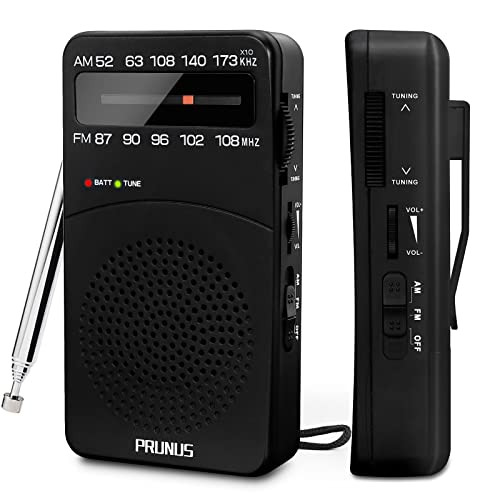
Best for quick portability and reliable reception. This compact radio weighs around 4.2 ounces and measures roughly the size of a small smartphone, making it ideal for pockets, belts, or backpacks. It includes a back clip and lanyard for hands-free carrying, which is convenient during morning runs or park strolls. It uses a DSP chip and a 16.5-inch adjustable antenna to improve reception on both AM and FM bands. Tuning and volume controls are straightforward, with a visible tuning indicator to locate stations quickly.
Best for: active individuals who want a pocketable radio with dependable signal pickup. The device shines in urban and suburban areas where stations are plentiful, yet remains useful in rural spots thanks to the long antenna.
Caution: Battery life depends on usage; keep spare batteries handy for extended outings. Note that the product description emphasizes portability over premium feature sets.
PRUNUS J03 AM FM Radio Portable

Best for home use and seniors who benefit from a larger tuning area and easy handling. The J03 supports both AC power and four AA batteries, offering flexibility during outages or travel. It features a folding handle and larger chassis, improving portability without sacrificing readability. The large frequency scale and smooth tuning knobs simplify switching between AM and FM stations. It’s an accessible choice for users who prefer tactile operation and stable performance in indoor spaces and light outdoor activities.
Best for: households needing a dependable, user-friendly radio with straightforward controls. Choose this if you prioritize readability and a comfortable form factor over ultra-compact size.
Caution: Batteries are not included; plan for a battery set if you anticipate off-grid listening.
DreamSky AM FM Portable Radio

Best for strong reception and clear sound in remote areas. DreamSky emphasizes robust reception with a large built-in speaker and an earphone jack for distraction-free listening. The analog dial offers quick and intuitive tuning, making it suitable for seniors and casual listeners who want a simple interface. It supports both AC power and battery operation, giving flexibility for use at home or on outdoor adventures.
Best for: users who value strong audio output and uncomplicated operation, particularly in places with fluctuating power or signal quality.
Caution: The product relies on standard batteries for portable use; ensure you have back-up power options when traveling far from outlets.
Portable AM/FM Transistor Radio (Model BJL-671)

Best for emergency kits and travel. This model supports AM, FM, and shortwave bands, with a DSP anti-jamming chip to improve sensitivity. It includes a long telescopic antenna and a 5-watt speaker for clear audio output. It offers both battery and USB power, presenting flexibility for different scenarios. The large channel tuner and volume controls aid easy operation, making it a practical choice for users who want a versatile radio for varied listening contexts.
Best for: preparedness-minded buyers seeking broad frequency coverage and reliable performance across indoor and outdoor settings.
Caution: Shortwave availability may vary by region; check local broadcast options if shortwave listening is a primary goal.
Buying Guide
What to look for in an analog AM/FM radio
Signal reception: A longer telescoping or adjustable antenna generally improves reception, especially in areas with weaker signals. DSP chips or robust tuners can also help reduce static.
Power options: Consider whether you want battery-only, AC-powered, or dual power (battery and USB/solar). For emergencies, a radio with long-lasting batteries or the ability to run on USB is valuable.
Ease of use: Large knobs, clear frequency dials, and simple switching between AM and FM are important for seniors or casual listeners. A back clip or handle adds portability for outdoor use.
Which features matter most by use case
- Everyday home listening: Look for a model with easy-to-read dials, stable tuning, and good speaker output.
- Travel and outdoor activities: Prioritize compact size, light weight, durable build, and flexible power options.
- Emergency readiness: Choose radios with long battery life, robust reception, and multi-band coverage (AM, FM, and occasionally SW).
- Seniors and visually impaired: Favor large, tactile controls and high-contrast scales for easier operation.
Comparison tips
When evaluating models, compare antenna type and length, power sources, outdoor usability, and whether the radio offers a clear visual tuning indicator. If you often listen in urban areas, strong FM reception is key; for rural listening, AM clarity and dial readability can be more important.
Maintenance and care
- Keep the antenna extended only as needed to avoid damage.
- Replace batteries promptly and store radios in dry, cool places to protect components.
- Clean dials with a dry cloth; avoid harsh cleaners that could degrade plastics.
FAQ
- Q: Do analog AM/FM radios work without internet or power? A: They can work on batteries or AC power, depending on the model. Some include USB or multiple power sources for flexibility.
- Q: Is a larger dial better for seniors? A: A larger, easy-to-read dial helps in quick station selection and reduces eye strain.
- Q: Are shortwave bands common in consumer radios? A: Some models include SW bands, which are useful for niche listening but are less common than AM/FM in everyday use.
- Q: Can these radios pick up stations in remote areas? A: Yes, models with longer antennas and DSP tuning generally perform better in areas with weak signals.
- Q: Should I choose battery or AC power? A: If you need portability, battery operation is essential. For home use, AC power provides constant listening without worrying about battery life.