Best Midi Pedalboard Options for Guitarists in 2026
Looking for a midi pedalboard for guitar to expand your control at the foot? This guide highlights five solid options that fit a range of setups from live rigs to home studios. Each pick is evaluated for compatibility, portability, and ease of integration with common guitar gear and MIDI-enabled keyboards. Whether you need more notes, built‑in power, or compact design, there’s a suitable choice here for a wide audience—from beginners to pro players seeking reliable hands-free control.
Summary table of selected products:
| Product | Best For | Key Benefit | Notes |
|---|---|---|---|
| JG3 Tech 24 Note MIDI Bass Pedalboard | Hammond-style rigs and MIDI keyboard users | Radial pedalboard curvature and broad compatibility | Heavy, large footprint |
| Studiologic MP-117 MIDI Controller Pedal Board | Pro MIDI control with long cable runs | Dynamic pedalboard with 17 notes | Bundle with 10 ft MIDI cable |
| Crumar MojoPedals 13-Note MIDI Pedalboard | Compact setups needing command options | 13-note, 3 footswitches, LED display | Smaller footprint |
| RVONE Guitar Pedal Board | Portable, budget-conscious players | 10 isolated power outputs | Aluminum, compact |
| STRICH PB‑M15 | All-in-one power and board control | Integrated power supply, multiple outputs | Full featured, slightly larger |
JG3 Tech 24 Note MIDI Bass Pedalboard

The JG3 Tech pedalboard presents a 24-note MIDI control surface designed to replicate the feel of a Hammond-style pedalboard. It emphasizes compatibility with various brands and MIDI keyboards, making it a versatile base for complex rigs. Best for players who want a dedicated, radially curved pedal surface that mirrors traditional organ layouts while still interfacing with modern MIDI gear. A potential limitation is its size and weight, which may affect portability on tight stages.
Studiologic MP-117 MIDI Controller Pedal Board Bundle

The Studiologic MP-117 bundle combines a dynamic pedalboard with a 10-foot MIDI cable, enabling robust control of MIDI devices across longer setups. It is particularly well-suited for players who need reliable, expansive MIDI control without complex patching. Best for performers who prioritize dependable connectivity and a straightforward pedal layout. A note: as a bundled option, ensure your other MIDI gear is compatible with Studiologic’s control scheme.
Crumar MojoPedals 13-Note MIDI Pedalboard
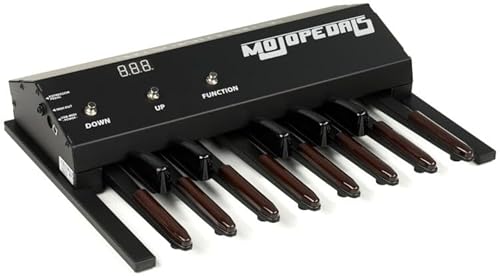
The Crumar MojoPedals 13-Note MIDI Pedalboard provides a compact control surface with three footswitches and an expression input, plus an LED display. It’s ideal for players needing a smaller footprint while still delivering MIDI command options. Best for guitarists who want a mid-sized pedalboard that remains highly functional in tighter stage environments. Limitation: fewer notes than larger boards may constrain elaborate setups.
RVONE Guitar Pedal Board With Power Supply

The RVONE pedal board emphasizes built-in power with 10 isolated DC outputs, which helps reduce noise across pedals. Its compact 14.5″ x 5.2″ footprint makes it suitable for small setups, travel gigs, or home recording. Best for players who need a portable, budget-friendly, power-stable solution. Caution: integrated power can limit expansion if you plan to add many pedal effects over time.
STRICH Guitar Pedal Board With Built-in Power Supply

The STRICH PB-M15 offers an integrated power supply across 10 independent outputs, including 9V, 12V, and 18V options, plus a USB port. It also ships with a built-in design that aims to simplify setup for on-the-go performances. Best for players who want a compact all-in-one platform with diverse power options. Limitation: the integrated system may be more complex to service or upgrade than separate power supplies.
Buying Guide: Key Considerations For Midi Pedalboards
- Number of notes and expandability: How many control points do you need at your feet? Choose a board that meets your current setup and offers room to grow.
- Power supply: Does the pedalboard include an integrated power supply? Are separate power rails needed for your pedals? Consider noise isolation and voltage compatibility.
- Portability vs. footprint: Do you perform live on small stages or in home studios? Balance pedal count with the weight and footprint of the board.
- Compatibility: Ensure the device communicates with your MIDI keyboard, audio interface, or other MIDI-enabled gear. Check connector types and required cables.
- Durability and materials: Aluminum boards are common for durability; wooden boards can offer lighter weight and a different aesthetic.
- Bundled accessories: Cables, patch cables, and bags add value. Compare what’s included with each option.
Frequently Asked Questions
- What is a MIDI pedalboard and how does it work with guitars? A MIDI pedalboard sends controller data to compatible devices, enabling hands-free control of synths, modules, or software instruments used with guitars.
- Do I need a separate MIDI cable for every pedal? Not necessarily. Some boards use USB-MIDI or internal routing; check your gear’s input/output options.
- Can a pedalboard power supply affect tone? Power quality can influence noise in some setups; isolated outputs help minimize hum and interference.
- Are wooden pedalboards as durable as aluminum? Wooden boards can be lighter and offer a unique vibe, but aluminum boards typically endure heavy touring better.
- Which option is best for travel? Look for compact footprints, light weight, and bundled cables; the right board balances portability with required features.
- How important is built‑in programming like LED displays? Display visibility helps during live gigs; consider ease of access for programming on stage.