Best Battery Charger for ECU Programming: Stable Power for ECU Coding and ADAS Calibrations
When choosing a battery charger for ECU programming, aim for a unit that provides stable voltage, sufficient current, and features that support long-duration programming, battery repair, and ADAS calibration. The top picks below are designed for ECU reprogramming, module coding, and flashing, while also supporting traditional charging and battery maintenance. This guide highlights five models suited for different buyers—from professional shops needing high current to DIY enthusiasts needing reliable pulse repair and voltage stabilization.
AOOL Flash Reprogramming Power Supply 120 Amp

Brand: AUTOOL. This unit provides a high-current 120A output with a stable 10.8V–16.0V range, designed specifically for ECU programming and vehicle diagnostics without voltage drops. It supports a dedicated flash reprogramming mode and module coding, making it suitable for shops handling frequent ECU updates and ADAS calibrations. The included 6.5-foot cables aid in flexible setup during reprogramming sessions.
Best for: Professional technicians and shops performing regular ECU reprogramming, module coding, and diagnostics where uninterrupted power is critical. It’s ideal when you need a reliable, high-current supply that won’t sag during reflash operations.
Caution: The unit delivers sustained high current for a limited time; plan workflows to avoid overextending the 3-minute max duration without recharging.
AUTOOL EM355 Programming Power Supply 12V

Brand: AUTOOL. This 12V ECU programming power supply maintains a stable output (10.8–16.0V) to prevent data loss during coding and flashing. It includes a three-stage smart charging system and pulse repair features to support weak or sulfated batteries, extending battery life while ensuring consistent programming voltage during ECU operations.
Best for: Technicians who need precise voltage control with built-in battery conditioning, particularly when frequent ECU coding, flash reprogramming, or ADAS calibrations are performed on varied vehicle makes.
Caution: Pulse charging adds complexity to charging cycles; ensure compatibility with the vehicle’s battery type before relying solely on the auto-repair mode during programming sessions.
Schumacher Electric DSR Pro 100A Heavy-Duty Charger
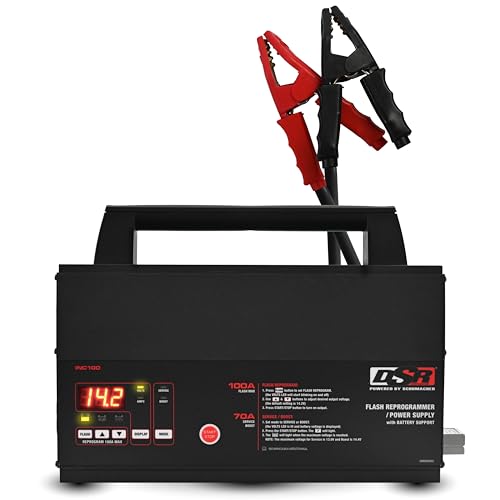
Brand: Schumacher Electric. The DSR Pro INC100 provides a flash reprogram mode delivering up to 100A with a service mode around 13.5V and boost up to 14.4V. This professional-grade unit is designed for major ECU reprogramming tasks and offers a steady power output necessary for reliable coding and ADAS calibration workflows.
Best for: Professional users needing robust, constant power during high-current ECU reprogramming steps, with practical flexibility to switch between service and boost modes as required.
Caution: While powerful, it’s a heavier, more feature-rich unit; ensure its size and weight fit your workshop setup and that you’re comfortable with higher current management.
PowerMax PMBC Series 75 Amp Battery Maintainer Charger

Brand: PowerMax. This PMBC model provides a clean DC power supply suitable for complex programming and ADAS calibrations, with a fixed 13–16.5V output range and built-in display for voltage monitoring. It includes an on/off switch and a long 15′ cable set to accommodate different vehicle layouts.
Best for: Shops and DIYers requiring stable voltage during ECU programming and diagnostics when long cable runs are necessary or when a dedicated power source is needed to complement a vehicle’s battery during reflash operations.
Caution: The fixed voltage range means you should verify compatibility with specific vehicle ECU requirements to avoid mismatched voltage during critical programming steps.
TOPDON T90A Car Battery Charger

Brand: TOPDON. The T90A offers 12/24V automatic charging with a broad 5–90A adjustable current range and 6 modes, including a SUPPLY mode for voltage stabilization during ECU operations. It supports a wide range of lead-acid chemistries and includes temperature compensation for safer charging during programming sessions.
Best for: Users seeking flexible automotive charging with advanced programming support, especially when staging devices for ECU coding, ADAS calibrations, or diagnostic work across different vehicle types.
Caution: While versatile, verify the compatibility of its 24V mode with specific vehicles requiring 24V programming environments, as some ECUs operate within tighter voltage tolerances during reflash.
Buying Guide: How To Choose A Battery Charger For ECU Programming
- Voltage stability during reprogramming: Look for units that guarantee a tight 10.8–16V range with the ability to hold voltage under load.
- Current capacity and duration: For ECU flashing, prefer high-current modes (100A+) with controlled delivery and short max duration or a built-in protection to prevent voltage drop during long sessions.
- Pulse charging and battery repair: Pulse charging helps activate weak batteries and supports sulfated cells, extending life while maintaining reliable power during programming.
- Compatibility with battery chemistries: Ensure support for lead-acid variants (standard, AGM, EFB, gel) and lithium if you plan to work with mixed fleets.
- Safety features: Overload, short-circuit, reverse polarity protection, temperature monitoring, and auto-cutoff help prevent damage to ECUs and the charger itself.
- Ease of use and diagnostics: A clear display showing voltage, current, and temperature reduces guesswork during critical reprogramming steps.
- Mobility and cabling: Long cables or attached jump-start features can be beneficial for reaching vehicles in cramped spaces or when the vehicle’s battery and ECU are located far apart.
- Warranty and professional support: For shop use, prefer models backed by solid customer support and longer warranties to minimize downtime.
FAQ
- What voltage should a programming power supply maintain during ECU reflash?
- Is higher current always better for ECU programming?
- Can these units support lithium batteries?
- What is a “pulse charging” mode good for?
- Why is a fixed output voltage sometimes a limitation?
- Are these units safe for long ECU reprogramming sessions?
Typically, a stable 10.8–16V range is recommended to prevent data loss and voltage drops during ECU coding and ADAS calibrations.
Higher current helps during high-demand reprogramming, but it should be managed with proper timing and protection to avoid damage to the ECU or battery.
Some models support both lead-acid and lithium chemistries; check manufacturer specifications for exact compatibility before use.
Pulse charging helps activate sulfated or deeply discharged batteries, improving readiness for programming work and extending battery life.
A fixed output voltage may not fit all ECUs; verify required voltage tolerances for your vehicles to avoid under- or over-voltage during programming.
Yes, when used within specified current limits, with proper monitoring, and with protection features enabled to handle fault conditions.