Best Unbalanced 1/4 Cable Options for Easy Instrument Connectivity
Instruments and gear often rely on unbalanced 1/4 inch (6.35 mm) cables to connect guitars, amplifiers, mixers, and keyboards. This guide highlights five reliable unbalanced 1/4″ cables that balance durability, signal clarity, and value. It’s ideal for guitarists, keyboard players, and studio setups seeking straightforward, low-noise connections. The top picks are best for musicians who want dependable cables for gigs, practice, or home studios without overinvesting in premium pro-audio gear.
| Product | Best For | Approx Length | Why It Stands Out |
|---|---|---|---|
| Cable Matters 2-Pack 6ft TS to TS | Guitarists and bassists needing bulk reliability | 6 ft each | Durable build, shielding, and gold-plated contacts keep signal clean |
| Jelly Tang 10Ft Mono Cable | Stage and studio users needing longer runs | 10 ft | Premium core, gold-plated connectors, and robust jacket |
| Hosa CPP-105 1/4″ TS to TS | General purpose studio and live setups | 5 ft | Compact, standard mono interconnect with OFC conductors |
| HOSONGIN 3.3ft 2-Pack | Compact pedalboards and tight setups | 3.3 ft | Two-layer shielding with corrosion-resistant connectors |
| Hosa CPP-202 Dual 1/4″ TS to Dual 1/4″ TS | Stereo interconnects for effects and mixers | 6.6 ft | Dual mono for clean stereo paths and rugged construction |
The table above showcases five unbalanced 1/4 cable options that strike a balance between performance and price. The selections cover a range of lengths, shielding levels, and use cases—from guitar rig cables to studio interconnects and pedalboard patches.
Cable Matters 2-Pack 1/4 Inch TS to TS Cable

Best for guitarists, bassists, and keyboard players who need reliable instrument cables for amps, mixers, or patch panels. Built with a braided shield to minimize EMI, heavy-gauge copper conductors, and polyethylene insulation for high-frequency response. The set includes two 6 ft cables with gold-plated connectors and a textured grip for easy handling. Choose this if you want a durable, straight-to-straight instrument cable that resists kinks and maintains signal integrity.
Caution: Some users may prefer longer lengths for stage setups; these are 6 ft each, which is adequate for typical practice rooms or small stages but may require extensions for larger venues.
Jelly Tang 6.35mm 10Ft Mono Cable

Best for stage players and home studios needing longer cable runs. This 10 ft mono cable uses a 6.35 mm connector with 24K gold plating and a pure copper core to reduce signal loss. It’s suitable for connecting guitars, keyboards, amplifiers, and mixers. Pick this if you require extra reach without sacrificing signal quality.
Limitation: Longer cables can be more susceptible to tangles; consider cable management solutions for frequent transport.
Hosa CPP-105 1/4 Inch TS to TS, 5 Feet

Best for compact studios and practice setups needing a short, reliable interconnect. It uses a standard 5-foot length with a straightforward 1/4″ TS Male to 1/4″ TS Male configuration. The construction emphasizes sturdy connectors and reliable signal transfer. Choose this if you want a dependable short patch cable for tight spaces or pedalboards.
Caution: Short cables can limit placement options on larger rigs; ensure your layout fits a 5 ft run.
HOSONGIN 3.3ft 2-Pack 1/4″ Guitar Cables

Best for compact pedalboards, practice rooms, or portable rigs that demand space efficiency. Each 3.3 ft cable uses a two-layer shield and 24K gold-plated connectors to resist corrosion and maintain clean sound. The nylon braided shield adds durability and ease of handling. Choose this if you want two compact cables with robust shielding for noise reduction.
Limitation: Short length may require careful routing to avoid pedalboard crowding or pedal conflicts.
Hosa CPP-202 Dual 1/4 Inch TS to Dual 1/4 Inch TS
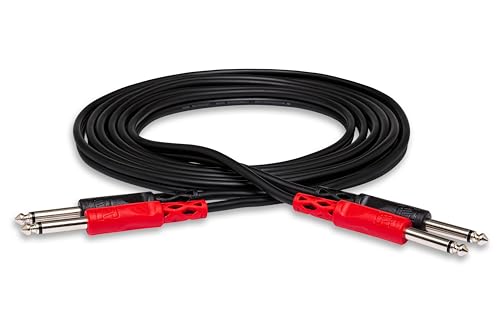
Best for stereo interconnects and dual-mono paths in effects chains, mixers, and patch bays. The 6.6 ft length provides ample reach for studio setups. OFC conductors and sturdy molded connectors support reliable signal transfer with durable strain relief. Choose this if you need a dual 1/4″ TS interconnect for stereo gear.
Caution: Dual-mono cables are not ideal for simple mono applications where a single path is sufficient; ensure your equipment requires stereo interconnects.
Buying Guide: Key Considerations for Unbalanced 1/4 Cables
Length and environment matter. Short cables minimize signal loss and are ideal for tight studios, while longer cables suit stages and large rooms but may require better shielding. Shielding type, conductor material, and connector quality influence noise rejection and longevity. Consider these questions when selecting:
- What equipment are you connecting (guitar, keyboard, mixer, pedalboard) and what length do you need?
- Do you require mono or stereo interconnects, or a dual-path connection?
- Is shielding important for EMI/RFI resistance in your setup?
- How important is durability for travel or frequent setup/teardown?
- What budget and space constraints do you have?
Practical Buying Tips
- For stage use, lean toward cables with robust shielding and gold-plated contacts to minimize signal loss.
- In home studios, choose cables with strong jackets and manageable length to reduce clutter.
- If you need several cables, consider multi-packs to simplify replacements and consistency across gear.
Frequently Asked Questions
- What is an unbalanced 1/4 cable good for? It connects most guitars, keyboards, and pedals to amps or mixers with minimal impedance concerns for typical setups.
- Can I use a 1/4″ cable for balanced connections? Balanced connections typically use TRS (tip-ring-sleeve) cables; standard TS cables are unbalanced.
- Are longer cables more prone to signal loss? Yes, longer runs can introduce more resistance, but good materials and shielding mitigate this.
- What should I look for in a durable guitar cable? Shielding quality, copper conductors, gold-plated connectors, and a strong outer jacket help reliability and tone.
- Is a dual 1/4″ TS cable useful for pedals? Yes, dual mono cables can connect stereo effects and multi-effects setups without needing separate cables.
- Do short cables affect tone? In practice, well-made short cables preserve tone similarly to longer cables, with less signal degradation.