Best Smart EV Charging Stations for Home Use in 2026
Answering the question many EV owners ask: which smart Level 2 charger fits your home, budget, and driving habits? This guide highlights five top options that balance speed, connectivity, and ease of use. The right pick depends on your electrical setup, whether you want plug-and-play or a professional install, and how important remote monitoring and scheduling are for you. The top picks cover different needs: ultra-fast options for larger battery EVs, networked chargers for frequent travelers, and rugged outdoor units for harsh weather. The buyer profiles below help you compare quickly and decide which charger is best for you, your family, and your driveway.
| Product | Connector Type | Max Output | Best For |
|---|---|---|---|
| Splitvolt Level 2 Smart EV Charging Station | J1772, 50A | 12kW (50A) | Homeowners needing adjustable power and scheduling |
| ChargePoint HomeFlex Level 2 EV Charger | J1772, 50A | Max 50A | Networked charging with broad support |
| AIMILER Level 2 EV Charger | J1772, 32A | 32A / 7.68kW | Budget-friendly, portable setup |
| VDLPOWERVP Level 2 EV Charger | J1772, 50A | 11.5kW (50A) | Smart app with long cable |
| TLE LEVEL Level 2 EV Charger | J1772, 40A | 9.6kW (40A) | Low-cost, plug-and-play |
Splitvolt Level 2 Smart EV Charging Station
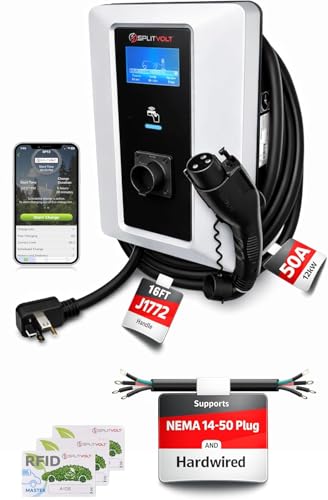
Best for homeowners who want flexible installation and strong on-site control. This charger offers plug-and-play compatibility with a 50A NEMA 14-50 outlet and the option to hardwire for higher reliability. It supports 12kW (50A) or 9.6kW (40A) outputs and includes a display, scheduling, RFID access, and OCPP compatibility for future network integration. Ideal for users who want adjustable charging speed (8A–50A) to fit a busy schedule or a limited electrical budget. A caution: Tesla owners will need an adapter to use the J1772 connector. Best for: households that value local control and potential network expansion, especially with non-TeslaEVs.
ChargePoint HomeFlex Level 2 EV Charger

Best for users who want a large network and app-based control. This unit supports a broad ChargePoint ecosystem with 24/7 support and access to extensive charging locations across North America and Europe. The ChargePoint mobile app enables charging control, reminders, and smart home integrations. Note: WiFi is needed for full functionality. Best for: commuters who want seamless app features and a trusted network for travel and work trips. Caution: some features require reliable WiFi connectivity.
AIMILER Level 2 EV Charger (WiFi App / Plug-Play)

Best for budget-conscious buyers who still want faster charging than Level 1. The AIMILER charger offers 32A output with a J1772 connector, ETL listed, and 6x faster charging than Level 1. It is designed for 240V circuits and supports app-based adjustments or manual amperage changes via the device. Best for: apartments, condos, or homes where a 40A circuit is available and Tesla owners use adapters. Limitation: some models note Tesla compatibility requires a J1772 to Tesla adapter.
VDLPOWERVP Level 2 EV Charger

Best for users seeking a long reach and smart monitoring. This 11.5kW charger uses a 50A circuit, includes WiFi connectivity for app-based scheduling and remote monitoring, and comes with a 27.3-foot cable for flexible installation. Best for: homes with deeper garages or outdoor installations where cable reach matters. Caution: ensure your circuit capacity matches the high amperage rating to avoid tripping breakers.
TLE LEVEL Level 2 EV Charger

Best for budget-minded buyers who want plug-and-play simplicity. This portable Level 2 charger delivers up to 9.6kW on a 40A circuit and uses a NEMA 14-50 plug. It is easy to install in most garages and RV parks, making it a strong pick for road trippers or temporary setups. Choose this if you want a straightforward unit with solid performance without extra network features. Limitation: fewer smart features compared with networked chargers; best not relied on for advanced scheduling in some environments.
Buying Guide
What to consider when choosing a smart EV charging station:
- Power output and circuit requirements: Match the charger’s amperage with your home’s electrical panel and available circuit breaker capacity. Higher amperage means faster charging but requires appropriate wiring.
- Plug-and-play vs. hardwired: Plug-and-play is easier to install but may offer less control. Hardwired options typically require a licensed electrician.
- Connector compatibility: All listed options use J1772 connectors; Tesla owners may need adapters to charge at non-Tesla networks or mixed-fleet homes.
- Smart features: Consider app control, scheduling, remote monitoring, and OCPP compatibility for network expansion or tenant management.
- Cable length and mounting location: Longer cables offer flexibility but add weight and cost. Outdoor-rated housings protect against weather and debris.
- Network reliability: WiFi or cellular connectivity affects app features and remote status checks. Ensure your home network supports 2.4 GHz WiFi if required.
Frequently Asked Questions
- Do I need professional installation for Level 2 charging? It depends on the model. Plug-and-play units can often be used with existing outlets, while many 240V Level 2 chargers require a dedicated circuit and professional wiring.
- What is the typical charging speed difference between Level 1 and Level 2? Level 2 chargers typically deliver 7.7–11.5 kW, equating to much faster charging than Level 1, which uses 1.4 kW or less.
- Will a Level 2 charger work with any EV? Most Level 2 chargers use the J1772 connector and are compatible with non-Tesla EVs. Tesla vehicles generally require an adapter for J1772 connectors.
- Is wireless or app-based control essential? App control adds scheduling, reminders, and energy tracking, but not all households need it. Choose based on how you manage charging costs.
- Can I install a charger outdoors? Many units are outdoor-rated; check IP ratings and weatherproofing to ensure reliable operation year-round.
- Do these chargers support off-peak charging? Several models offer scheduling to charge during off-peak utility hours, which can save on electricity costs.