Best MIDI Keyboard for Mac: Top Picks for Production, Performance and Portability
The best MIDI keyboard for Mac users combines portability, tactile playability, and solid software integration. This guide highlights five keyboards well-suited for macOS, including beat makers, composers, and on-the-go producers. Each picks supports common macOS DAWs and bundles software to boost productivity. Read on to find the right fit if you’re a beginner, a mobile creator, or a studio-based producer seeking reliable control over your Mac workflow.
Summary table of chosen products:
| Product | Best For | Key Features | Notes |
|---|---|---|---|
| Akai MPK Mini MK3 | Mobile producers and beat-makers | 25 mini keys, 8 drum pads, 8 knobs, NKS support | Compact and power-efficient |
| Akai MPK Mini IV | Beginners and hobbyists | 25 keys, 8 assignable knobs, color display, MPC pads | Hands-on control with clear visuals |
| Arturia MiniLab 3 | Versatile studio workflow | 25 keys, 8 pads, premium build, software bundle | Flow-friendly with broad control |
| Akai LPK25 | Budget-friendly Mac setup | 25 keys, arpeggiator, USB power | Simple yet capable |
| Donner DMK 25 Pro | Feature-rich on-the-go kit | 25 keys, 8 pads, OLED, 16 scales, DAW packages | Comprehensive for travel use |
Akai MPK Mini MK3 25 Key USB MIDI Keyboard Controller

This USB-powered controller provides 25 velocity-sensitive keys, 8 backlit drum pads, and 8 assignable knobs. It includes Virtual Instrument software and Native Instruments sound packages via NKS Integration, enabling direct control from the device. The 4-way thumbstick supports dynamic pitch and modulation, with an arpeggiator offering adjustable resolution, range, and modes. Best for mobile producers, home studios, and anyone who values compact, hands-on control for Mac-based production.
Who this is best for: compact studios, beat-makers, and students needing portable control with strong software integration.
Why chosen: Combines familiar Akai MPC-style workflow with modern NKS support for easy, productive macOS sessions.
Limitation: Smaller keyboard range may slow full-range piano-style playing for some users.
Akai MPK Mini MK3 Black (Variant)
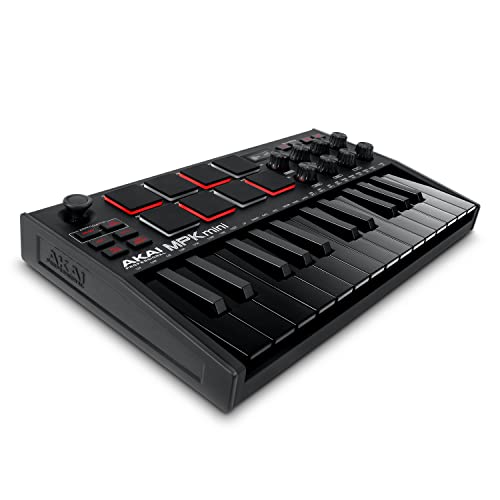
Also featuring 25 mini keys, 8 pads, and 8 knobs, this variant emphasizes portability with the same NKS-ready integration for macOS workflows. It complements on-the-go production setups and classroom environments where a low-profile keyboard is advantageous. While visually similar to the standard MK3, buyers should compare storage and color options when selecting a kit for macOS, as appearances may affect setup cues for some users.
Who this is best for: students, travelers, and macOS makers who appreciate a consistent workflow in a compact package.
Why chosen: Ensures consistent performance and software compatibility in macOS environments.
Limitation: The compact form factor can limit expansive piano-style play for some players.
Akai MPK Mini IV USB-C MIDI Keyboard Controller

The MPK Mini IV focuses on a newer USB-C connection and an enhanced control surface. It provides 25 velocity-sensitive keys, 8 MPC-style pads with RGB feedback, and 8 assignable knobs. The full-color screen and push/turn encoder simplify navigation of presets, DAW functions, and on-device control. Best for beginners who want clear, visual feedback and straightforward macOS integration for music production and performance.
Who this is best for: new producers, educators, and macOS users seeking a modern, easy-to-use interface.
Why chosen: The upgraded display and tactile controls help beginners learn faster and stay productive in macOS workflows.
Limitation: May have a learning curve for players seeking deeper modular control right away.
Arturia MiniLab 3 — Universal MIDI Controller

Arturia MiniLab 3 provides 25 keys and 8 multi-color pads with premium build quality. The controller emphasizes “GO WITH YOUR FLOW” design, enabling fluid control with mute, track selection, and fader operations. The included software package enhances macOS workflows by offering a broad sonic palette and deep integration with DAWs. Best for producers who want a flexible, all-in-one controller with tactile pads and constant learning curve ease.
Who this is best for: studio users who value a smooth, ergonomic workflow and a wide software bundle for macOS.
Why chosen: Its intuitive layout supports quick transitions between composition, sound design, and performance.
Limitation: Some users may outgrow the compact 25-key layout for complex piano parts.
Akai LPK25 – USB MIDI Keyboard Controller

The LPK25 offers 25 keys with a compact footprint, arpeggiator, and USB-powered operation. It’s a budget-friendly option for Mac users who want reliable MIDI control without a large desk footprint. The dedicated octave controls and sustain function support expressive play, while arpeggiator and clock features enable creative sound shaping with software instruments.
Who this is best for: hobbyists, students, and anyone needing a basic Mac-compatible controller.
Why chosen: It provides essential MIDI control at a lower price point with useful arpeggio features.
Limitation: Lacks the larger pad matrix and advanced screen found on higher-end models.
DaierTek Midi Keyboard Controller — 25 Keys

DaierTek offers 25 velocity-sensitive keys, 8 backlit pads with velocity sensitivity and aftertouch, and 8 assignable encoders. It supports wireless Bluetooth MIDI and USB, with a built-in battery for portability. Compatibility spans Windows, Mac OS, Android, and iOS, making it versatile for macOS studios and mobile setups. Best for users who want wireless operation and broad device compatibility in one package.
Who this is best for: mobile producers and those who need wireless Mac integration.
Why chosen: The multi-device compatibility and built-in battery enable flexible macOS workflows and travel-ready setups.
Limitation: Bluetooth MIDI can introduce occasional latency on busy projects or older systems.
Buying Guide — Key Considerations For Mac Buyers
What should macOS buyers evaluate before choosing a MIDI keyboard?
- Compatibility: Ensure macOS compatibility with your DAW (Logic Pro, Ableton Live, GarageBand, etc.) and confirm class-compliant USB MIDI support.
- Keybed and feel: Decide between velocity-sensitive mini keys or full-size keys. Consider aftertouch, aftertouch sensitivity, and keyboard action if you plan piano-like playing.
- Pads, knobs, and faders: Determine whether you need drum pads for beat making, or if transport and DAW control via knobs/faders will improve your workflow.
- Connectivity: USB-C vs USB-A, Bluetooth MIDI, and power options (bus-powered vs external). USB-C is common on modern Macs; Bluetooth adds portability but may introduce latency.
- Software bundle and integration: Look for bundles that complement macOS workflows. NKS or Native Instruments integrations can speed up setup and sound design.
- Portability vs. comfort: If you travel often, a compact 25-key model is ideal. If you work primarily at a desk, consider 37-key options for more range.
- Future-proofing: Consider expandability like MIDI/CV I/O or additional pads for future projects.
Frequently Asked Questions
- What’s the best beginner MIDI keyboard for Mac?
- Which MIDI keyboards include Native Instruments or software bundles?
- Do Bluetooth MIDI keyboards work well with macOS?
- Is 25 keys enough for first-time piano-style playing?
- What should I prioritize for on-the-go production?
- Can these keyboards control DAW transport functions?
Answers:
- For beginners, MPK Mini IV or Mini MK3 variants provide a balanced mix of keys, pads, and software to start quickly on macOS.
- Many Akai and Arturia models include bundles with Native Instruments instruments or companion software, enhancing macOS workflows.
- Bluetooth MIDI can work well but may introduce occasional latency compared to USB, especially in busy projects.
- 25 keys suit entry-level piano parts and melodies, though players seeking extensive range may prefer 37-key or larger controllers.
- On-the-go production benefits from compact designs with USB bus power and optional wireless connectivity.
- Most models include transport and DAW control features to streamline macOS-based recording and editing.