Best 1 Watt Tube Amp Head for Home Practice and Small Jams
Answering the search for compact, true-tube tone, these 1-watt amp heads are ideal for home practice, small gigs, or studio work. The top picks below are selected for players who want authentic tube feel without loud volumes. Best for: bedroom players, beginners seeking real tube response, and traveling guitarists needing portable tone. The table summarizes key suitability at a glance.
| Product | Best For |
|---|---|
| Blackstar HT-1RH MK III | Direct, versatile tone with two channels for practice and small sessions |
| Peavey Invective MH 20/5/1-watt | Two-channel lead/clean with built-in noise gate and EQ flexibility |
| Hughes & Kettner TubeMeister Deluxe 20-20/5/1-Watt | Lightweight, flexible wattage with built-in DI and effects loop |
| OriPure OA-H15 15W | Small footprint with true tube preamp and 1W/15W switch |
| Peavey 6505 Mini | Classic 6505 tone with selectable wattage including 1W via attenuator |
Blackstar HT-1RH MK III – 1W Head

The Blackstar HT-1RH MK III uses a high-quality 1W tube power amp, delivering authentic tube warmth at lower volumes. This head is ultra-compact, making it ideal for home practice and easy transport to rehearsals. It features a three-band EQ for tonal shaping and a practical two-channel setup that responds well to different guitar pickups and pedals. Best for players who want a true tube feel without loudness compromise, including bedroom players and traveling musicians.
Selected for its clean, reliable 1W performance and built-in cab/speaker simulation, which helps in recording or direct-to-audio-interface setups. Caution: The built-in speaker-emulation is designed for direct-output scenarios; monitor with an actual cabinet or PA for best stage feel.
Peavey Invective MH 20/5/1-watt Head

The Peavey Invective MH model provides two channels with a 3-band EQ and noise gate, giving strong lead and rhythm tones at 1W. Its attenuator supports 20W, 5W, or 1W output, offering flexible volume control for home studios, small stages, or rehearsal spaces. The inclusion of a footswitchable reverb, crunch, and effects loop adds practical versatility for various styles. Best for players who want traditional Peavey reliability with modern wattage options.
Limitation: While compact, the full 20W stage-grade headroom is not achievable at 1W; use the 1W setting for intimate practice rather than loud performances.
Hughes & Kettner TubeMeister Deluxe 20-20/5/1-Watt

The TubeMeister Deluxe offers selectable wattages of 20/5/1, a built-in Red Box DI, and an effects loop. This makes it an excellent choice for players who want a small tube head with studio-grade DI for direct recording or live sound. Best for players who prioritize DI compatibility and flexible power options while keeping a compact footprint. A potential limitation is that the 1W mode, while functional, may not deliver the same sustain as higher-wattage tube stages.
OriPure OA-H15 15W Head

The OriPure OA-H15 is a versatile all-tube head offering a 1W/15W switch and a broad EQ range. It features two preamp stages, with gain and volume controls to sculpt clear tones into overdriven textures. The handcrafted output transformer and grain-oriented steel components aim to improve high-frequency response and low-end clarity. Best for players who want a true tube circuit with a switchable power option for practice or small gigs. Limitation: Some users may prefer more published tone-shaping options beyond basic gain and EQ controls for ultra-precise studio work.
Peavey Invective 20/5/1-watt Head
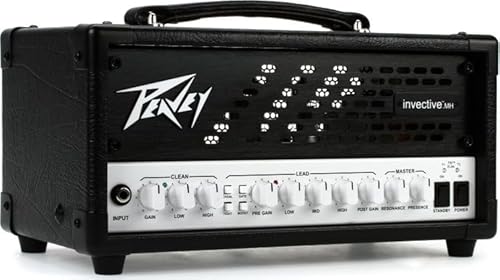
Note: This listing highlights a different model in the Invective line but maintains the 1W wattage option via attenuator. It offers two channels with a dedicated noise gate, and a two-band clean with a three-band lead EQ. Best for players who want a modern high-gain voice in a compact, watt-adjustable head. Use 1W for practice and 20W for rehearsal to retain dynamic range.
Buying Guide: Key Considerations For 1W Tube Amp Heads
- Power and headroom: Look for 1W settings that preserve dynamic response without feeling anemic. Attenuation and wattage-switching options help tailor volume to the venue.
- Preamp topology: Consider the number of channels, presence of gain controls, and EQ bands. A two-channel layout is versatile for clean and lead tones.
- Speaker/DI options: Some models include built-in speaker simulation or DI outputs (Red Box DI, XLR). This helps direct recording or direct-to-PA use without a cabinet.
- Build and portability: Ultra-compact designs are ideal for travel, practice, and small gigs. Weight and input/output options affect setup flexibility.
- Effects loop and reverb: An effects loop expands compatibility with pedals and time-based effects. Built-in reverb adds space to tones without extra gear.
- Tube life and maintenance: Tube-driven amps require care for tube health and biasing considerations. While 1W models minimize stage wear, tube care remains essential.
Frequently Asked Questions
- What is the main advantage of a 1W tube amp head?
It provides authentic tube tone at very low volume, ideal for home practice and studio work without loud volumes. - Do 1W amps require external cabinets?
Some models include speaker-simulation or DI outputs; others may perform best with a real cabinet for the true feel. - Can a 1W amp head be used for small gigs?
Yes, when paired with a suitable cabinet or PA support; certain models offer attenuated wattage to suit small venues. - Are there reliable 1W tube amps with built-in effects?
Several models include reverb and simple loops; more complex effects are typically added via an effects loop or pedalboard. - How important is the tube type in 1W practice amps?
Tube selection (EL84, 12AX7, etc.) shapes tone and response, contributing to the overall feel even at low volume. - What should I consider when choosing between 1W and higher wattage?
Consider the desired tone character, stage volume needs, and whether you plan to record directly or via a cabinet.