Best Bass Guitar Direct Boxes for Clean, Hum Noise-Free DI the Right Way
If you’re seeking a reliable direct box (DI) to connect bass guitar to PA systems, recording interfaces, or live rigs, this guide highlights five solid options. These passive and active DI boxes help preserve tone, reduce hum, and match impedance between your instrument and other gear. Ideal buyers include touring players needing rugged gear, studio engineers chasing clean signal, church musicians, and educators setting up rehearsal rigs. Below, you’ll find quick buying reasons, who each product is best for, and practical limitations to consider. A quick comparison table follows the intro for rapid参考.
Buying quick reference (selected products):
- Best overall for versatile passive DI needs: Pyle Premium Direct Injection Audio Box (two budget-friendly options)
- Best for noise-free signal with minimal setup: Bolanle D2 Premium Passive Stereo DI Box
- Best for high-impedance to balanced conversion in live/studio: PRORECK DC21
- Best for multi-channel stereo use on stage: Bolanle J22 Active Stereo DI Box
- Best value for a robust, rugged Donner DI with transformer isolation
Pyle PDC22 Premium Direct Injection Box
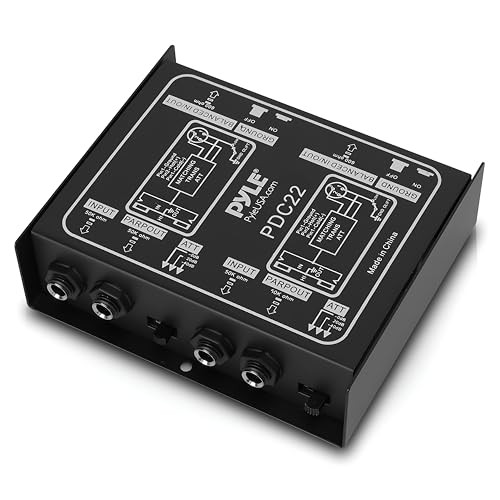
This passive DI unit uses a ¼ inch device connector and impedance transformer to connect guitars, basses, keyboards, and external processors to a PA or mixer. It emphasizes buzz and hum cancellation for clean, stable output. Best for players needing straightforward instrument-to-PA isolation with minimal setup, such as small venues or rehearsal rooms. A possible limitation is the lack of additional channels for multi-instrument setups.
Pyle Premium Direct Injection Audio Box (2.36″ x 4.09″)

This second Pyle model mirrors the first in offering a ¼ inch device connector and impedance transformer to convert unbalanced signals to a balanced output. It is well suited for bass and guitar players who want dependable hum-free connection to a mixer. The simplicity is a strength, though users limited to a single input may find it less flexible for multi-channel needs.
Bolanle Passive 1-Channel DI Box

The Bolanle 1-channel DI focuses on pure signal conversion without power. It includes a ground lift switch and a signal-attenuation option to prevent overload. Best for stage use where a simple, reliable DI box is needed for basses or guitars. It’s a strong choice for musicians who want a no-fuss, power-free solution, with a caveat of single-channel limitation for complex rigs.
PRORECK DC21 Passive DI Box

The PRORECK DC21 provides professional impedance matching with a transformer to prevent tone loss. It offers balanced/unbalanced bidirectional conversion and a ground isolation feature to reduce hum and buzz. This model is suitable for live performances and studio work where a reliable, high-fidelity signal path is crucial. A potential limitation is that some users may prefer active DI for very hot signals or long cable runs, which this passive box does not provide.
Bolanle Bolanle D2 Premium Passive Stereo DI Box

This two-channel DI box offers -15dB per channel pad, ground lift, and polarity switching. It’s ideal for stereo arrangements, multi-instrument setups, and situations where signal management per channel is needed. The stereo capability helps maintain phase independence between left and right channels. A limitation is the absence of active power options, which could matter in very long cable runs or lower-output sources.
Donner Special-Ⅰ Passive DI Box

The Donner Special-Ⅰ emphasizes high sound quality with an ultra-flat response and robust isolation transformer. It’s designed for stage and studio applications, offering reliable impedance matching and hum reduction. Best for players who want a cost-effective yet capable DI with transformer isolation. A possible drawback is that it’s a standalone passive unit, so it may not satisfy needs for very hot signals without additional gain staging.
Buying Guide: Key Considerations For Bass DI Boxes
- Passive vs. Active: Passive DI boxes require no power and tend to preserve tone during signal transfer, while active DI boxes can provide gain and better performance with long cables or very high-impedance sources. Choose based on your rig’s needs and stage environment.
- Impedance Matching: Look for transformers that optimize impedance between your bass and the mixer or interface. Proper matching reduces tone loss and preserves high-end detail.
- Ground Loop Elimination: Ground lift switches and isolation transformers help eliminate hum caused by ground loops. This is crucial for live stages with multiple power sources.
- Channel Count: If you tour or record with multiple instruments, consider DI boxes that offer multi-channel or stereo outputs. Single-channel boxes are simple but limit routing options.
- Portability and Build: Rugged metal enclosures, compact footprints, and reliable jacks are important for on-the-road reliability. For church or classroom use, ease of setup might be prioritized.
- Pad Attenuation and Attenuation Options: Per-channel pads (-0dB, -10dB, -20dB, etc.) help manage hot signals and prevent clipping. This is especially useful with hot bass outputs or active keyboards in the chain.
- Power Requirements: If selecting an active DI, confirm the power source (phantom, battery, or USB) and whether it suits your venue or setup.
FAQ
- What is a DI box used for with bass? A DI box converts high-impedance, unbalanced signals from a bass into a low-impedance, balanced signal suitable for PA systems or recording gear, while often reducing noise and hum.
- Do I need a ground lift on a DI box? Ground lift helps break ground loops that cause hum. It is helpful on stages with multiple power sources or long cable runs.
- Should I buy a stereo DI box for bass? If you use stereo outputs or dual instruments, a stereo DI can preserve left/right separation and improve mix accuracy.
- Can a passive DI box handle hot signals from bass guitar? Many passive DI boxes handle average bass outputs well, but extremely hot signals may require attenuation or an active DI for headroom.
- What’s the advantage of a transformer in a DI box? A transformer provides galvanic isolation, reduces noise from ground loops, and maintains signal integrity over longer cable runs.
- Is an active DI necessary for live bass performances? Active DIs can offer more gain and headroom on very long cables or noisy environments, but many players are satisfied with high-quality passive options.
Notes On Selection
All five products above are suitable for bass guitar DI needs, offering various combinations of impedance matching, hum elimination, and channel capabilities. When choosing, prioritize how many channels you need, whether you require stereo capability, and how much power (if any) you’re willing to manage on stage or in the studio.