Best 8-Inch Bookshelf Speakers for Clear Home Audio
Answering the buyer’s search for 8-inch bookshelf speakers, this guide highlights five solid options and explains which listeners each is best for. These selections balance strong low-end performance with compact cabinet size, suitable for living rooms, home theaters, studios, and desk setups. Ideal buyers include: small-to-mid sized rooms needing solid bass, budget-conscious newcomers building a stereo system, and professionals seeking accurate monitor-like sound in a compact form. The table below compares key traits to help you decide quickly.
| Product | Best For | Key Benefit | Notes |
|---|---|---|---|
| Klipsch RB-81 II | Music lovers, small living rooms | Dynamic horn-loaded tweeter with efficient design | High output with less power |
| Audio Express Koe’ B102 | Hi-fi enthusiasts, flexible setups | Matched SPL/Freq charts for consistency | Wall-mountable; passive design |
| Sony SS-CS5M2 | Compact spaces, budget buyers | 3-way, 3-driver system | Good low-end boost |
| Polk T15 | Beginner surround setups | Deep bass for a bookshelf speaker | Wall-mountable; versatile placement |
| JBL 308P MkII | Studio-like clarity, desktop monitoring | Active monitor with precise transducers | Powered, convenient for desks |
Klipsch Reference RB-81 II Bookshelf Speaker

The Klipsch RB-81 II uses a Dynamic 1″ titanium Linear Travel Suspension horn-loaded tweeter and an 8″ Cerametallic woofer to deliver efficient, high-output sound. This configuration prioritizes living-room listening with a clear, dynamic top end and solid bass for its size. Best for music lovers who want punchy, detailed highs without requiring a large cabinet, and for rooms where louder output is beneficial without amplifiers that push to distortion.
Best for: compact spaces where you want big, lively sound. Limitations: relies on room placement for bass texture; not a built-in sub solution.
Audio Express Koe’ B102 – 100 Watt Bookshelf Speakers

The Koe’ B102 pair emphasizes accuracy with individually tested SPL/Frequency charts for matched performance. As passive speakers, they offer flexible amplifier choices, letting buyers tailor tone and power. They present a clear, detailed soundstage with crisp highs, balanced mids, and controlled bass for music, movies, and gaming. Best for: audiophiles who want measurement-backed consistency and flexible amplification. Caution: requires a capable receiver or amplifier for best results.
Sony SS-CS5M2 3-Way Bookshelf Speakers

The Sony SS-CS5M2 uses a 3-way, 3-driver design with a 5.12″ woofer to boost lower frequencies while maintaining clear mids and highs. This makes them a practical choice for small rooms where space is at a premium but stereo depth remains important. Best for: listeners who want a compact, versatile pair that can handle music and home theater duties. Limitation: smaller woofer may underperform at very high volume compared with larger 8″ designs.
Polk Audio T15 8″ Bookshelf Speakers

The Polk T15 delivers deep bass through a 5.25″ Dynamic Balance driver and a 0.75″ tweeter. They are wall-mountable and designed to serve as front, left-right, or rear speakers in a surround setup. Best for: beginners building a home theater or starting a two-channel system with room to expand. Caution: bass performance is strong for the size, but not a substitute for a dedicated subwoofer in large rooms.
JBL Professional 308P MkII 8-Inch Monitor
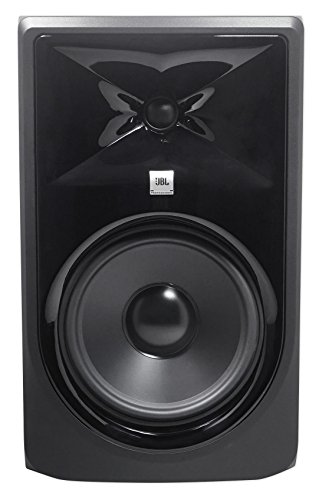
The JBL 308P MkII is a powered 8″ monitor designed for near-field listening with precise transducers, modern updates for transient response, and low distortion. It’s a robust choice for desks, studios, or mixing setups where accuracy matters. Best for: professional or semi-professional environments needing reliable, self-contained monitoring. Caution: being an active monitor, it requires electrical power and proper placement for best image.
Buying Guide
What to consider when choosing 8-inch bookshelf speakers:
- Room size and listening distance: Larger rooms benefit from higher efficiency and stronger bass extension.
- Speaker type: Passive vs. powered. Passive speakers rely on an external amplifier; powered monitors include built-in amplification.
- Frequency response and sensitivity: Look for speakers with a balanced response in the 40 Hz to 20 kHz range and reasonable sensitivity for your amp.
- Cabinet design and placement: 8″ woofers need room to breathe; consider stand, shelf, and wall placement plans.
- Use case: Music listening vs. home theater vs. studio work will influence driver configuration and tonal balance.
- Compatibility: Ensure amplifier power and impedance align with the speaker’s ratings.
- Budget vs. expansion: Some models excel in immediate use but may limit future upgrades; others are stepping stones to a larger system.
FAQ
- What is the advantage of an 8″ woofer in a bookshelf speaker? – It generally provides stronger bass extension for a compact cabinet, improving fullness in small-to-medium rooms.
- Should I choose passive or powered 8″ bookshelf speakers? – Passive speakers require an external amp, offering customization; powered monitors are ready to use and excellent for desk setups.
- Are 8″ bookshelf speakers suitable for movies? – Yes, especially models with good bass and clear dialogue; pairing them with a subwoofer can enhance realism in larger rooms.
- Do I need room treatment for bookshelf speakers? – Basic room treatment helps reduce reflections and improves imaging, especially in small rooms.
- How important are frequency response specs? – They guide whether a speaker will reproduce you music or movies with the desired balance across bass, mids, and highs.
- Can I mix brands in a system with 8″ speakers? – Yes, but consider tonal balance and impedance to ensure coherent sound across channels.