Best 4 Channel Power Amplifier for Professional PA and DJ Setups
Answering the question “what is the best 4 channel power amplifier for my PA or DJ system?” this guide compares top options for reliability, output, and versatility. Ideal buyers include event DJs needing high power in compact racks, small venues requiring clear stage sound, and studio setups that demand flexible configurations. Below is a concise buying table of the five highlighted products to help you compare at a glance.
| Product | Channels | Output (4Ω) | Best For |
|---|---|---|---|
| Sound Town NIX-D4800 | 4 | 720W RMS per channel | Live DJ sets and portable installs |
| FULODE 4-Channel | 4 | 1500W RMS per channel at 4Ω | Stage and studio with high headroom |
| MUSYSIC MU-D9600 | 4 | 9600W peak per pair (channels) | Large events with multiple zones |
| Sound Town UPDM-Q3 | 4 | 1150W RMS per channel at 4Ω | PA, DJ, and conference rooms |
| Sound Town ST-UPDM4C | 4 | 1400W RMS per channel at 4Ω | High-power standalone or bridge-ready setups |
Sound Town NIX-D4800 4-Channel PA/DJ Power Amp

What it offers: Class-D efficiency with 4 x 720W RMS at 4Ω and a peak total of 4800W. The STEREO/PARALLEL switch provides flexible routing, while input sensitivity options (0.775V/1V/1.4V) aid signal matching. Best for: compact 4-channel PA rigs and mobile DJs needing substantial power without adding weight.
Why chosen: The 1U rack design keeps a small footprint while delivering substantial headroom. This model suits players who prioritize portability and consistent output across a 4-ohm load. Caution: Monitor thermal performance under long gigs; ensure adequate ventilation to avoid thermal throttling.
FULODE 4-Channel Power Amplifier

What it offers: 4 x 1500W RMS at 4Ω (and 4 x 1000W at 8Ω) with multiple modes (Stereo, Bridge, Parallel). Independent front-panel gain controls per channel and XLR/SPEAKON connectivity for versatile wiring. Best for: DJs and venues needing high output with flexible configuration and reliable protection features.
Why chosen: The combination of high wattage and versatile mode options makes it a strong choice for ambitious setups requiring robust power. Caution: Larger power draw means ensure adequate electrical supply and cooling in dense racks.
MUSYSIC MU-D9600 4-Channel Amplifier

What it offers: Four channels with up to 9600W peak output per pair, enabling multiple speaker zones with precise per-channel control. It also supports Stereo, Mono, and Bridge modes for flexible system layouts. Best for: Large venues, concerts, and events where multiple zones and high SPL are required.
Why chosen: The four-channel design with high peak capability supports complex installations. Caution: The stated peak output may not reflect real-world continuous power; plan for continuous ratings and proper cooling in extended use.
Sound Town UPDM-Q3 1U Class-D 4-Channel

What it offers: 4 x 1150W RMS at 4Ω with built-in low-pass filtering to support subwoofers via LPF, plus STEREO/PARALLEL/BRIDGE routing for flexible configurations. Best for: Conference rooms and PA setups that require precise sub-bass control and simple wiring.
Why chosen: The integrated LPF is a clear benefit for subwoofer-focused systems, reducing high-frequency interference. Caution: May require careful management of heat in long performances; ensure good airflow around the unit.
Sound Town ST-UPDM4C Ultra-Light 4-Channel
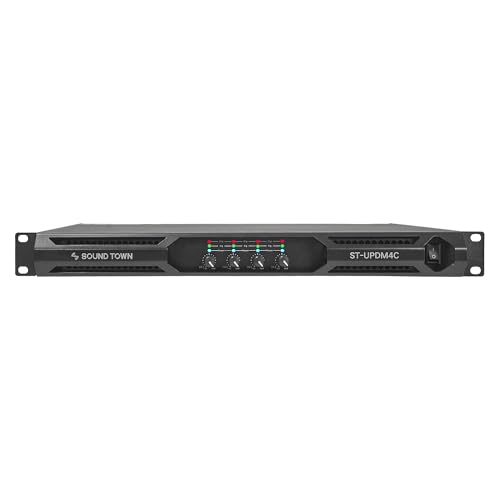
What it offers: 4 x 1400W at 4Ω with UPDM technology for high power and efficiency, plus support for 2, 4, and 8-ohm loads. Best for: Venues or installations that need utmost power with flexible impedance handling without increasing rack footprint.
Why chosen: The high wattage at 4Ω makes it a strong candidate for loud spaces where headroom matters. Caution: Check compatibility with your existing speakers to avoid impedance mismatch that could reduce performance.
Buying Guide
- Power needs: Match amplifier wattage to your speakers’ RMS ratings. Higher RMS per channel provides headroom for dynamic music and live events.
- Impedance compatibility: Ensure amps support 4Ω speakers if your system uses 4Ω loads. Some amps also support 8Ω and bridge modes for flexibility.
- Signal routing: Look for Stereo, Bridge, and Parallel modes. These enable multi-zone setups or combining channels for higher output to a single speaker.
- Protection features: Independent channel gains, limit indicators, and thermal protection protect both amp and speakers during demanding use.
- Connectivity: XLR and Speakon inputs/outputs are standard for reliable, professional wiring. Check for compatible adapters if needed.
- Cooling and form factor: Class-D amps are efficient and light, but DL needs adequate airflow in racks. Consider 1U or 2U designs based on space and heat load.
Frequently Asked Questions
- What is a four-channel amplifier good for? It powers multiple speakers or zones, ideal for DJs, small venues, and conference installations.
- Is Class-D power better for portable setups? Yes, Class-D offers high efficiency and lower weight, beneficial for mobile rigs and compact racks.
- Do I need a separate limiter or processor? A limiter helps protect speakers in high-output environments; consider your system’s dynamics and room acoustics.
- Can I bridge a 4-channel amplifier? Some models support bridge mode to combine channels for higher single-channel power; verify per model specifications.
- How important is cooling? Critical for sustained performances; ensure ventilation and avoid stacking gear tightly in enclosed spaces.
- What should I consider for wiring? Use proper speaker cable gauge and quality connectors (XLR, Speakon) to minimize loss and ensure reliability.