Best Audio Mixer for Headphones: Clear, Portable, and Easy to Use
The best audio mixer for headphones combines simple controls with reliable sound. This guide highlights five compact, headphone-friendly mixers that are well-suited for personal listening, podcasting, or small setups. Each option helps you blend multiple inputs while keeping headphone monitoring clear and direct. Suitable buyers include: casual listeners creating a personal mix, podcasters needing simple multi-source blending, students connecting phones or laptops for practice, and hobbyists building compact recording rigs. Below, compare features, inputs, and best-use scenarios to choose confidently.
| Product | ||
|---|---|---|
| SOLUPEAK 2 Channel 3.5mm Stereo Mini Headphone Audio Mixer | 2-channel, 3.5mm inputs | Two sources, simple listening |
| LZSIG Mini Audio Mixer, 4-Channel | 4-channel, 1/4″ & 1/8″ outputs | Expanding setup, clean noise |
| ESWN DNXB 2 Channel Stereo Audio Mixer | 2-channel, 3.5mm inputs | Compact PC/phone use |
| cooidea 2 Channel Stereo Audio Mixer | 2-channel, 3.5mm inputs | Sleek metal shell, compact |
| Hohean 2 Channel Stereo Audio Mixer | 2-channel, 3.5mm inputs | USB-powered, general purposes |
SOLUPEAK 2 Channel 3.5mm Stereo Mini Headphone Audio Mixer

The SOLUPEAK mixer blends two input sources into a single 3.5mm output suitable for headphones. It offers independent volume controls for each input, allowing you to balance two devices simultaneously. This model is best for buyers who want a compact, affordable solution to listen to music while hearing other inputs at the same time. A simple front-panel design keeps operation straightforward for everyday use. Best for: casual listening, quick mixes, and single-studio setups where space matters.
Limitation: with only two channels, it may not accommodate multiple complex sources without extra routing. The 3.5mm interface is widely compatible but may require adapters for some devices.
LZSIG Mini Audio Mixer, 4-Channel
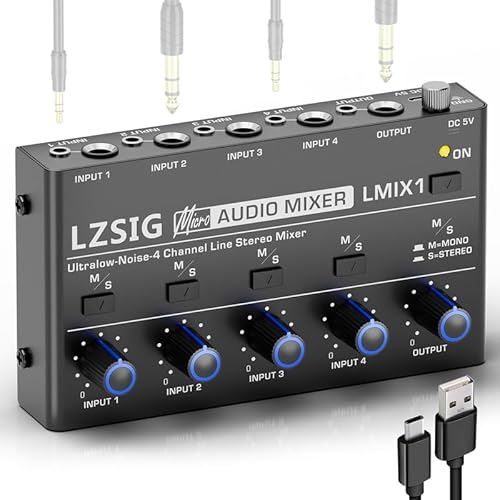
The LZSIG mixer provides four inputs and flexible output options, with an ultra-low-noise design and dedicated mono/stereo switching. It is ideal for expanding a small setup, such as plugging in keyboards, drums, or game consoles, then delivering a clean stereo or mono output to headphones or powered speakers. It uses reliable ROHM op-amps and a dedicated power management chip to minimize noise. Best for: multi-source hobbyists, educators, and compact studios needing more channels without compromising sound fidelity.
Limitation: may be more feature-rich than necessary for just two sources; some users might prefer more explicit channel labeling for quick setup.
cooidea 2 Channel Stereo Audio Mixer

The cooidea mixer emphasizes a metal shell with a compact footprint and a high-quality headphone output. It features a classic chip design and a capacitor-free output path, contributing to strong bass performance and clear sound. The device also aims to suppress ground loop noise, making it a practical choice for setups with multiple devices. Best for: users prioritizing durable hardware and clean audio in a small form factor.
Caution: while the metal build is sturdy, the compact size can limit space for additional inputs or chunky cables. Ensure your cables fit comfortably in the enclosure.
Hohean 2 Channel Stereo Audio Mixer

The Hohean mixer provides two independent channels with 3.5mm inputs and a USB-powered setup, making it convenient for computer-based environments. Independent volume controls on each channel simplify on-the-fly balancing, and the device is designed for easy plug-and-play use without driver requirements. Best for: home offices, classrooms, and quick experimental setups where USB power is convenient.
Caution: USB-powered devices can be affected by computer power draw or hub configurations; test with your primary device to ensure stable performance.
Buying Guide: How to Choose the Right Headphone Mixer
Key questions and practical considerations help align a headphone mixer with your needs.
- How many sources do you need to mix at once? If you only need two, a two-channel model may be simplest. For more inputs, a four-channel option gives flexibility.
- What devices will you connect? Consider input compatibility (3.5mm, 1/8 inch, or 1/4 inch) and whether you need USB-powered operation or a standalone powered unit.
- Do you require independent volume controls? Independent channel knobs make balancing easier, especially when monitoring with headphones.
- Is noise performance important? Ultra-low-noise designs and ground-loop suppression benefit setups with multiple power sources or long cable runs.
- What’s your portability requirement? Compact metal chassis are ideal for travel, classrooms, or on-the-go recording.
- Budget and durability: metal housings tend to be more durable, while plastic enclosures can be lighter and cheaper but potentially less rugged.
Practical comparison at a glance
- Best for two sources with simple listening: SOLUPEAK model. Simple controls, straightforward use.
- Best for expanding in a small studio: LZSIG 4-channel. More inputs, clean noise performance.
- Best compact, everyday PC/phone use: ESWN DNXB 2-channel. Small, convenient for desk setups.
- Best blend of style and sound in a tiny footprint: cooidea 2-channel. Durable metal shell and solid audio output.
- Best USB-powered option for quick setups: Hohean 2-channel. Plug-and-play with modern devices.
Frequently Asked Questions
- What is a headphone mixer used for? It blends multiple audio sources so you can monitor a combined signal through headphones.
- Do I need a powered mixer? If you only need headphone listening and small speaker outputs, a powered, passive-but-amplified design isn’t always required.
- Can a headphone mixer improve gaming or streaming audio? Yes, it can help balance voice chat, game sound, and music for clearer monitoring.
- Are 3.5mm inputs common on these devices? Yes, most consumer compact mixers use 3.5mm inputs for compatibility with phones, laptops, and portable players.
- Is USB power necessary? Not always; some models are USB-powered, which adds convenience for computer desks, while others rely on external adapters.
- Do these mixers affect microphone quality? Some include dedicated mic paths or XLR inputs; if you need XLR, FIFINE or other dedicated mic mixers are better suited.