Best USB Audio Interfaces for Recording: Top Picks for Home Studios
If you’re seeking dry, studio-quality sound for recording guitars, vocals, podcasts, or streaming, a USB audio interface is essential. This guide highlights five solid options that balance preamp quality, input versatility, and software bundles. The best pick often depends on whether you need compact portability, multiple inputs, or tighter latency control. The table below summarizes the five selected interfaces and who they’re best for.
| Product | Best For |
|---|---|
| Focusrite Scarlett Solo 3rd Gen USB Audio Interface | Guitarists and vocalists seeking studio-grade clarity with Air mode |
| PreSonus AudioBox 96 | Portable, value-packed two-channel recording |
| M-Audio M-Track Duo | Streaming, podcasting, and versatile two-input setup |
| Synido USB C Audio Interface 2×2 | Double-ended inputs with clear monitoring modes |
| MAONO PS22 Lite USB Audio Interface | Home studio newcomers and guitar/vocal recording |
Focusrite Scarlett Solo 3rd Gen USB Interface

The Focusrite Scarlett Solo 3rd Gen is designed for single-mic-and-one-instrument setups. Its high-headroom mic preamps and switchable Air mode deliver brighter recordings on acoustic guitar and vocals, with 24-bit/192kHz converters for professional-quality capture. This model is ideal for solo musicians, podcasters, or small project studios seeking straightforward operation and clear, polished tracks.
- Best for: Singers and guitarists needing clean, studio-like vocal and guitar tones.
- Why selected: Simple two-input configuration plus Air mode for enhanced presence; high-quality converters and gain halos prevent clipping.
- Limitation: Only one mic and one instrument input, which may limit multi-instrument recording without a mixer.
PreSonus AudioBox 96 25th Anniversary Interface

The AudioBox 96 is a compact two-channel USB 2.0 interface with two Class-A mic preamps and MIDI I/O. It’s well-suited for home studios focusing on voice work, guitar, and light production, paired with Solid preamps and dependable drivers. The included features cover essential recording needs with straightforward monitoring and reliable performance.
- Best for: Portable two-channel recording with easy setup and MIDI I/O for small productions.
- Why selected: Good value, solid preamps, and practical input options for quick songwriting sessions.
- Limitation: Lacks some advanced features or onboard effects found on higher-end models.
M-AUDIO M-Track Duo USB Interface
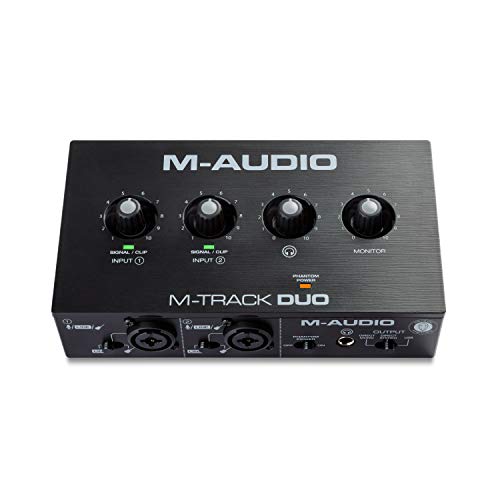
The M-Track Duo offers dual combo XLR/Line inputs with 48kHz recording, making it a versatile option for streaming, podcasts, and music. It supports zero-latency monitoring via a USB/Direct switch and provides separate headphone and line outputs for flexible monitoring setups. This interface is a practical choice for creators who need reliable performance with two high-quality inputs.
- Best for: Podcasters and musicians who want reliable two-channel recording with easy monitoring.
- Why selected: Versatile input combo, solid monitoring options, and a user-friendly software suite.
- Limitation: 48kHz recording limit may be a constraint for some high-resolution projects.
MAONO PS22 Lite USB Audio Interface

The MAONO PS22 Lite is geared toward recording enthusiasts and streamers who want 24-bit/192kHz resolution and a clear dynamic range. It supports XLR inputs, phantom power, and a dedicated instrument input, making it suitable for guitar-centric performances and podcasting. It aims to deliver a warm, natural sound with straightforward controls.
- Best for: Beginners or hobbyists seeking high-resolution recording with simple setup.
- Why selected: Strong digital specs in a compact form factor and compatibility with a range of microphones.
- Limitation: The feature set is comparatively basic next to premium two-channel interfaces.
Buying Guide: How to Choose the Right USB Audio Interface
What matters most for your workflow?
Identify your primary use: vocals, instruments, podcasts, streaming, or a combination. If you record one person at a time, a two-input interface with a solid mic preamp might be enough. For multiple instruments or passive guitar recording, consider interfaces with instrument-specific inputs and higher headroom.
Preamp quality and conversion
A higher-quality mic preamp contributes to cleaner recordings with lower noise and better gain control. Look for interfaces offering 24-bit/192kHz conversion for greater detail and dynamic range. The “Air” or similar modes on some Focusrite models can add presence to voices and guitars without harsh EQ adjustments.
Input and monitoring options
Two-input interfaces are common for solo artists, but you may want MIDI I/O, direct monitoring, or independent headphone/line outputs for flexible monitoring. Consider whether you need XLR/Instrument combos, phantom power, or a dedicated instrument input for guitar/Bass.
Latency and software ecosystem
Low-latency monitoring is essential for real-time performance and vocal tracking. Some interfaces ship with software bundles—DAWs, plugins, or studio suites—which can influence your total value. Ensure drivers are reliable for your computer system (Windows or macOS) and that the device is compatible with your preferred DAW.
Portability and build
For mobile setups or small desks, compact designs with sturdy metal enclosures are advantageous. If you travel with your gear, consider USB-C compatibility and bus-powered operation to avoid extra power adapters.
Budget and future-proofing
Budget-friendly two-channel interfaces are great for beginners, while more capable two- or four-channel models support long-term growth. Evaluate whether you’ll eventually need MIDI I/O, more inputs, or enhanced preamps to justify a higher upfront investment.
Frequently Asked Questions
- What is the difference between USB 2.0 and USB-C interfaces?
USB-C interfaces often provide better power delivery and compatibility with newer computers, along with faster data transfer. Most modern models use USB-C or offer USB-C compatibility via adapters.
- Do I need phantom power for my microphone?
Yes, if you’re using condensers or certain dynamic mics that require external powering, phantom power is typically provided via the interface’s XLR input.
- Is latency a concern for home studios?
Latency can affect real-time monitoring. Look for interfaces with direct monitoring and low-latency drivers to reduce delay during recording and performance.
- Should I buy an interface with MIDI I/O?
If you plan to connect external synthesizers or keyboards, MIDI I/O can simplify setup and improve workflow.
- Can I use any USB audio interface with any DAW?
Most interfaces are compatible with major DAWs (DAW compatibility varies by driver). Check the driver support for your OS and DAW in the product documentation.