Best Audio Mixer for Podcasting: Top Picks for 2026
Answering the search intent of podcasters, streamers, and content creators who want professional-sounding audio, these mixers are selected for reliability, ease of use, and compatibility with common podcast setups. This guide highlights five options that cover individual mic control, USB/XLR interfaces, noise handling, and live monitoring. Best-for profiles: solo podcasters, interview setups, gaming/streaming voices, and small studios seeking plug‑and‑play solutions.
Summary table of chosen products:
| Product | Best For | Key Benefit |
|---|---|---|
| FIFINE Gaming Audio Mixer SC3 | Solo podcasters and streamers | Independent channel control with 48V phantom power |
| tenlamp Podcast Microphone Bundle (P15) | All-in-one starter kits | Built-in noise reduction for clean vocal capture |
| Focusrite Scarlett Solo 3rd Gen | Professional-sounding home studios | High‑quality mic pre-amps and 24‑bit/192 kHz conversion |
| RØDE RØDECaster Pro II | All-in-one production for multi-person podcasts | Four combo inputs and robust on‑device features |
| FIFINE SC8 Gaming Mixer | Multimedia creators and gamers | Voice effects, 7.1 immersion, and USB connectivity |
FIFINE Gaming Audio Mixer SC3

The FIFINE SC3 focuses on independent channel control for a single microphone, with a built-in 48V phantom power option to support condenser mics. It is best for solo podcasters or streamers who need straightforward, real-time volume adjustments and mute/monitor controls without relying on software. A limitation is that it does not support USB microphones, which matters for non-XLR setups.
- Best for: Solo creators who want direct mic control and minimal setup.
- Why selected: Clear, tactile fader control and reliable phantom power support.
- Limitation: Not compatible with USB mics; requires an XLR mic.
tenlamp Podcast Microphone Bundle with Live Sound Board
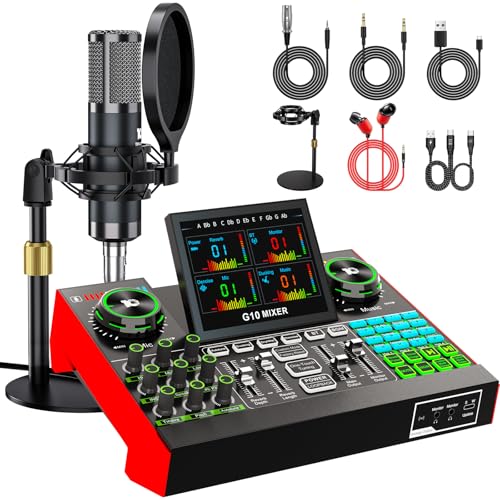
This all-in-one bundle includes a condenser microphone, mixer, and essential accessories designed for creators starting a podcast or live stream. The built-in noise reduction aims to deliver cleaner vocal recordings and is suitable for streaming, podcasting, voice recording, and general content creation. Best for beginners who want a ready‑to‑go kit.
- Best for: New podcasters who want a complete start-to-finish setup.
- Why selected: Integrated microphone, mixer, and essentials reduce extra purchases.
- Limitation: Fewer advanced mixing controls discussed beyond noise reduction.
Focusrite Scarlett Solo 3rd Gen

The Scarlett Solo 3rd Gen offers pro pre-amps and improved converters, making it a strong choice for podcasters who want studio-grade sound. With an instrument input and high-headroom mic pre-amp, it supports vocal and instrument recording with minimal clipping risk. It is best for solo or small-duo podcasts seeking high fidelity and simple USB connectivity.
- Best for: Podcasters who want high-quality pre-amps and simple USB output.
- Why selected: Classic, reliable sound quality with modern 24-bit/192 kHz conversion.
- Limitation: Lacks built-in media controls; requires external software for complex routing.
RØDE RØDECaster Pro II

The RØDECaster Pro II is an all-in-one production solution with four combo inputs, built-in high‑gain preamps, and integrated connectivity for computers, smartphones, tablets, and more. It supports multi-person podcasts, streaming, and music production, and includes on-device features to simplify workflows. Best for: multi-guest podcasts and creators who want a self-contained studio. Caution: its breadth of features can require a learning curve for first-time users.
- Best for: Multi-guest podcasts and all-in-one production needs.
- Why selected: Rich I/O options with easy live control and built-in processing.
- Limitation: Higher complexity may require more time to master.
Fifine Gaming Mixer SC8

The FIFINE SC8 focuses on streaming and gaming with voice effects, a dedicated game/chat balance knob, and 7.1 surround options. It’s best for creators who want on‑device voice shaping and easy PC/console compatibility. A potential limitation is that the built‑in effects are most effective for voice modulation rather than purely neutral podcast recording.
- Best for: Creators who want built-in voice effects and cross‑platform control.
- Why selected: Dedicated game/chat balance for clear team comms during streams.
- Limitation: Effects may be less desirable for listeners seeking a natural vocal sound.
Buying Guide: What to Consider When Choosing an Audio Mixer For Podcasting
Key questions to guide your choice:
- What type of mic will you use? If you rely on XLR mics, ensure phantom power and pre-amp quality meet your needs. USB mics simplify setup but limit interface options.
- How many simultaneous inputs do you need? Solo podcasts may get by with one or two channels, while multi-person shows benefit from four or more inputs.
- Do you need built-in processing or plug-and-play simplicity? All-in-one solutions save time, but dedicated interfaces can offer higher fidelity and broader future compatibility.
- Is monitoring essential? Real-time monitoring helps you balance levels, reduce feedback, and avoid latency issues during live recording.
- What is your setup environment? Noise reduction, EQ, and filtering capabilities help in noisy spaces and with varied recording conditions.
FAQ
- What is the difference between an audio mixer and an audio interface? An audio mixer adjusts multiple audio sources in real time and may include built-in effects, while an audio interface primarily routes audio to and from a computer with mic pre-amps.
- Do I need phantom power for podcasting? If you use condensers or certain high-sensitivity mics, phantom power is important. Dynamic mics typically do not require it.
- Is USB connectivity important for podcasting? USB is convenient for direct computer connections and simplifies setup, especially for beginners.
- Can I use a mixer with gaming consoles? Some mixers offer cross‑platform inputs and Bluetooth or optical connections; check the product’s inputs and outputs.
- Should I buy a bundle or individual components? Bundles simplify setup and can be cost-effective for beginners; individual components offer more customization for growing studios.
- What’s a good upgrade path? Start with a solid USB interface or mixer, then consider adding a dedicated microphone, acoustic treatment, and a separate monitor or headphones for accurate monitoring.