Best 2 Inch Full Range Speaker for DIY Audio Projects
The top choice for a compact 2-inch full-range speaker depends on your intended use, power needs, and installation space. This guide highlights five suitable options, focusing on compact size, simple integration, and reliable performance for DIY audio, Arduino projects, home theater tweaks, and small speaker builds. Each product section explains who it’s best for, why it was selected, and any notable limitations to consider.
| Product | Brand | Impedance | Rated Power |
|---|---|---|---|
| ACEIRMC 2inch 4Ohm 10W Full Range Speaker | ACEIRMC | 4 Ohm | 10 W |
| DWEII 6Pcs 2″ 4Ohm 3W Full Range Speaker | DWEII | 4 Ohm | 3 W |
| Gikfun 2″ 4Ohm 3W Full Range Speaker EK1725 | Gikfun | 4 Ohm | 3 W |
| Gikfun 2″ 4Ohm 5W Full Range Speaker EK1949 | Gikfun | 4 Ohm | 5 W |
| Shutao 2Pcs 2 Inch 10W Full Range Speaker | Shutao | 4 Ohm | 10 W |
ACEIRMC 2Inch 4Ohm 10W Full Range Speaker
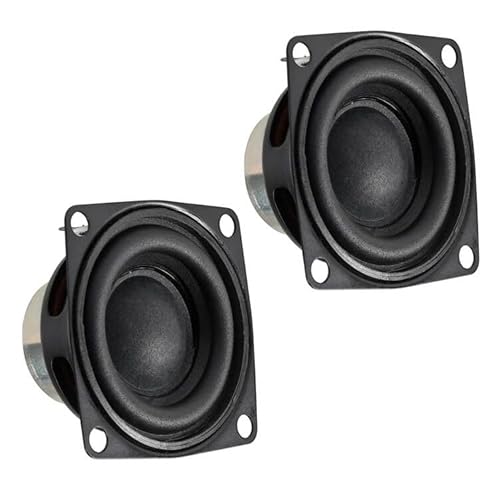
Best for compact DIY audio projects where a simple plug-and-play 2-inch speaker is required. This ACEIRMC model provides a 4-ohm impedance and a 10-watt rating, making it suitable for small HiFi setups, educational kits, or Arduino-based audio experiments. It performs well in compact enclosures and can drive simple sound reinforcement tasks in hobby projects.
Who it’s best for: hobbyists building compact audio devices, students prototyping sound projects, and ARDUINO enthusiasts seeking a straightforward 2-inch driver.
Why selected: combines a low-profile form factor with adequate power for small speakers, easy wiring, and broad compatibility with small audio circuits.
Limitations: its 10 W rating is peak-like for short bursts; long listening at higher levels may require careful enclosure and power considerations. Some users may want slightly higher sensitivity for room-filling sound.
DWEII 6Pcs 2″ 4Ohm 3W Full Range Speaker

Best for bulk projects or multi-channel DIY audio builds. The set includes six 2″ drivers rated at 3 W each with 4-ohm impedance. Its compact design is suitable for small speaker arrays, Arduino-based sound systems, or budget-conscious kits requiring multiple identical drivers.
Who it’s best for: makers creating compact speaker arrays, classroom experiments, or budget-friendly audio prototypes.
Why selected: high quantity option enables easy multi-driver configurations without sourcing individually. It suits small applications where multiple channels are advantageous.
Limitations: each driver has modest power, so use modest amplification and appropriate enclosure design to avoid distortion or overheating at higher volumes.
Gikfun 2″ EK1725 4Ohm 3W (Pack of 2)

Best for small DIY projects requiring a pair of reliable 2″ drivers. The EK1725 pack offers two 4-ohm, 3-watt speakers with notable versatility for home audio-visual setups, radio replacements, or hobbyist soldering tasks. They are particularly suitable for compact enclosures and simple sound projects.
Who it’s best for: makers who want a ready-made pair for dual-channel builds or replacement in compact devices.
Why selected: a balanced combination of size, impedance, and power for straightforward integration into small systems.
Limitations: lower power output means they are best used with modest amplification and not intended for large rooms or high sound pressure needs.
Gikfun 2″ EK1949 4Ohm 5W (Pack of 2)

Best for higher-output small-room applications or compact hi-fi builds needing a touch more voice coil power. The EK1949 pack provides 5 W per speaker and 4-ohm impedance, supporting clearer highs and more dynamic response in tiny enclosures or portable devices.
Who it’s best for: hobbyists who want a slightly stronger 2″ driver for better midrange presence in a compact system.
Why selected: higher power rating in a compact form factor translates to better headroom without enlarging the enclosure.
Limitations: as with other small drivers, deeper bass is limited by cone size; pairing with a tuned enclosure helps maximize performance.
Shutao 2Pcs 2″ 10W Full Range Speaker

Best for compact applications that need more power than typical 3–5 W drivers. These 2″ drivers deliver up to 10 W and maintain a 4-ohm impedance, making them suitable for small multimedia systems, DIY soundbars, or compact repair projects where more output is desired.
Who it’s best for: builders seeking higher headroom in a small footprint, such as mobile audio projects or mini sound modules.
Why selected: higher wattage in a small form factor provides a clearer, louder sound before distortion, given appropriate enclosure design.
Limitations: larger watts can require careful thermal and enclosure considerations to avoid overheating in continuous use.
Buying Guide
What to consider when choosing a 2-inch full-range speaker
- Impedance and amplifier compatibility: most 2″ drivers are 4 ohms. Match with your amplifier’s channel load to avoid strain.
- Power handling: higher wattage offers more headroom. Ensure enclosure and wiring can handle the chosen driver’s output.
- Frequency range and sensitivity: small drivers excel in mid-to-high frequencies; look for models with decent sensitivity (dB) for better perceived loudness in small rooms.
- enclosure type and size: the enclosure shape and volume affect bass response and overall sound quality. Smaller enclosures with proper tuning still deliver usable bass for compact builds.
- Use case and pairing: for Arduino or hobby kits, prefer drivers with simple wiring and stable impedance. For multimedia projects, consider pairs or multiple drivers for stereo or multi-channel setups.
FAQ
- Q: Are 2-inch drivers suitable for music listening in a living room? A: They can be, in compact DIY speakers or soundbars, but expect limited bass and volume compared to larger drivers.
- Q: Do these drivers require a large enclosure? A: Not necessarily, but enclosure design significantly influences bass response in 2″ drivers.
- Q: Can I mix different 2″ drivers in the same enclosure? A: It’s possible with careful crossover design, but matching impedance and power is important for balanced sound.
- Q: What’s the best driver for Arduino projects? A: Drivers with easy wiring, stable impedance, and moderate power—like the EK1725 or EK1949 packs—are convenient.
- Q: Should I choose multiple 2″ drivers for more output? A: Yes, for stereo or multi-driver arrays; ensure the amplifier can drive multiple loads without risk.
- Q: How do I avoid distortion at higher volumes? A: Use an enclosure tuned for the driver, minimize distortion-prone wiring, and respect the driver’s power rating.