Best 5-Inch Studio Monitors for Home Studios: Clear Sound, Wide Imaging, Essential Pick
Answering the need for accurate, near-field listening, these 5-inch studio monitors are well suited for small home studios, desktop music production, and multimedia editing. Each product below targets different buyers—ranging from budget-conscious creatives to those seeking DSP control and Bluetooth convenience. The table summarizes key strengths to help you compare at a glance.
| Product | Best For | Key Strength |
|---|---|---|
| PreSonus Eris 5BT | Music producers and multimedia listeners seeking wireless convenience | Bluetooth streaming with solid 100W class AB power |
| PreSonus Eris E5 | DIY engineers needing accurate midrange and clear highs | 5.25” woofer with balanced high end |
| JBL 305P MkII | Room setups needing wide sweet spot and precise imaging | Image Control Waveguide for wide listening area |
| Ortizan C7 | Multimedia users who want flexible inputs and wireless capability | BT 5.3 plus multiple wired inputs |
| KRK RP5G5 | Producers prioritizing lower distortion and imaging | Low Diffraction Baffle for tighter stereo |
Note: This guide uses objective, specification-based comparisons. For each product, you’ll find who it’s best for, why it stands out, and a practical limitation to consider before you buy.
PreSonus Eris 5BT Bluetooth Studio Monitors

Best for: Small home studios that benefit from wireless connectivity without sacrificing accuracy. The Eris 5BT delivers studio-quality, accurate sound for music production, hi-fi listening, and multimedia use. Its 100 watts of Class AB amplification (50W per speaker) maintain tonal balance and clarity at practical desk levels. The woven-composite woofer and reinforced cabinet design help deliver a tight low end you can feel, without muddying the mids or highs.
Why selected: The combination of accurate monitoring with Bluetooth streaming makes it a versatile choice for producers who need a compact, all-in-one monitoring solution. The 5BT’s expressive bass response ensures you can trust low-end translation when mixing bass-heavy tracks.
Limitation: Bluetooth adds latency and potential compression; for critical mixing, wired playback is still recommended.
PreSonus Eris E5 Pair 2-Way 5.25” Monitors
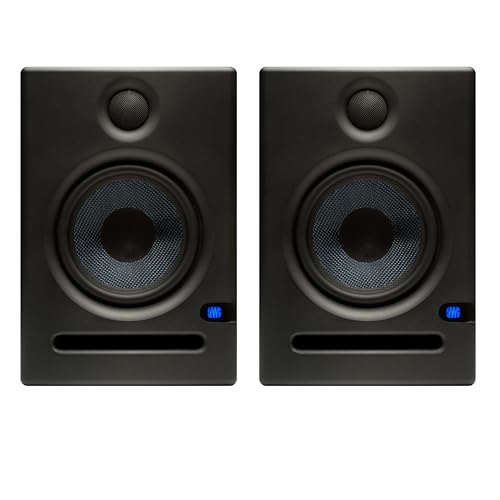
Best for: Track-focused producers who want a cost-effective upgrade that translates well on various systems. The 5.25-inch woven composite woofer delivers solid low-end with minimal bass distortion, and a 1-inch ultra-low-mass silk-dome tweeter helps keep high frequencies smooth and balanced.
Why selected: Clear, reliable monitoring with a straightforward, no-nonsense feature set that suits home studios and small project rooms looking for accurate translation across genres.
Limitation: May lack the DSP options or Bluetooth features found on some competitors; wired use is recommended for critical sessions.
JBL 305P MkII 5″ Monitors

Best for: Producers seeking a wide listening area with accurate imaging for collaborative sessions or room sharing. The 305P MkII uses JBL’s patented Image Control Waveguide to deliver a precise soundstage and a wide sweet spot, which helps during stereo mixing and podcasting.
Why selected: Dual 41-watt Class-D amplifiers deliver dynamic range and a solid low end with the 5-inch woofer and Slip Stream port, making it a strong all-around performer for near-field setups.
Limitation: The imaging benefits are best realized in a well-treated room; untreated spaces may exaggerate room reflections.
Ortizan C7 Dual-Mode 2.0 Studio Monitors

Best for: Multimedia enthusiasts who value flexible connectivity and wireless streaming with ease. The Ortizan C7 combines BT 5.3 wireless pairing with multiple wired inputs, including RCA and 3.5 mm AUX, enabling quick setup across devices.
Why selected: The built-in 24-bit DAC and the 3.5-inch carbon fiber woofer with a silk-dome tweeter provide clear midrange and smooth highs, suitable for video editing, gaming, and casual music listening.
Limitation: Because it emphasizes versatility, it may not deliver the same level of studio precision found in dedicated monitor lines as you move toward critical mixing tasks.
KRK RP5G5 ROKIT 5″ Monitors

Best for: Producers prioritizing clarity, reliable imaging, and minimal distortion in compact rooms. The RP5G5 uses custom-designed Class D power amplifiers and a new 1-inch silk dome tweeter for improved high-mid and high-frequency performance, plus a low-diffraction baffle to enhance stereo imaging.
Why selected: The design targets improved listening accuracy and extended high-frequency clarity, making it a practical choice for precise mix decisions in near-field applications.
Limitation: Some users find the adjustment options less intuitive without reference materials or presets; wired routing choices are favored for consistency in small rooms.
M-AUDIO BX5BT Pair 5″ Monitors
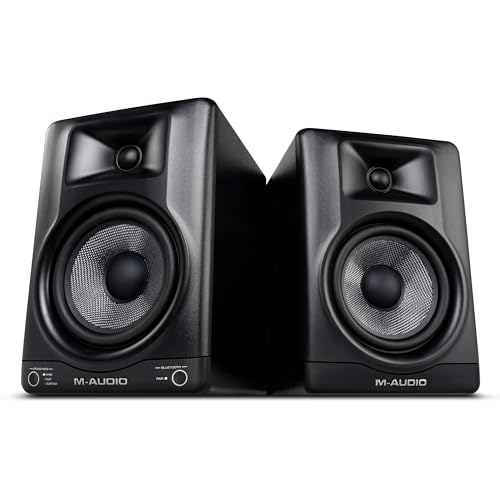
Best for: Creators who want a robust, feature-rich monitoring pair with DSP and Bluetooth. The BX5BT offers 240W bi-amplified power and built-in DSP with front-panel control, plus App-based tweaking to fit your room or workflow.
Why selected: The ability to switch between FLAT, HYPE, or CUSTOM via the front panel and the companion app helps tailor the sound for different tasks such as music production, video editing, or podcasting.
Limitation: DSP presets can be overkill for simple listening tasks; in untreated rooms, flatter settings generally translate more accurately for mixing decisions.
PreSonus Eris Studio 5 Monitors

Best for: Musicians and engineers seeking high-frequency clarity and a wide listening window. The Eris Studio 5 includes a 1-inch silk-dome tweeter and a 5.25-inch woofer with a custom-tuned EBM waveguide for a broad, accurate stereo image.
Why selected: This pair is designed to deliver natural highs and a reliable midrange, which helps with detailed mixing decisions and accurate tonal balance across genres.
Limitation: Like many near-field monitors, ideal results come from placement and room treatment; in untreated spaces, bass may require minor calibration.
Buying Guide: Key Purchase Considerations
How large is your workspace? Near-field monitors like these are designed for desks and small rooms. If you have a larger room, consider monitors with higher SPL and better room compensation.
What connectivity do you need? If you want wireless playback, models with Bluetooth (such as the Eris 5BT or BX5BT) simplify setup. For critical mixing, prioritize wired options with flat frequency response and proper input flexibility.
Do you need DSP or room tuning? Some models offer DSP crossovers and EQ presets via apps or front-panel controls. These features help tailor the sound to your room but can complicate straightforward listening.
Is translation to other systems important? Look for monitors with strong imaging and a wide sweet spot (e.g., JBL 305P MkII) to help your mixes translate to other listening environments.
Budget and upgrade path: If you plan to grow your studio, favor monitors with solid build quality and a serviceable power class that scales with your needs rather than chasing every new feature available.
Frequently Asked Questions
- What is a “5-inch” studio monitor good for?
5-inch monitors provide a balance of accurate midrange and compact form, suitable for near-field listening in small to mid-sized rooms. - Do I need Bluetooth on studio monitors?
Bluetooth adds convenience for casual listening but can introduce latency. For critical mixing, use wired connections and treat your room. - What is a good way to place near-field monitors?
Place them at ear level, equidistant from your listening position, and form an equilateral triangle with your head. Aim for a reflective-free triangle to improve imaging. - Should I choose DSP-tuned monitors?
DSP tuning helps adapt to your room and preferences, but it can obscure a flat reference if not configured carefully. Start with flat settings and adjust as needed. - Are powered monitors better than passive ones for beginners?
Powered monitors simplify setup and reduce cabinet footprint, a practical benefit for beginners or space-limited studios.