Best Graphic Equalizer Car Audio for Clearer in-Car Sound
Answering the common buyer question: which 7-band car audio graphic equalizers deliver reliable control, clean outputs, and flexible inputs? This guide highlights five strong options and explains who each is best for. Ideal buyers range from budget-conscious beginners to audiophiles seeking high-voltage outputs and precise frequency shaping. Below is a quick product snapshot table to help you compare core specs at a glance.
| Product | Band Count | Inputs/Outputs | Best For |
|---|---|---|---|
| Clarion EQS755 | 7 | Front 3.5mm Aux, Rear RCA Aux, High Level Inputs | Mid-range builds requiring solid low-pass filtering |
| Skar Audio SKA7EQ | 7 | Main & Aux RCA Inputs, High Voltage Outputs | High-fidelity, high-output systems |
| Stetsom EQX764 | 7 | 4 Inputs, 6 Outputs, 10V Line Drive | Maximum voltage for louder amplifiers and clean signal |
| CT Sounds CT-7EQ | 7 | 1/2-DIN Parametric | Precise band adjustment and car audio tuning |
| Taramp’s TEQ 7.4 | 7 | 2 Inputs, 3 Outputs, AUX/Gain | Flexible connectivity with strong tonal control |
Clarion EQS755 7-Band Car Graphic Equalizer
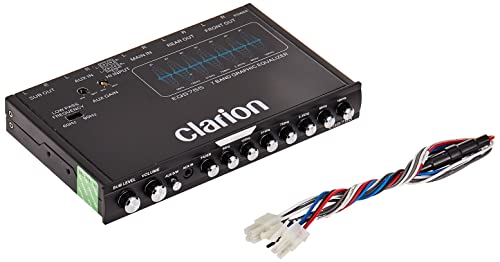
The Clarion EQS755 is a 1/2-DIN chassis graphic equalizer with a built-in low-pass filter and 6-channel/8-Volt RCA outputs (front, rear, and subwoofer). It features a 7-band graphic equalizer with centers at 50Hz, 125Hz, 315Hz, 750Hz, 2.2kHz, 6kHz, and 16kHz, plus independent master volume and subwoofer level with a fader control. A selectable 12dB low-pass filter (60Hz or 90Hz) adds to its flexibility. Best for buyers who want a compact, all-in-one processing unit with robust input options and blue illumination for visibility at night. Limitation: maximum voltage and output options are modest compared to high-end units, which may matter for very loud systems.
Skar Audio SKA7EQ 7-Band Graphic Equalizer
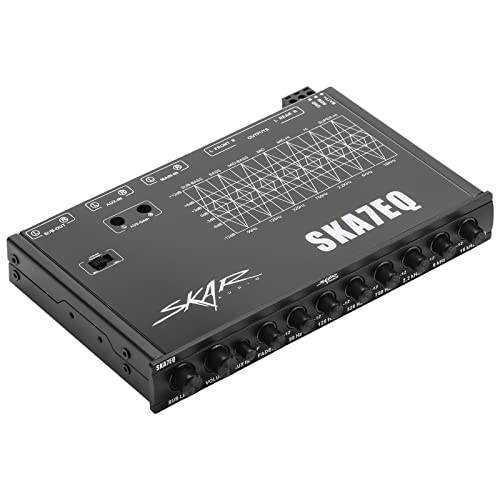
The Skar Audio SKA7EQ provides 7 bands in a 1/2 DIN form factor with high-voltage RCA outputs and a selectable 2-input system (balanced options). It emphasizes a high output voltage (up to 7V) with minimal THD (0.005%), and a dedicated subwoofer level control in front for quick adjustments. Best for enthusiasts seeking higher output to drive multiple amplifiers and tighter sub control. Caution: the unit’s performance can depend on the quality of connected amplifiers and wiring; ensure proper grounding to avoid noise.
Stetsom EQX764-7 Band Equalizer

The Stetsom EQX764-7 Band Equalizer stands out with 4 inputs and 6 outputs and a notable 10VRMS line-drive output. It covers 50Hz, 125Hz, 315Hz, 750Hz, 2.2kHz, 6kHz, and 16kHz with a 12dB cut/boost per band. Best for those who want maximum signal strength to feed multiple amplifiers while preserving signal integrity. Limitation: the higher voltage potential requires careful setup to avoid amplifier clipping or speaker damage if gain levels aren’t set properly.
CT Sounds CT-7EQ 7-Band Parametric
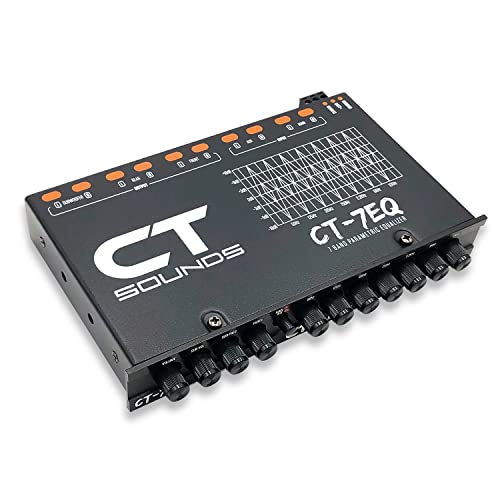
The CT-7EQ is a 7-band parametric equalizer designed to finely divide and enhance audio across 20 Hz to 20 kHz. Band centers include 50Hz, 125Hz, 315Hz, 750Hz, 2.2kHz, and 12kHz. It emphasizes precise control over each frequency, enabling targeted room- or car-acoustic adjustments. Best for buyers prioritizing detailed parametric shaping over simple fixed-band EQ. Limitation: being a parametric unit, it may require more setup and understanding of frequency ranges to unlock its full benefits.
Taramp’s TEQ 7.4 Stereo Graphic Equalizer

The Taramp’s TEQ 7.4 offers a robust 7-band graphic equalizer with 2 input channels and 3 output channels, plus AUX gain and fader control. It supports flexible integration with multiple amplifiers and emphasizes a clean, powerful signal across front, rear, and sub outputs. Best for systems needing flexible routing and straightforward gain management. Caution: ensure compatibility with your head unit’s outputs and your vehicle’s electrical system to avoid noise or interference in some setups.
Buying Guide
What should you consider when choosing a car graphic equalizer?
- Input and output options: Do you need multiple RCAs, auxiliary inputs, or high-level inputs for factory radios?
- Voltage and headroom: Higher voltage outputs can drive more amplifiers with less distortion. Consider your planned amplifier setup.
- Band design and control: Fixed-band vs. parametric. Parametric models offer finer control but require more tuning know-how.
- Physical size: 1/2-DIN or 1-DIN fits, and mounting flexibility matters for factory installations.
- Noise and grounding: Look for units with good grounding options and features to minimize ground loops and interference.
- Ease of tuning: Independent master controls, subwoofer level, and fader controls help streamline setup.
- Compatibility with your system: Consider subwoofers, amplifiers, and head units to ensure clean signal distribution and adequate headroom.
Quick comparison by scenarios
- Best for compact builds with solid low-pass filtering: Clarion EQS755
- Best for high-output, multi-amp setups: Skar Audio SKA7EQ
- Best for maximum signal strength to multiple amps: Stetsom EQX764
- Best for precise frequency shaping with parametric control: CT Sounds CT-7EQ
- Best for flexible routing and straightforward gain management: Taramp’s TEQ 7.4
Frequently Asked Questions
- What is a 7-band graphic equalizer typically used for in cars?
Answer: It lets you adjust specific frequency ranges to tailor bass, mids, and treble for your vehicle’s acoustics. - Do I need a high-voltage output from an equalizer?
Answer: Higher voltage can improve signal integrity when driving multiple amplifiers, but proper gain staging is essential to avoid distortion. - Is a parametric equalizer better than a graphic one for car audio?
Answer: Parametric units offer precise control over center frequencies and bandwidth, which is useful for fine tuning, at the cost of ease of setup. - Can I install a 1/2-DIN equalizer in most cars?
Answer: Many 1/2-DIN units fit in common aftermarket and some factory openings; check your dash space and mounting kit compatibility. - Will an equalizer improve my stock radio’s sound?
Answer: Yes, by shaping the frequency response and reducing noise, though the overall improvement depends on the rest of your audio chain.