Best 3 Way Crossover Car Audio Solutions for Clearer, Customizable Sound
Answering the search for a 3 way crossover car audio setup, this guide highlights five solid options that help separate front, rear, and subwoofer signals for cleaner, more precise sound. These crossovers are best for car audio enthusiasts building or upgrading 3-way systems, as well as installers seeking flexible tone shaping. Each product is explained with who it’s best for, potential limitations, and practical setup notes. The summary table below gives a quick snapshot to compare key points at a glance.
| Product | Best For | Key Benefit |
|---|---|---|
| Timpano TPT-360 | Budget-conscious 3-way setups | Full-featured three-way crossover with wide crossover point range |
| Clarion MCD360V | Flexible, wired remote control lovers | Six inputs/outputs and adjustable levels for front, rear, sub |
| PRV AUDIO EX3.5 | Custom tuners who want broad filter control | Three-way or two-way with extensive high/low pass options |
| Skar Audio SKEC23 | Six-channel, compact setups | Three-way design with 6 channels and 14.4V DC operation |
| Hifonics HFXR | Active crossover users with bass control | Remote bass control and flexible 2/4 channel input |
Timpano 3-Way Electronic Crossover TPT-360

The TPT-360 offers a complete three-way crossover with the option to operate as a two-way front/rear system or a full three-way configuration. It provides a wide range of crossover points among front, rear, and sub outputs. Best for enthusiasts building a compact but flexible 3-way setup, or installers needing a versatile unit. Caution: ensure compatibility with your amplifier channels and power ratings to avoid overloading outputs.
Clarion MCD360V 3-Way Crossover

This versatile unit supports two- or three-way configurations with rear fader and a wired remote subwoofer level control. It is a full-featured crossover with 6/4/2 channel RCA inputs and adjustable outputs for front, rear, and sub. Choose this if you want robust remote control and flexible setup without expanding beyond six inputs/outputs. Limitation: the feature set is compact to its listed channels, so verify your planned configuration aligns with inputs and outputs.
2 Pack 4 Ohm 3 Way Passive Crossover CRX-303

The passive CRX-303 crossovers handle 300 watts max power and use ferrite and air-cooled spools with high-grade capacitors. Best for straightforward three-way passive setups without active electronics. If your system relies on active crossovers, this option is best avoided in favor of powered or electronic crossovers, as it requires compatible speakers and ample wattage handling.
PRV AUDIO EX3.5 Stereo 3 Way/2 Way Crossover
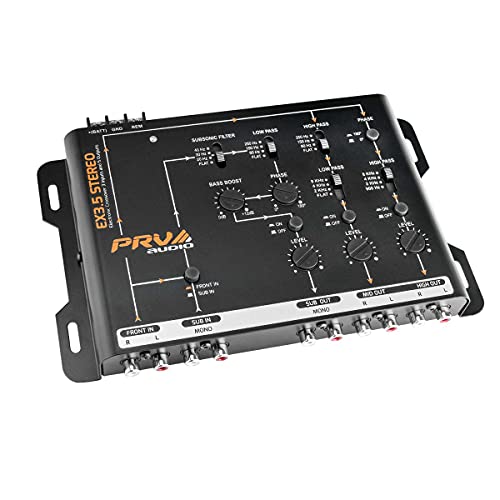
PRV EX3.5 provides a wide frequency adjustment range and flexible input/output options, supporting 2 or 3-way configurations. Best for users who want fine-tuning with adjustable high-pass and low-pass filters and a dedicated sub output with bass boost. Limitation: detailed setup benefits from careful calibration and may require additional gear for optimal performance.
Skar Audio SKEC23 3-Way Crossover

The SKEC23 is a 3-way, 6-channel electronic crossover designed for front, rear, and subwoofer pathways, operating at 14.4V with a maximum output of 5V. Best for compact builds where six channels fit the system’s footprint. Be mindful of ceiling output requirements if pushing to higher volumes.
Hifonics HFXR Active Crossover
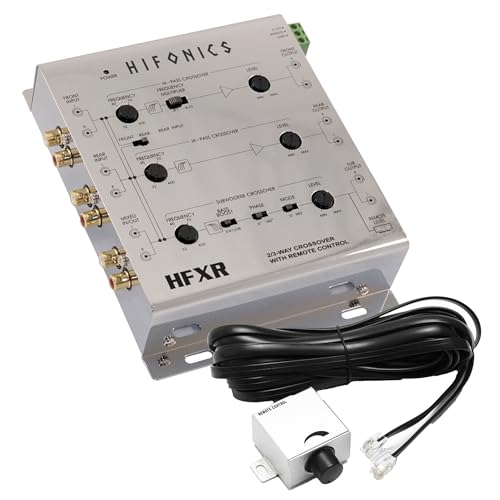
The HFXR active crossover supports both 2- and 3-way configurations with a remote bass control and a 45 Hz boost option via a quasi-parametric setup. Best for users who want an actively controlled sound with integrated bass emphasis. Limitation: remote bass control requires compatible installation depth and wiring to reach the desired listening position.
Buying Guide
What should you consider when choosing a 3-way crossover?
- System type: Active vs passive. Active crossovers require powered stages and can offer finer control, while passive crossovers are simpler but may limit tunability.
- Channel count: Ensure the unit supports your front, rear, and subwoofer channels to avoid needing adapters or adapters.
- Filter adjustments: Look for adjustable high-pass, low-pass, and slope (Q) controls to tailor the crossover points precisely to your drivers.
- Remote control: Some models provide wired or wireless remotes for sub or bass level adjustments from the seat; decide if you need this convenience.
- Power handling: Match the crossover’s outputs to your amplifier and speaker ratings to prevent distortion or damage.
- Installation footprint: Check the unit’s dimensions and mounting style to fit your dash, glovebox, or trunk installation.
Frequently Asked Questions
- What is a 3-way crossover in car audio?
A 3-way crossover splits audio into three frequency bands—typically for front, rear, and subwoofer channels—to improve clarity and balance.
- Do I need an active crossover for a 3-way setup?
Not always. Passive crossovers can work for simple systems, but active crossovers offer more precise control and power handling when paired with separate amplifiers.
- What should I look for in a 3-way crossover?
Key factors include channel count, adjustable high-pass and low-pass filters, frequency range, and whether remote control is supported.
- Can I install a 3-way crossover myself?
Yes, if you are comfortable with car audio wiring and have access to the amplifier channels and speaker outputs required by the unit.
- What is the advantage of a mono/subwoofer output on a crossover?
A dedicated sub output often includes bass boost or dedicated level control, enabling focused bass management separate from the other channels.
- Are passive crossovers compatible with all drivers?
No. Ensure the crossover’s impedance, power rating, and crossover points suit your tweeters, midrange, and subwoofers.