Best Clip on Guitar Tuner: Precise, Portable Tuning for Any String Instrument
When you need fast, reliable tuning on stage, in the studio, or at home, a clip-on guitar tuner is the smart choice. This guide highlights top options suited for guitarists, bass players, ukulele players, and violinists who value quick reads, vibration-based accuracy, and easy visibility in varied environments. The featured products cover a range of budgets, screens, and mounting styles to help you pick the right one for your setup.
| Product | Best For | Why It Stands Out |
|---|---|---|
| Fender FCT-2 | Pro players needing cross-instrument versatility | Vibration sensing with color LCD needle for fast, intuitive tuning across multiple instruments |
| SNARK SN5X | Guitarists and violin players seeking a compact, 360° viewing option | Rotates 360° for easy viewing from any angle; reliable clip design |
| Sound harbor Clip-On (1 Pack) | Budget-conscious players handling noisy environments | Vibration sensing, 360° rotatable screen, multi-instrument compatibility |
| D’Addario Eclipse PW-CT-17BK | Players who want strong visibility and adjustable calibration | Large screen with adjustable viewing angles; wide calibration range |
| D’Addario Eclipse Rechargeable PW-CT-27 | Guitarists seeking rechargeable convenience | Rechargeable with long battery life and accurate tuning |
Fender FCT-2 Professional Multi-Instrument Clip-On Tuner

- Best for: Musicians who switch between guitar, bass, ukulele, and violin and need one device.
- Why selected: It senses vibrations directly from the instrument for stable tuning across environments, with a color LCD needle display showing tuning progress at a glance.
- Limitation: Some users may prefer a larger display in very bright outdoor settings.
SNARK SN5X Clip-On Tuner for Guitar, Bass & Violin

- Best for: Players who need a compact, easy-to-read tuner with flexible viewing.
- Why selected: The “Stay Put” clip and 360-degree display rotation suit both left- and right-handed players on varied stages.
- Limitation: May have a smaller screen footprint compared to larger-display models.
Sound harbor 1 Pack Clip-On Tuner

- Best for: Budget buyers who still want solid vibration-based tuning across multiple instruments.
- Why selected: Quick and accurate tuning from instrument vibrations, plus a 360° rotatable screen for flexible viewing.
- Limitation: Feature set is basic compared with higher-end models; no rechargeable option built-in.
D’Addario Eclipse PW-CT-17BK Headstock Tuner
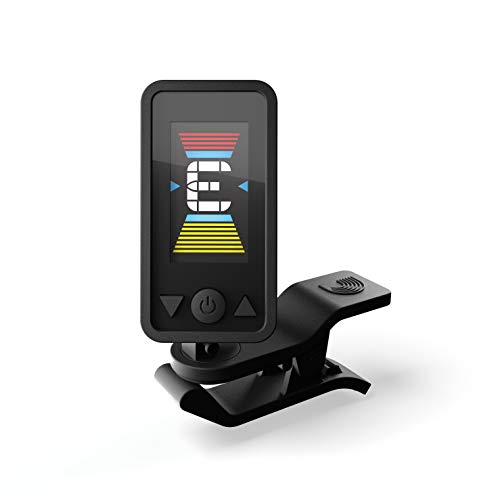
- Best for: Players who value strong visibility and precise calibration options.
- Why selected: Large vertical color display and dual swivels for optimal viewing angles on any headstock.
- Limitation: Calibration range is distinct but may require familiarity to maximize accuracy in unusual tunings.
D’Addario Eclipse Rechargeable PW-CT-27 Tuner

- Best for: Players who want long tuning sessions without replacing batteries.
- Why selected: Rechargeable with up to 24 hours of tuning per charge and a wide calibration range for precise performance.
- Limitation: Rechargeability adds a small upfront cost and requires USB charging access.
D’Addario Guitar Tuner – Micro Headstock

- Best for: Players seeking stealth tuning with a discrete presence on the headstock.
- Why selected: Extremely compact, tri-color backlit display, and the ability to stay mounted during play.
- Limitation: Very small footprint may be harder to read for some users in bright environments.
D’Addario Micro Clip-On Tuner (Non-Rechargeable)
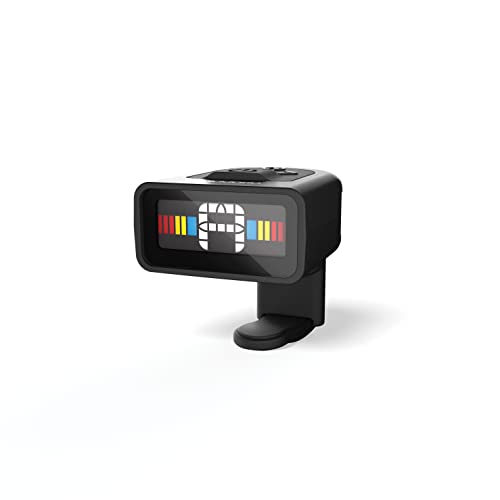
- Best for: Players who want a compact, invisible tuner behind the headstock.
- Why selected: Very small, stealthy design with an easy, tri-color screen indicating tuning status.
- Limitation: Some users may prefer a larger display for easier quick reads on stage.
Buying Guide
What should you consider when choosing a clip-on tuner?
- Accuracy and sensing method: Most tuners rely on vibration sensing to avoid picking up ambient noise. If you perform in loud venues or if you play bass or cello, vibration-based tuning is typically more reliable than microphone-based options.
- Display and readability: Large, color-contrasted screens improve readability under stage lights. A rotatable or 360° display helps right- or left-handed players and reduces neck strain from awkward viewing angles.
- Calibration range: A wider calibration range (e.g., 410–480 Hz) accommodates alternate tunings and non-standard instruments. Ensure you can adjust calibration if needed.
- Power options: Rechargeable tuners save battery costs and avoid frequent battery changes. If opting for non-rechargeable models, ensure easy access to replaceable batteries.
- Instrument compatibility: If you switch between guitar, bass, ukulele, violin, and other string instruments, choose a model with dedicated multi-instrument modes or fast switching.
- Size and discreetness: Some players prefer a compact, stealthy unit that stays out of sight; others want a larger display for quick reads during performances.
FAQ
What is the main advantage of a clip-on tuner?
Clip-on tuners sense vibrations from the instrument, offering stable tuning in noisy environments and requiring minimal setup.
Do clip-on tuners work for both guitars and violins?
Yes. Many models include modes for guitar, bass, ukulele, violin, and chromatic tuning to cover multiple instruments.
Are rechargeable clip-on tuners worth it?
Rechargeable tuners offer long tuning times per charge and reduce ongoing battery costs, making them convenient for practice and performances.
Can I tune without looking at the screen?
Some tuners provide a strong visual cue, including color-coded indicators or vibrating feedback, but a readable screen is typically best for precise tuning at a glance.
How should I attach a clip-on tuner to my headstock?
Clip-on tuners use a secure clamp designed to grip without scratching. Position the screen for easy viewing while playing, and avoid over-tightening the clamp.
Is it better to tune with a tuner or by ear?
Tuners provide precise, repeatable tuning and are especially helpful for beginners, players with intonation concerns, and performances requiring exact pitch stability.