Best Optical to 3.5mm Adapters for TV Audio and Speakers
When you need to convert digital optical audio to a 3.5mm analog signal, these adapters are essential. This guide highlights five reliable options, clarifying who each is best for and why. It’s ideal for owners of TVs, soundbars, consoles, or PCs seeking solid, straightforward connectivity without complicated setups.
Summary table
| Product | Brand | Best For | Notes |
|---|---|---|---|
| 192KHz DAC Optical to 3.5mm Converter | Tackston | TV sound out to speakers/headphones | Optical to 3.5mm, up to 192kHz, simple unidirectional design |
| PROZOR 192KHz Digital to Analog Audio Converter (Aluminum) | PROZOR | Clean, high-res digital-to-analog for home cinema | DAC with dual RCA and 3.5mm outputs |
| LiNKFOR 3.5mm to SPDIF Converter | LiNKFOR | Preserves audio fidelity when routing 3.5mm to optical | 3.5mm to SPDIF, PCM 2-channel output |
| PROZOR 192KHz Digital to Analog Audio Converter (SPDIF Toslink) | PROZOR | Versatile PCM output with 3.5mm | Optical to 3.5mm and RCA, PCM/LPCM support |
| PROZOR 192kHz Digital to Analog Converter – Toslink | PROZOR | Upgraded DAC for clear sound | Built-in amplifier, broad device compatibility |
192KHz DAC Optical to 3.5mm Converter

Best for: TV sound out to speakers or headphones when you need a simple, one-way optical-to-analog conversion. This Tackston option translates optical input to a female 3.5mm output with a high sampling rate up to 192kHz/24-bit, ensuring clear, detailed audio. Caution: TV remote volume control may not affect playback volume during use; adjust volume on the playback device.
PROZOR 192KHz Digital to Analog Audio Converter

Best for: Home theater or gaming setups needing high-resolution PCM output. This model outputs to L/R RCA and 3.5mm simultaneously and supports 32–192kHz sampling at 24-bit. It includes guidance to configure TV audio to PCM and to manage volume via connected devices. Caution: Ensure the TV’s audio format is PCM to avoid distortion.
LiNKFOR 3.5mm to SPDIF Converter

Best for: Users who want to convert 3.5mm analog output to digital SPDIF optical for pristine, uncompressed 2-channel PCM audio. It supports 48kHz and is designed to preserve fidelity. Limitation: Not a full digital-to-analog converter; it outputs digital from analog input, not vice versa.
PROZOR 192kHz Digital to Analog Converter (Toslink)

Best for: Users who want a robust SPDIF Toslink to 3.5mm experience with a dedicated DAC and built-in amplifier. It supports PCM/LPCM and 192kHz sampling and is designed for HD TVs and Blu-ray players. Caution: Optical output is not supported in all configurations; confirm supported outputs before use.
PROZOR 192KHz Digital to Analog Audio Converter (Aluminum)
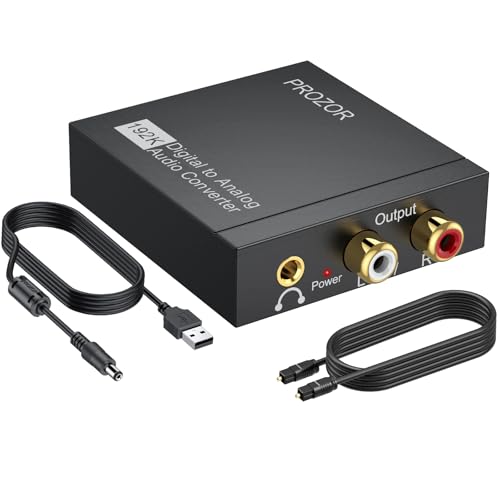
Best for: Users seeking an upgrade-friendly DAC with a compact built-in amplifier and broad device compatibility. It outputs to L/R RCA and 3.5mm and supports up to 192kHz/24-bit PCM. Caution: Some setups require adjusting TV volume via settings or connected devices to avoid distortion.
Buying Guide: Key Purchase Considerations
- Signal direction: Ensure the device converts from digital optical (SPDIF/TOSLINK) to analog (3.5mm/RCA) unless you specifically need the reverse. Some models are directional and will not work in the opposite direction.
- Output options: Look for DACs that offer both 3.5mm and RCA outputs if you plan to connect multiple devices, such as speakers and headphones, at once.
- Sampling rate and bit depth: For clearer, more detailed sound, choose adapters supporting up to 192kHz/24-bit. Real-world gains depend on your source and playback equipment.
- TV compatibility: Some units require PCM output from the TV. Check if your TV’s audio format needs adjustment to PCM/LPCM to avoid distortion.
- Volume control: Many optical-to-analog adapters do not respond to TV remote volume adjustments. Plan to adjust volume on the playback device or through the receiver.
- Build and heat: Aluminum enclosures often indicate sturdier construction and better heat dissipation for longer use in home cinema setups.
- Ease of setup: Prefer models with clear labeling for input/output and straightforward cabling to minimize setup time and confusion.
Frequently Asked Questions
- What is an optical to 3.5mm converter used for?
It transforms digital optical audio into an analog 3.5mm signal so you can drive speakers or headphones from devices without a 3.5mm output. - Will these adapters work with all TVs?
Most work with TVs that provide an optical/SPDIF output; however, check that the TV settings support PCM or LPCM outputs and that the device is directional (digital to analog). - Do I need a separate DAC for high-end audio?
A dedicated DAC can improve clarity and reduce distortion when compared to basic adapters, especially at 192kHz/24-bit. - Can I use 3.5mm to optical in both directions?
Some devices support 3.5mm input to optical output, but many adapters in this category only convert optical to analog. Verify direction before purchase. - What is PCM vs. LPCM?
PCM (Pulse Code Modulation) and LPCM are digital audio formats; LPCM is a type of PCM used in multichannel contexts. Ensure your source outputs PCM/LPCM for best compatibility. - Do these adapters include volume control?
Most do not respond to TV remote volume; you’ll typically adjust volume on the connected speakers, headphones, or receiver.