Best 1000 Watt Car Amplifiers for Serious Bass in 2026
If you’re searching for a true 1,000-watt car amplifier to drive a subwoofer or a high-output system, you’ve found a practical starting point. This guide compares five top models, highlighting who each amp is best for, why it was selected, and any limitations to consider. Ideal buyers include weekend car enthusiasts chasing strong bass, installers needing space-saving designs, and those seeking reliable, high-output Class D power without excessive heat. A quick summary table below helps you compare core specs at a glance.
| Product | Power (RMS/Bridge) | Best For | Notes |
|---|---|---|---|
| CT Sounds CT-1000.1D | 1000W RMS @ 1Ω | Compact installs with max output | Very small footprint, efficient for its size |
| Skar Audio RP-1200.1D | 1200W RMS @ 1Ω | High-demand bass systems | 1Ω stability; on-board bass boost |
| STINGER MT-1000.1V2 | Up to 700W @ 2Ω / 400W @ 4Ω (varies by config) | Footprint-conscious, versatile setups | Compact, strapable design for multi-impedance use |
| Pioneer GM-A5702 | 240W x 2 @ 2Ω; 480W x 1 @ 2Ω (bridged) | Reliable two-channel emphasis with bridged options | Class AB efficiency with strong bridge capability |
| Crunch Ground Pounder GP-1000.2 | 1000W mono bridged @ 4Ω | Bridged mono power in a two-channel design | Versatile bridged configuration for subwoofers |
CT Sounds CT-1000.1D Compact Class D Monoblock Amplifier

The CT-1000.1D delivers 1000 watts RMS at 1 ohm, 650W RMS at 2 ohms, and 350W RMS at 4 ohms. It features a bass knob with 0–320 Hz range and a compact chassis designed for tight spaces. Best for: drivers needing maximum power from a small footprint in a single-sub setup or compact vehicles. Why selected: it combines high output with a small form factor, making installation easier while still delivering strong, clean bass. Caution: check vehicle electrical capacity to prevent voltage drop under peak demand.
Skar Audio RP-1200.1D Monoblock
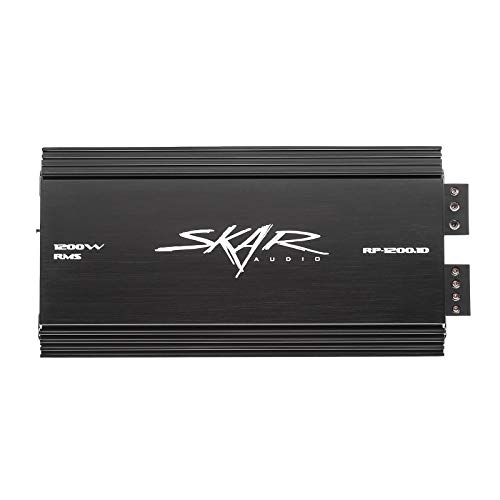
The RP-1200.1D is a Class D MOSFET monoblock delivering 1,200W RMS at 1Ω. It offers a wide frequency response (20 Hz to 250 Hz) and an On-board Bass EQ switch with either +6 or +12 dB boost at 45 Hz. Best for: serious bass fans who want aggressive subwoofer control and the ability to tailor low-frequency response. Why selected: high RMS power at 1Ω supports louder, cleaner bass. Caution: ensure your subwoofer and electrical system can handle the 1Ω load to avoid overheating or instability.
BOSS Audio Systems R1100M Monoblock

The R1100M is a 1100W mono amplifier designed for 2Ω stability and includes a MOSFET power supply, a low-pass filter, bass boost, and remote subwoofer control. Best for: installations needing robust bridge-compatible channels with easy remote tuning. Why selected: strong raw power with practical features for tuning and protection. Caution: as a Class A/B design, efficiency may be lower than a pure Class D option in long listening sessions.
STINGER MT-1000.1V2 Mono Block

The MT-1000.1V2 provides a compact digital Class D monoblock output with up to 700W @ 2Ω, 400W @ 4Ω, and 1800W @ 2Ω minimum bridged, delivering strong low-end without occupying cargo space. Best for: compact builds where space is at a premium and you still need substantial bass power. Why selected: excellent power density and flexible impedance options. Caution: verify that the amp’s impedance settings match your subwoofer configuration to prevent protection modes from triggering.
Pioneer GM-A5702 2-Channel Amp

The GM-A5702 is a 2-channel Class AB amp rated at 240W x 2 @ 2Ω and up to 480W bridged. It’s suitable for front-channel upgrades or bridged setups that demand more power per speaker. Best for: listeners seeking reliable, high-output amplification with straightforward bridging. Why selected: a well-known brand with robust performance in a compact, efficient package. Caution: Class AB design can be less efficient than Class D in draw and heat over long periods; consider ventilation needs.
Buying Guide
What should you look for in a 1000W+ amplifier?
Key factors include affordable power at low impedances, compatibility with your subwoofers or speakers, and the overall efficiency of the design. Class D models typically run cooler and deliver more watts per watt of electrical input, making them ideal for tight spaces. Bridgeability, impedance stability, and built-in features such as bass boost controls, remote bass knobs, and protection circuits help ensure reliable long-term use.
Which power rating matters most?
RMS power at a given impedance determines real-world loudness and reliability. A 1,000W RMS amp at 1Ω will hit harder than a similar-rated amp at 4Ω. If you run multiple subs or want maximum headroom, focus on higher RMS values at the impedance your system uses.
What about efficiency and heat management?
Class D amps usually outperform Class A/B in efficiency, producing less heat for the same output. If heat buildup is a concern in your vehicle, prefer Class D designs like the CT Sounds, Skar RP, or STINGER options. Ensure your vehicle’s electrical system can handle peak loads, especially at low ohms.
How do I choose between 1Ω, 2Ω, and 4Ω loads?
Lower impedances draw more power from the amplifier and the electrical system. If your subs are rated at 1Ω, you’ll see higher RMS output but must confirm stability and cooling. If your subs are 2Ω or 4Ω, verify that the amp is rated accordingly to avoid overheating or protection shutdowns.
Installation considerations
Compact footprints help in tight installs, but you still need adequate ventilation, a solid ground, and appropriate wiring gauges. A dedicated power and ground line, fuse protection, and proper sub enclosure design complement a high-wump amplifier for best results.
FAQ
- What is RMS power and why does it matter?
RMS power reflects continuous, real-world output. It’s a better measure for comparing amps than peak power. - Is Class D always better for car audio?
Typically yes for efficiency and heat, but some installers prefer Class AB for sound character. Verify your goals and system design. - Can I run a 1000W amp with any sub?
Ensure your sub’s rated power and impedance align with the amplifier’s stable impedance and power output. - Do I need a separate bass knob?
Many amps include a bass boost or remote knob; use it to fine-tune bass response without adjusting head unit settings. - What wiring is required for these amps?
High-output amps require appropriately rated power and ground cables (often 4 AWG or thicker) and a suitable fuse close to the battery. - Is it safe to bridge two channels for subwoofers?
Bridging increases output but requires compatible impedance and a proper enclosure; follow the manufacturer’s bridging guidelines.