Best XLR to 1/4 Converter Adapters for Pro Audio
Looking for the right XLR to 1/4 inch converter? This guide highlights top options that balance signal integrity, durability, and value for different setups. Best for home studios, live sound, or on-the-go gigs, these adapters help you connect XLR devices to 1/4″ inputs or outputs with minimal noise and reliable performance. The top picks are aimed at mixers, microphones, amplifiers, and stage rigs. Below is a quick summary table of the five selected products.
| Product | Brand | Type | Best For |
|---|---|---|---|
| Togconn 1/4″ TRS Male to XLR Adapter 4 Pack | Togconn | 1/4″ TRS to XLR (Male/Female options) | Balanced connections for mixers and stage boxes |
| 1/4 to XLR Adapter 4 Pack by Seefeful | Seefeful | 1/4″ TRS to XLR (Male to Male / Male to Female) | Versatile compatibility for pro audio setups |
| Smithok 2 Pack 1/4 to XLR Cable | Smithok | XLR to 1/4″ TRS cable | All-metal build for robust stage use |
| Tisino 2 Pack 1/4″ TRS to XLR Adapter | Tisino | 1/4″ TRS to XLR Male | Studio and live performance signal integrity |
| WYMECT 1/4 TRS to XLR Female Adapter 2 Pack | WYMECT | XLR Female to 1/4″ TRS | Connecting XLR outputs to 1/4″ inputs |
Togconn 1/4″ TRS Male to XLR Adapter 4 Pack

Best for: Musicians and live sound technicians who need multiple, reliable adapters for simultaneous connections. These adapters convert 1/4″ male TRS inputs to XLR outputs and include a counterpart for XLR input compatibility. The hard metal shell and nickel-plated contacts reduce wear, noise, and EMI, making them suitable for frequent stage setup and rehearsal environments.
Why chosen: The set offers two pairs of balanced connections, practical for studio and live rigs where XLR compatibility with 1/4″ devices is necessary. The nickel-plated contacts help preserve signal integrity in cluttered wiring environments.
Caution: The pack focuses on 1/4″ to XLR male outputs; if you need XLR female compatibility, verify the correct adapter pairing for your gear.
Seefeful 1/4 to XLR Adapter 4 Pack

Best for: Professionals seeking versatile conversion between XLR and 1/4″ signals, including live sound and studio setups. Includes both male-to-male and male-to-female configurations for flexible routing.
Why chosen: Sturdy die-cast shells with zinc alloy construction and nickel plating resist wear and EMI, helping maintain signal clarity in demanding environments.
Caution: Some users may require longer term testing to assess longevity under heavy daily use; ensure proper mating with your cables to avoid loose connections.
Smithok 2 Pack 1/4 to XLR Cable

Best for: Musicians and engineers needing durable XLR-to-1/4″ cables for reliable signal transmission. The all-metal construction and shielding minimize noise and RF interference.
Why chosen: The dual-pack offers flexibility for multiple devices, with consistent performance across both mono and stereo use cases. It emphasizes durability and correct fit for professional gear.
Caution: The cable length is fixed at 11.8 inches (30 cm); longer runs may require different lengths or additional link cables.
Tisino 2 Pack 1/4″ TRS to XLR Adapter

Best for: Studio engineers and performers needing stable, all-metal adapters for consistent connections between TRS 1/4″ sources and XLR devices.
Why chosen: Balanced 1/4″ to XLR male connections with robust die-cast housing ensure dependable operation in both live and studio contexts. They are designed to minimize signal loss and noise.
Caution: Check compatibility with your specific XLR devices (some phantom-powered gear may have unique grounding considerations).
WYMECT 1/4 TRS to XLR Female Adapter 2 Pack
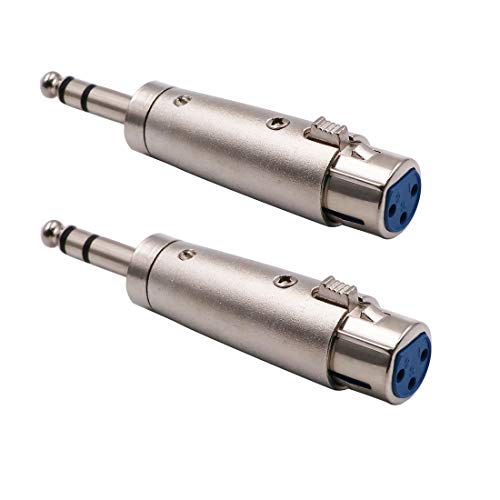
Best for: Projects where XLR outputs need to connect to 1/4″ inputs, especially when a female XLR side is preferable for coupling with existing cables.
Why chosen: All-metal construction with nickel-plated connectors fosters durability and stable connections, reducing noise and EMI in professional environments.
Caution: This pack provides XLR female to 1/4″ TRS adaptations; ensure your gear pairing aligns with the connector gender required by your chain.
Buying Guide: Key Considerations For XLR To 1/4″ Converters
Is the adapter balanced or unbalanced? Look for TRS to XLR adapters that preserve balanced signals to minimize hum and buzz in live venues or crowded studios.
What about connector durability? All-metal housings with nickel plating generally offer greater longevity in frequent unplugging, especially on stage.
Do you need male-to-male, male-to-female, or female-to-male configurations? Choose adapters that match your gear’s ports to avoid dongle clutter or mismatches.
What length and cable integration do you require? Short cables are ideal for pedalboards and racks; longer runs may require separate cables or longer adapters.
EMI and RF considerations: Protective shielding helps reduce interference when multiple devices share a single rack or stage area.
Frequently Asked Questions
- What is the difference between TRS and TS in these adapters? TRS (stereo) supports balanced signals, while TS (mono) is typically unbalanced. Use TRS on balanced paths to reduce noise.
- Are these adapters compatible with dynamic microphones? Yes, many dynamically wired devices can connect via XLR to 1/4″ adapters, but verify the input stage of the receiving device.
- Should I choose XLR male or female on the adapter? It depends on the direction you need to connect. Match the adapter gender to the corresponding cable or device port.
- Can these adapters cause signal loss? Any additional connector can introduce slight impedance changes; high-quality metal housings and good contacts minimize loss.
- Do these adapters require power? No, passive adapters do not require external power; they simply route the signal.
- When should I use a dedicated XLR cable instead of adapters? If you frequently connect XLR devices to 1/4″ inputs, a purpose-built XLR cable may offer better reliability and organization.