Best High to Low Level Converter Solutions for Car Audio
High-to-low level converters transform factory speaker signals into line-level signals suitable for external amplifiers and subwoofers. This guide helps buyers choose the right converter for different vehicle setups, from budget installs to premium audio upgrades. The top picks below are selected for reliability, versatility, and ease of installation. Best for: DIY installers, weekend tinkerers, and car audiophiles seeking cleaner signals and easier amplifier integration.
| Product | Best For | Key Benefit |
|---|---|---|
| Kicker 46KISLOC2 | OEM radios with 55 W input | Compact, high-quality sound with remote turn-on |
| Scosche LOC80 | Subwoofer and aftermarket amps | Wide compatibility, simple installation |
| NuIth Car Audio Converter | Factory or aftermarket head units | Easy RCA output conversion with gain adjust |
| DS18 V2HL.V2 | OEM integration with amp and factory features | Signal sensing and OEM-friendly output |
| PAC SNI-35 | Factory radios adding an amp | Adjustable output, noise isolation |
Kicker 46KISLOC2 K-Series Stereo Line-Output Converter

The KISLOC2 converts a factory speaker signal into both RCA outputs and a 12-volt remote wire using DC offset. It accepts up to 55 watts (16 volts) of input, making it suitable for moderate systems. Best for: installers who want a compact, sonically neutral converter with reliable remote turn-on. Caution: ensure your head unit and wiring can supply the 55 W input without distortion.
Scosche LOC80 Line Output Converter

LOC80 offers broad compatibility and easy installation for converting speaker-level signals to RCA line-level outputs, ideal for driving a subwoofer or aftermarket amp. Best for: users upgrading a variety of factory systems without major rewiring. Caution: check impedance compatibility with your factory amp to avoid low-volume or distorted output.
NuIth Car Audio Speaker Wire to RCA Converter

This 2-channel RCA output converter adds amplification by transforming speaker wire signals into low-voltage RCA outputs, with level gain adjustment to fine-tune bass. Best for: drivers who want straightforward gain control during on-road tuning. Caution: the device relies on stable factory or aftermarket wiring; check gain settings to avoid unexpected bass boosts.
DS18 V2HL.V2 High/Lo Converter

The DS18 V2HL.V2 emphasizes OEM-friendly integration with signal sensing that activates on demand and a 2-channel RCA output. Best for: vehicle owners needing seamless integration with factory features like climate control while upgrading to aftermarket amps. Caution: verify compatibility with your OEM head unit’s wiring to prevent misfiring or silence on startup.
PAC SNI-35 Variable LOC Line Out Converter

The SNI-35 offers adjustable line output and uses an audio transformer for noise isolation. Best for: modifying a factory radio to feed a dedicated amplifier while minimizing interference. Caution: the adjustable output may require precise setup to avoid under- or over-driving the amp in non-standard systems.
Scosche LOC2SL Line Output Converter with Remote
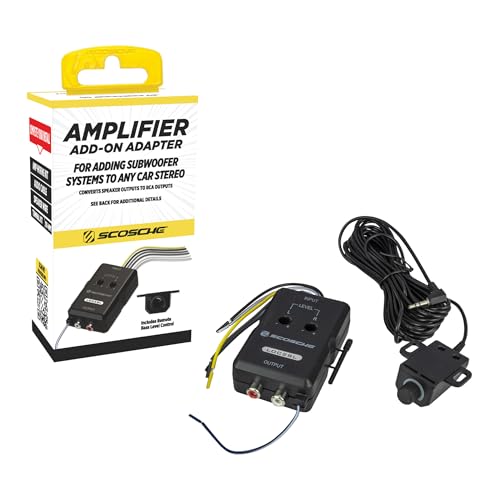
The LOC2SL includes a remote control knob for easy level adjustments and delivers high/low conversion for a two-channel setup. Best for: users needing precise, on-dash control over subwoofer levels without removing panels. Caution: ensure the remote knob’s wiring is routed safely to avoid interference with vehicle controls.
Kicker 46KISLOC K-Series Interconnect

Compatibile with OEM radios featuring short-circuit protection, the KISLOC offers up to 8 volts of output from up to 55 watts input. Best for: compact, high-quality signal transfer from factory radios to aftermarket amps. Caution: check your head unit’s protection features to ensure compatibility with the 8V outputs.
Scosche SLC4 Line Output Converter / OEM Premium Amplifier Adapter

The SLC4 is a versatile 4-channel LOC that supports converting speaker wires to RCA lines or enabling an aftermarket radio while retaining premium factory amps. Best for: complex installs requiring multiple channels or keeping factory JBL/Bose amplification intact. Caution: multi-channel wiring may demand careful routing to avoid signal bleed between channels.
Buying Guide: Key Considerations For High-To-Low Level Converters
- Input/output compatibility: Match the converter’s input wattage range to your factory head unit and the required RCA output for your amplifier.
- Number of channels: Choose based on how many amp channels you plan to drive (2-channel vs 4-channel or more).
- Signal integrity features: Look for signal sensing, remote turn-on, noise isolation, and transformer-based designs for cleaner output.
- OEM integration: If retaining factory features (climate, steering wheel controls), prioritize converters designed for OEM compatibility.
- Remote control and gain adjustment: Seek units with on-dash or integrated remote controls for easier tuning while driving.
- Installation effort: Easier installs favor compact modules with clear wiring diagrams and universal compatibility.
- Limitations: Some converters have input wattage caps or require specific impedance; verify these against your system plan.
Frequently Asked Questions
- What is a high-to-low level converter used for?
It converts speaker-level signals from a factory radio to RCA line-level signals suitable for aftermarket amplifiers or subwoofers.
- Do I need a converter if my car has a built-in amplifier?
Often yes, when adding an external amp or subwoofer, a converter helps feed a clean signal to the new amplifier.
- Can I install a converter myself?
Many installations are DIY-friendly with basic wire routing; follow the product’s wiring guide and safety precautions.
- Is more power output always better for an amplifier input?
Not necessarily; ensure the converter’s output matches the amplifier’s input range to avoid clipping or distortion.
- What should I check before buying?
Check input wattage, number of channels, noise isolation, OEM compatibility, and whether a remote turn-on is needed for your setup.
- Are some converters better for OEM integration than others?
Yes; models designed for OEM head units often preserve factory features and minimize wiring changes.