Best Digital Delay Guitar Pedals for Warm, Versatile Echo
Answering the search for a reliable digital delay, these pedals deliver clear repeats, flexible delay times, and usable analog vibes. This guide highlights five models ideal for different players: studio tones, live tones, beginners, and pedalboard-limited setups. The table below summarizes who each product suits best.
| Product | Best For |
|---|---|
| JOYO Digital Delay Guitar Pedal (JF-08) | Players seeking warm analog-like character with simple 3-knob control |
| BOSS Digital Delay DD-8 | Versatile live rigs needing many modes and a built-in looper |
| BOSS DD-3T Digital Delay | Quick, easy setups with broad delay range for diverse styles |
| JHS Pedals 3 Series Delay | Players wanting distinct digital vs. analog voicings |
| DONNER Echo Square Delay Pedal | Budget-friendly multi-mode delay with digital, analog, and more |
JOYO Digital Delay Guitar Pedal, JF-08

Best for players who want a warm, analog-voiced delay from a digital platform. JOYO equips a special filter circuit that yields a mellow character reminiscent of classic analog delays, with a range from 25ms to 600ms. The three-knob layout—Time, Repeat, and Level—keeps it simple for quick, on-the-fly tweaks during practice or gigs. It uses true bypass to preserve your signal when off, making it a strong choice for tone-conscious players.
Why choose this: the mellow, vintage-tinged filter wash helps solos and ambient tones blend without overpowering the core guitar tone. Best for players seeking a compact, affordable pedal that leans toward a warm, analog feel rather than pristine digital coldness. Caution: the 3-knob layout is straightforward but offers fewer modern modulations than some multi-mode pedals.
BOSS Digital Delay DD-8

The DD-8 is best for players building a versatile live rig or home studio with multiple delay needs. It offers eleven modes, including basic digital, vintage echoes, shimmer, modulated delays, a looper, and more. The built-in looper supports up to 40 seconds of recording time with overdub capability, and three-pedal operation works with external footswitches. This model appeals to players who want one pedal to cover many delay flavors without swapping units.
Best for: players who need a wide palette—from clean slapbacks to spacious, ambient delays—without sacrificing speed of use in performance settings. Limitation: with many modes, the interface can feel busy for beginners seeking a single, simple delay effect.
BOSS DD-3T Digital Delay

The DD-3T updates a classic industry standard with modern practicality. It provides a delay range from 12.5 to 800 ms, divided into three ranges for quick setup. This makes it a strong choice for players who want a familiar, easy-to-use interface with lots of range for staggered echoes and solos. It is particularly suited for players who value fast, intuitive control during performances or simple studio sessions.
Best for: players who want reliable, straightforward operation and broad delay times without extra modes. Limitation: lacks the deep modulation and looper features found on some newer multi-mode pedals.
JHS Pedals 3 Series Delay
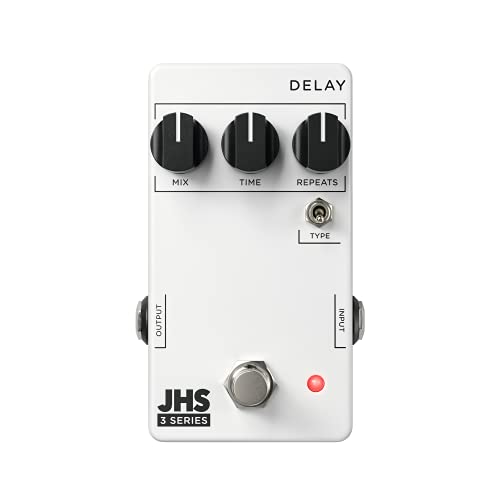
JHS Pedals positions the 3 Series Delay as a compact, high-value option with distinct voicings. It offers a range of 80 ms to 800 ms and a Type toggle that lets players switch between clearer digital-voiced delay and darker analog-voiced delay. This makes it ideal for players who want both precision and choice in tonal coloration, whether layering on stage or in a studio. Best for: those who appreciate a clear way to pick between digital clarity and analog warmth in a single compact unit.
Limitation: the compact form factor can limit extra features compared with larger multi-function delays.
DONNER Echo Square Delay Pedal
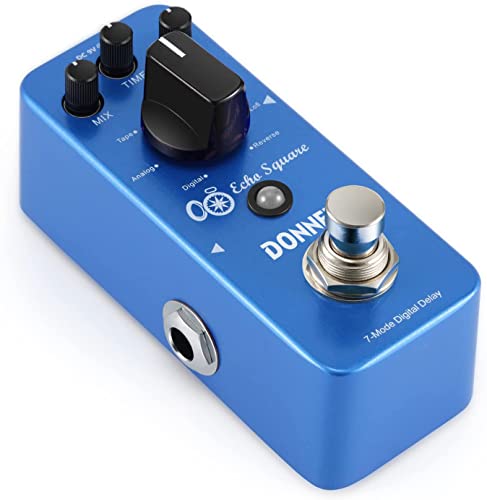
The Donner Echo Square Delay offers seven delay modes, including digital, analog, tape, mod, sweep, lofi, and reverse, making it a flexible choice for players exploring different textures. It uses three knobs—MIX, TIME, and FBACK—to dial dry/ effect balance, delay time (20 ms to 838 ms), and feedback. This pedal suits players who want big tonal variety in a budget-friendly package and live-performance-ready reliability.
Best for: players who desire a broad palette of delay textures in a single, affordable pedal. Caution: some users may outgrow its simpler control scheme when requiring advanced modulation or complex presets.
Buying Guide: Key Purchase Considerations
What should you look for when choosing a digital delay pedal? Consider delay range, tone character, modes, and control layout. If you value an instant analog warmth, prioritize pedals with filter circuits or warm-tail characteristics. For versatility on stage, seek models with multiple modes or a built-in looper. For beginners, a simple three-knob design (Time, Feedback, Level) can be easier to dial in. If pedalboard space matters, compact formats with essential features may be ideal.
How many delay modes do you need?
More modes expand sonic options but add complexity. A multi-mode pedal is beneficial for live performers who switch textures on the fly, while a single-mode unit may suit players seeking a focused, reliable echo.
Is a looper important to you?
Some delays include looping capabilities that allow layered performances. If this feature is crucial, choose pedals like the DD-8 or other models offering a substantial loop section.
How important is tone preservation when off?
True bypass helps maintain your guitar’s tone when the pedal is disengaged. This is essential for players who rely on a clean signal chain and want zero coloration when the effect is not in use.
What about build quality and footprint?
Rugged metal enclosures suit gigging players, while smaller enclosures save pedalboard space. Consider your travel and setup routine when selecting a form factor.
FAQ
- What is a digital delay with analog feel? Some digital delays use filter circuits or specific EQ paths to emulate analog warmth and saturation, giving repeats a mellower, vintage flavor.
- Do digital delays sound different on stage? Yes. Some delays include modulation or shimmer that can be more audible in a live mix, depending on amp and room acoustics.
- Is a looper necessary in a delay pedal? Not always, but it can greatly expand live performance options by allowing layering and practice loops without a separate looper unit.
- Should I prioritize more delay time or more modes? Prioritize delay time if you want long, ambient tails; prioritize modes if you want a broad palette for different songs and genres.
- Can true bypass affect tone? True bypass preserves your signal when the pedal is off, reducing high-end loss and signal coloration in many setups.
- Which pedal is best for beginners? Pedals with a simple three-knob layout and a clear signal path—such as those with Time, Repeat, and Level—are often easiest to start with.