Best Bass Amp With Line Out for Practice and Small Gigs
Whether you’re practicing quietly at home, rehearsing with a band, or streaming a live session, a bass amp with a line out offers convenient DI-like connectivity and versatile tone shaping. This guide highlights five reliable options across a range of budgets and use cases. The top picks are ideal for beginners building fundamentals, hobby players refining technique, and performers needing portable, stage-ready sound.
Who this is for:
– Beginners and students: affordable, compact amps with essential controls.
– Practicing players: built‑in headphone jacks and MP3/aux inputs for silent practice.
– Touring or gigging players: lightweight amps with punchy sound and easy transport.
– Those seeking direct-line outputs for recording or PA use: amps with robust line-out or direct options.
| Product | Best For | Key Benefit |
|---|---|---|
| GLARRY 20W Combo | Beginners, quiet practice | Headphone/mP3 aux input for silent practice |
| Fender Rumble 15 V3 | Small gigs, practice | Lightweight with solid low-end punch |
| Fender Rumble 40 V3 | Small-to-mid gigs | Overdrive option and bigger 10″ speaker |
| Vendrato 20W | Travel practice | Compact with precise 3-band EQ and MP3 input |
| Demusea 20W | Beginner learners | Full 3-band EQ, portable and durable |
| JOYO Vibe Cube BA-30 | Live streaming, practice | Bluetooth/OTG for recording and playback |
| JOYO MA-10B | Very portable practice | Small, battery- or power-powered with headphone out |
| Line 6 POD Express Bass | Recording and practice | Ultra-portable with HX-quality tones |
GLARRY 20W Portable Bass Combo Amp

Best for beginners who want an affordable, lightweight practice amp with essential tone controls and a headphone/MP3 input. This 20W combo emphasizes a flexible 5-band-like feel through gain, volume, treble, bass, and middle dials, enabling you to sculpt your core tone. Its portability (about 6.6 lb) and optional belt clip support easy transport for lessons or small practice spaces.
Who it’s best for: new players or students needing a compact, budget-friendly amp for quiet practice and basic tone shaping. Limitations: lacks built-in DI output for direct PA connection; no explicit line-out labeled port beyond headphone/aux options.
Fender Rumble 15 V3 Bass Amp

The Rumble 15 V3 is a compact yet capable practice amp with an 8″ speaker, 15W power, and a 3-band EQ. It’s ideal for players who want a portable practice option that still offers punchy lows and a simple front-panel layout. A 3-band EQ helps shape tone for practice rooms and quiet gigs.
Who it’s best for: players seeking a lightweight, reliable practice amp with a familiar Fender aesthetic. Limitations: not explicitly described as having a dedicated line-out; best used for stage- or practice-room scenarios with speaker output only.
Fender Rumble 40 V3 Bass Amp

A step up from smaller models, the Rumble 40 packs 40W in a lightweight cabinet and features a larger 10″ Fender Special Design speaker for stronger lows and articulate mids. The overdrive circuit offers hands-free tonal changes via a footswitch option, which is helpful for small to mid-size gigs.
Who it’s best for: players needing more stage-oriented headroom and basic drive capabilities without adding heavy gear. Limitation: does not specify a dedicated line-out in the features list; best for setups that rely on amplifier-sourced direct sound and stage amps.
Vendrato 20W Bass Amp

This compact amp focuses on clear, precise tone with a dedicated 3-band EQ (bass, mid, treble) and an MP3 input for play-along sessions. Its portable design suits practice at home, travel, or teaching studios where space is limited.
Who it’s best for: players who want a straightforward, pocket-friendly practice amp with flexible sound shaping. Limitation: no explicit line-out description; use headphone/MP3 input for silent practice and casual recordings.
Demusea 20W Bass Amplifier
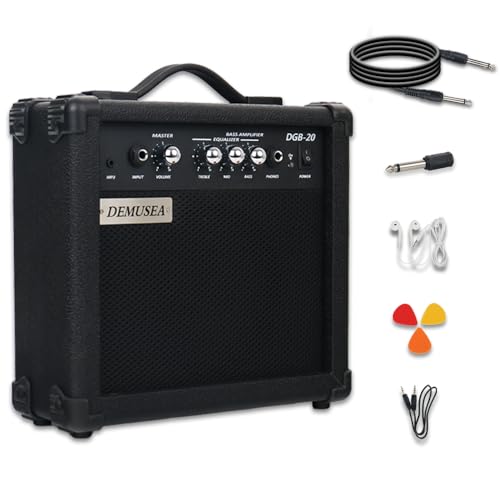
Demusea emphasizes a full 3-band EQ, allowing players to craft warm, bright, or punchy tones. The amp includes a headphone jack for late-night practice and an aux input for jamming along with tracks. The design prioritizes portability and durability for lessons and travel.
Who it’s best for: beginners and casual players requiring flexible tone control and travel-friendly design. Limitation: no explicit line-out described; suitable for practice and small-space gigs with direct-to-recording via other gear.
JOYO Vibe Cube BA-30 Bass Amp

The BA-30 offers 30W of power and a 4″ speaker with a MID FREQ control for precise tonal placement. It includes Bluetooth 5.1 and OTG direct recording, making it a strong choice for practice, livestreams, and quick mobile recording setups. Its compact form factor supports easy transport to gigs or rehearsals.
Who it’s best for: players who want modern connectivity for backing tracks and on-the-go recording. Limitation: small speaker size may limit bottom-end impact in louder environments; best used for practice or small venues.
JOYO MA-10B Mini Bass Amp

The MA-10B is a compact practice amp featuring two channels (Normal/Drive), a headphone output, and AUX input. It is highly portable, weighing under 3 pounds, and can run on battery for up to several hours, making it convenient for travel and outdoor jams.
Who it’s best for: solo players needing a tiny, budget-friendly option for quiet practice and casual busking. Limitation: limited wattage and speaker size mean it’s not ideal for band rehearsals or larger rooms.
Line 6 POD Express Bass

The Line 6 POD Express Bass is an ultra-portable option with HX-quality tones and a familiar interface. It’s tailored for players who want easy tone-shaping, quick practice, and reliable direct-output options for recording or direct-to-PA setups. The design emphasizes speed and ease of use for varying musical styles.
Who it’s best for: players who prioritize portability and studio-grade tones in a compact unit. Limitation: as a model-centric device, the emphasis is on modeled tones rather than a traditional physical cabinet experience.
Buying Guide: Key Considerations for Choosing a Bass Amp With Line Out
- Line-out and direct connectivity: If you plan to record or feed a PA, confirm there is a dedicated line-out or balanced DI option, or at least a reliable headphone/aux route you can use for recording with external gear.
- Wattage and speaker size: For home practice, 15–20W is typically enough. For small gigs, look for 30–40W with a larger speaker (8″ or 10″) for fuller lows.
- Tone controls: A 3-band EQ (bass, mid, treble) is standard. Some amps add a mid-frequency control for more precise tonal sculpting; consider your genre needs (rock, funk, reggae, jazz).
- Portability: Weight and size affect transport. If you travel often or rehearse in multiple rooms, prioritize lightweight, compact models with carrying handles or optional battery power.
- Latency and effects: For livestreaming or direct-recording workflows, Bluetooth or USB/OTG compatibility can simplify workflow, but verify the interface quality for reliable audio.
- Durability and construction: Durable housings with protective corners and quality furniture-grade finishes help during travel and lessons.
FAQ
- What is a line-out used for on a bass amp? It provides a direct connection to a recording device, PA system, or audio interface, enabling clean, direct bass signal without coloring from the amp’s speaker.
- Do I need a line-out if I only practice at home? Not necessarily, but it’s beneficial if you plan to record or perform live with a DI or PA system later.
- Is 20 watts enough for small gigs? Yes, for small venues or practice rooms; for larger spaces, a higher-wattage amp or direct connection to a PA is recommended.
- What’s the advantage of a built-in MP3/aux input? It enables you to play along with songs or backing tracks, improving practice efficiency without external devices.
- Should I choose a 10″ or 8″ speaker? A larger speaker (8–10″) generally delivers better low-end response and headroom; however, size and weight tradeoffs may be important for portability.
- Are modeling amps better than traditional ones? Modeling amps, like Line 6 POD Express, offer flexible tones and quick presets, which can be advantageous for studio work or varied genres.