Best 4 Zone Speaker Selector Switches for Multi-Room Audio Mastery
Answering the need for reliable multi-room sound, the best 4 zone speaker selector switches let you independently route audio to up to four speaker pairs from one amplifier. These choices suit home theater setups, multi-room living spaces, workshops, and patios. This guide highlights top 5 options, comparing power handling, impedance protection, independent volume, and ease of use to help you pick the right model for your setup.
Summary of chosen products:
| Product | Best For | Key Benefit | Limitations |
|---|---|---|---|
| Pyle PSS4 | Small to mid-size multi-room | 4 zones, solid power handling | Basic controls |
| Monoprice SSVC-4.1 | Impedance-protected setups | Impedance protection with volume control | May have more features in higher-end models |
| PROZOR 4-Zone | Safe, easy daily use | Passive design, four independent zones | No power adapter, manual setup |
| Pyle PSLSW4.5 | Thin profile, individual zones | Independent volume per channel | Limited data on protection specs |
| Monoprice SS-4 | Impedance protection with 4 zones | Reliable impedance protection | Basic feature set |
Premium 4 Zone Channel Switch Box (Pyle PSS4)

Best for: small to mid-size multi-room systems where you need four speaker pairs and straightforward setup. The PSS4 handles up to 100 watts per channel and supports 8-ohm minimum impedance, making it suitable for standard home theaters or living rooms with multiple zones.
Why selected: It offers four separate speaker pairs, simple wiring for 14-gauge wire, and a compact footprint. The 7.48″ W x 1.97″ H x 4.72″ D enclosure fits tighter spaces while delivering reliable channel distribution.
Limitation: Lacks advanced digital controls or built-in impedance protection beyond basic compatibility; consider models with explicit impedance protection if you run higher-power or mixed-impedance speakers.
Monoprice SSVC-4.1 4-Channel Selector with Volume
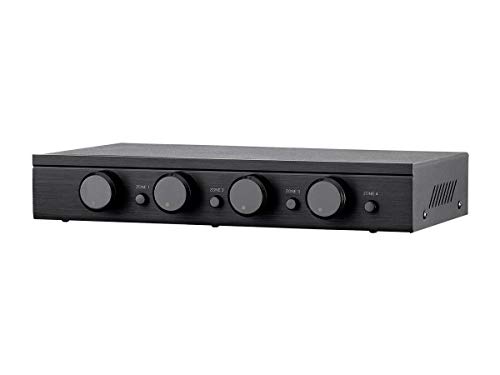
Best for: users who want automatic impedance protection alongside zone volume control. This model supports 100 watts per channel continuous handling and 200 watts per channel peak, with 5-ohm to 6-ohm minimum amplifier impedance depending on speaker configuration.
Why selected: It combines safe multi-zone control with individual volume per zone and on/off toggles. The impedance protection helps guard amplifiers when switching different speaker loads.
Limitation: Some users may want more advanced DSP or network features not offered here; this is a straightforward analog selector focused on protection and isolation.
PROZOR 4-Zone Passive Speaker Switch

Best for: users seeking a passive, power-efficient setup with straightforward four-zone control. It supports 4–16Ω passive speakers and uses independent A/B/C/D buttons to manage zones.
Why selected: Built-in AMP master switch provides easy daily use and extra protection by muting all zones when needed. The passive design avoids external power needs, simplifying integration into existing systems.
Limitation: Because it’s passive, the system relies entirely on the connected amplifier’s power; ensure your amp can drive all four zones concurrently at your desired levels.
Pyle 4 Channel Speaker Selector Switch PSLSW4.5
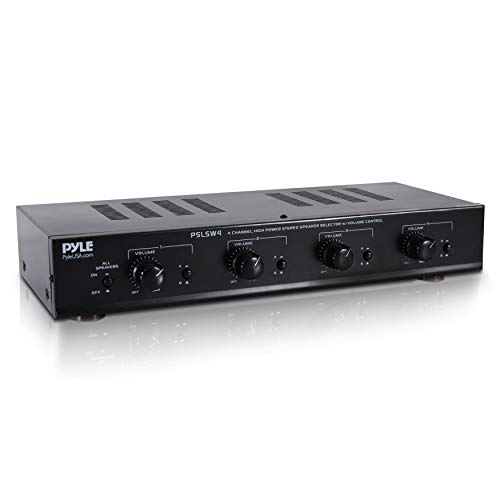
Best for: home theaters and multi-zone systems needing independent volume per channel with a compact form factor. It supports up to four pairs and 100W per channel, suitable for 8-ohm speakers.
Why selected: Independent volume controls per channel allow tailored listening experiences across rooms, while the compact design fits neatly into media furniture or desks.
Limitation: Data on impedance protection is less explicit; confirm compatibility with your specific speaker impedance to avoid mismatch during heavy use.
Monoprice SS-4 Premium 4 Channel with Impedance Protection

Best for: setups where impedance protection is a priority, ensuring safe operation when running multiple speaker loads. It supports 12-16 AWG wire and provides individual zone on/off controls.
Why selected: This model emphasizes auto-impedance protection, reducing risk of amplifier strain when switching between speaker loads. It is a reliable choice for larger, mixed networks requiring zone control safety.
Limitation: Some users may prefer higher-end models with more granular tone controls or remote operation; this unit focuses on protection and zone switching reliability.
Buying Guide
What to consider when choosing a 4-zone speaker selector switch
- Power handling: Match the wattage per channel to your amplifier and expected listening levels. Models listed here typically support 100W per channel; verify your amp’s output to avoid overloading.
- Impedance protection: Choose units with automatic impedance protection if you run different speaker loads or plan to push high volumes. This protects both amp and speakers.
- Independent zone controls: If each room or area needs distinct volume or on/off control, pick a selector with per-zone controls and clear labeling.
- Wiring compatibility: Check wire gauge support (commonly up to 14 AWG). Ensure screw-terminal connections fit your speaker cables without crowding.
- Passive vs. powered: Passive switches don’t need a power supply but rely on amp strength. Powered or “master” switches add convenience and protection features but require an outlet.
- Size and placement: Consider the enclosure footprint. Slim designs fit cabinets or media consoles; larger units may require shelf space.
- Future expandability: If you anticipate adding more zones or upgrading speakers, choose models with robust channel support and clear upgrade paths.
FAQ
- What is a 4-zone speaker selector switch used for?
It routes audio from one amplifier to four separate speaker pairs, allowing independent control of each zone.
- Do I need impedance protection on a speaker selector?
Impedance protection helps prevent amplifier strain when switching between different speaker loads, especially in larger systems.
- Can I use a 4-zone selector with any amplifier?
Most are designed for 8-ohm or similar loads; verify your amplifier’s minimum impedance and power ratings before pairing.
- Is it better to buy a passive or powered selector?
Passive units are simpler and require no power; powered or master-switch variants offer extra safety and convenience features.
- How many speaker wires can a typical 4-zone selector handle?
Most support 14 AWG to 16 AWG speaker wires in multiple pairs, but check the product’s wiring terminals for exact capacity.
- What if I need more than four zones later?
Look for models labeled for 4-, 6-, or 8-zone configurations or those with upgrade paths and modular designs.
For straightforward multi-room setups, these 4-zone selector switches provide reliable distribution, independent control, and protection features. Use the buying guide to align product specs with your amplifier and speaker configuration for optimal performance.