Best Stereo RCA to XLR Adapters for Pro Audio and Home Theater
Searching for the right stereo RCA to XLR adapter can be straightforward: find cables that reliably convert signals between common consumer gear and professional gear. This guide highlights five solid options and explains who benefits most from each. Whether you’re wiring a DJ setup, a home theater system, or a recording rig, these adapters help connect RCA outputs to XLR inputs with clarity and control. The buyer profiles below show who each product is best suited for and why each pick stands out.
| Product | Best For | Key Benefit |
|---|---|---|
| SiYear XLR Male to 2 x Phono RCA Plug Adapter | DJ setups and home studios | Dual RCA outputs from a single XLR source with EMI shielding |
| SiYear 10FT XLR Male to 2 x Phono RCA Plug Adapter | Long cable runs in live or studio contexts | Extended length with same dual-RCA conversion |
| Tisino 2 RCA to XLR Male Y Splitter Cable | Unbalanced studio or live rigs | Simple RCA-to-XLR split for straightforward connections |
| belipro Dual Female XLR to RCA Cable | Professional recording or stage setups | High-quality gold-plated connectors and robust shielding |
SiYear XLR Male To 2 x Phono RCA Patch Cable
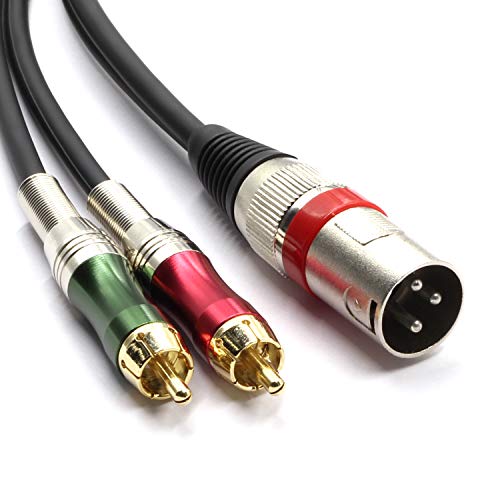
Application: Connect mixed consoles, microphones, tape recorders, and amplifier line outputs. Shielding is designed to prevent EMI/RFI interference for clean audio transfer. Suitable for DJ controllers to amplifiers and for integrating home theater and pro audio gear.
Who it’s best for: Small to medium home studios and DJ setups needing a compact, shielded XLR-to-dual-RCA solution.
Why chosen: Short, solid construction with high-density shielding minimizes static and pops, making it reliable for desk-level switching and quick stage setups.
Caution: This adapter converts XLR to two RCA lines; ensure your gear supports unbalanced RCA at the receiving end to avoid unexpected impedance mismatches.
SiYear 10FT XLR Male To 2 x Phono RCA Patch Cable
Application: Connect the mixed console, microphone, tape recorder, or amplifier line outputs with extended reach. High-density shielding protects against EMI/RFI over longer runs.
Who it’s best for: Musicians and engineers needing extra cable length while preserving signal integrity for stage or studio use.
Why chosen: The 3-meter length provides flexibility for desk-to-system layouts without sacrificing shielding quality.
Caution: Longer runs may introduce capacitance; pair with properly matched inputs to maintain fidelity at higher frequencies.
Tisino 2 RCA to XLR Male Y Splitter Cable

Application: Commonly used to create an XLR male connection from a stereo RCA input/output, with the XLR signal split across the RCA connectors. Useful for both directions in some setups.
Who it’s best for: Home studios or practice rooms needing a simple, budget-friendly splitter for unbalanced signals.
Why chosen: Straightforward, inexpensive option that supports quick signal routing between equipment like amps, mixers, and microphones.
Caution: This adapter is unbalanced; avoid demanding balanced high-fidelity work if your system requires true balanced signaling.
belipro Dual Female XLR to RCA Cable

Function Design: 2-XLR to 2-RCA interconnect cable usable in both directions for mixers, microphones, recorders, and amplifiers. Also suitable for integrating home theater equipment with pro audio gear.
Who it’s best for: Professionals needing robust dual-XLR to RCA interconnects with versatile directionality for studio and live setups.
Why chosen: 24K gold-plated connectors reduce signal loss and static while enhancing durability and corrosion resistance; OFC conductor supports high-fidelity transmission.
Caution: Gold-plating and shielding add cost; ensure connector compatibility with your gear’s connector layout to avoid fit issues.
Buying Guide
What should you look for in a stereo RCA to XLR adapter?
Key factors include connector quality, shielding, and whether the cable is unbalanced or balanced capable. Shielding reduces EMI/RFI, while gold-plated contacts improve corrosion resistance and signal integrity.
Balanced vs. unbalanced expectations
Most consumer-to-pro audio adapters are unbalanced. If you require true balanced signals, verify that both XLR and RCA ends support the intended signal path and that adapters preserve impedance matching.
Cable length considerations
Shorter cables minimize signal loss and capacitance. For longer runs, choose higher-quality shielding and thicker conductors. If you need long reach, prefer models that advertise shielding and low-noise performance over distance.
Application-by-application guidance
DJ setups benefit from compact, shielded adapters to connect mixers to amplifiers. Home theater users may favor longer runs with reliable shielding. Recording studios should prioritize durable connectors and low-noise paths for microphones and interfaces.
FAQ
- Can RCA to XLR adapters be used in both directions?
Many versions are designed to work in one or both directions; check product details to confirm bidirectionality.
- Will these adapters degrade audio quality?
- Are gold-plated connectors necessary?
Gold plating helps resist corrosion and can improve long-term reliability, especially in frequent plug-unplug scenarios.
- Is unbalanced RCA to XLR better for live use or studio work?
Unbalanced configurations are common for consumer devices; true balanced systems require compatible gear and careful wiring.
- How do I choose the right length?
Consider your setup layout, distance between devices, and whether extra length introduces unwieldy cable routing.
Quality shielding and connectors minimize degradation, but unbalanced paths may introduce hiss or hum in noisy environments.