
A mini jack stereo-to-mono splitter takes a 3.5mm stereo signal and separates it into left and right mono connections. For connecting a phone, laptop, or other 3.5mm output to two audio inputs, the Cable Matters 6-foot cable is a strong fit; the DTECH 3-foot cable suits shorter setups, while the compact 0.6-foot Togconn option is easier to carry. Check connector genders and plug sizes before choosing: these cables do not all have the same ends.
| Product | Best For | Connection |
|---|---|---|
| Cable Matters 6ft | Longer home or studio runs | 3.5mm TRS male to dual 1/4-inch TS male |
| DTECH 3ft | Medium-length setups | 3.5mm TRS male to dual 1/4-inch TS male |
| Togconn 0.6ft | Compact connections to two inputs | 3.5mm TRS male to dual 1/4-inch TS female |
| Devinal 1ft | Connecting to dual 1/4-inch inputs | 3.5mm TRS female to dual 1/4-inch TS male |
| RFAdapter 2-pack | Short 3.5mm-to-3.5mm splits | 3.5mm TRS male to dual 3.5mm TS female |
Cable Matters 6ft Breakout Cable
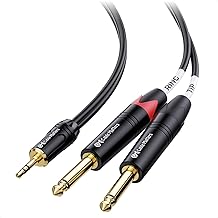
Best for: Buyers who need more cable reach between a 3.5mm source and two 1/4-inch inputs. This six-foot cable is designed to split stereo audio from a phone, tablet, laptop, or computer into left and right channels for equipment such as a mixer, amplifier, speaker, or studio monitors.
Its split ends can be separated to suit the setup. The listed construction includes oxygen-free copper conductors, braided copper shielding, and polyethylene insulation. Those details may matter when routing audio around other equipment or setting up a home studio, DJ system, or live sound connection.
- Choose this if you need a longer run and male 1/4-inch TS plugs at the receiving end.
- Its stated limitation is the connector format: it has dual 1/4-inch TS ends, not dual 3.5mm outputs.
DTECH 3ft Stereo Y Splitter

Best for: Buyers who want a mid-length cable for a 3.5mm audio output and two 1/4-inch inputs. The three-foot cable is described for connecting a phone, computer, or laptop to equipment such as a mixer, amplifier, speaker, or recording setup. Its two 1/4-inch TS plugs are color-coded to identify the left and right channels.
The nylon-braided jacket is listed as an added durability feature. This cable is a practical alternative to a longer six-foot cable when the source and receiving equipment are closer together, while providing more reach than a very short adapter lead.
- Choose this if three feet is enough and you need dual 1/4-inch male plugs.
- Avoid it if your receiving device needs female 1/4-inch jacks on the splitter cable; this product is described with 1/4-inch plugs.
Togconn Compact 0.6ft Splitter

Best for: A compact connection from a 3.5mm stereo output to two 1/4-inch inputs. The cable is listed as 0.6 feet, or 10 inches including adapters, and uses a 3.5mm TRS male plug with two 6.35mm female outputs. This gender arrangement is useful when the connected equipment or existing leads have 1/4-inch male plugs.
The product description lists an aluminum-alloy shell and 24K gold-plated plugs. It is intended to separate the stereo input into left and right channel outputs. The short length can help reduce excess cable around a desk or compact setup.
- Choose this if your source has a 3.5mm output and you need two 1/4-inch female sockets.
- Its short lead is a limitation when the source and connected cables are far apart.
Devinal 1ft Female TRS Splitter

Best for: Buyers whose source cable ends in a 3.5mm male plug and who need to connect to two 1/4-inch inputs. This one-foot adapter has a female 3.5mm TRS connection and two male 1/4-inch TS plugs. Its black- and orange-coded mono plugs are identified for left and right channels.
The listed description also says the cable is bi-directional, including use from dual 1/4-inch connections to a 3.5mm connection. It additionally describes using two mono 1/4-inch outputs to create a stereo feed for headphones. Check the direction and device connections needed for your specific setup before plugging in.
- Choose this if you need a female 3.5mm socket and dual male 1/4-inch plugs.
- It is only one foot long, so it may not provide enough reach for separated equipment.
RFAdapter Two-Pack 3.5mm Splitter

Best for: Buyers who need to split 3.5mm stereo into two 3.5mm mono connections rather than into larger 1/4-inch plugs. This set includes two six-inch adapters, each with a 3.5mm TRS male connection and two TS mono female connections. The product description identifies left and right audio connections.
The listed materials include gold-plated brass connectors, copper wire, and a flexible PVC wire jacket. Two short adapters can suit compact wiring or provide a spare, but this connector format is different from the dual 1/4-inch breakout cables elsewhere in this guide.
- Choose this if both split outputs need to be 3.5mm female mono connections.
- Avoid it if your receiving equipment requires 1/4-inch inputs; this set is described with 3.5mm outputs.
Buying Guide: How To Choose A Mini Jack Stereo Splitter
What does a stereo-to-mono splitter do?
A stereo-to-mono breakout cable carries the left and right channels of a stereo signal on separate branches. In the products above, a 3.5mm TRS connection is commonly the stereo side, while the two output connectors are mono TS connections. This makes it possible to route the left and right channels to separate inputs, such as two mixer channels or two speaker inputs.
A splitter does not necessarily combine left and right audio into one mono signal. If the goal is to hear both channels through one mono input, check the equipment’s input requirements and use a cable or device designed for that purpose. A simple Y cable intended to separate stereo channels is not automatically a mono summing adapter.
Which plug sizes and genders do you need?
Confirm both the plug diameter and whether each end must be male or female. A standard mini jack is 3.5mm, while the larger audio plug in this list is 6.35mm, often called 1/4 inch. The source connection may require a male plug to enter a headphone or line output, or a female socket to accept an existing cable.
Then check the two split ends. Cable Matters and DTECH are described with dual male 1/4-inch TS plugs. Togconn provides dual female 1/4-inch connections. The Devinal adapter has a female 3.5mm end and dual male 1/4-inch plugs. The RFAdapter set has dual female 3.5mm mono ends. Choosing the wrong gender may require another adapter, so compare the product description with the actual ports on your devices.
How much cable length is appropriate?
Measure the route between the source and the receiving device, allowing room for bends and movement. A short adapter can reduce clutter when devices sit together, but it cannot bridge a larger gap. The listed options range from six-inch adapters to a six-foot breakout cable. The Togconn listing specifies 0.6 feet, while Devinal is one foot and DTECH is three feet.
Extra length can make placement easier, but avoid selecting a cable based only on its maximum length. A cable that is much longer than the route may leave excess wire to manage. For setups with equipment on opposite sides of a desk or rack, compare the distance to the split point as well as the overall cable length.
Should you choose 3.5mm or 1/4-inch split outputs?
Choose based on the input sockets on the receiving equipment, not simply on the connector used by the source. If a laptop’s 3.5mm output needs to feed two 1/4-inch inputs, a 3.5mm-to-dual-1/4-inch cable is the relevant style. If both receiving connections are 3.5mm, the RFAdapter set is the closer match. Confirm that the cable’s TS or mono branches suit the intended inputs.
Adapters can change connector size or gender, but each extra connection adds another point to check during setup. Whenever possible, select a cable that directly matches the source and input ports.
What should you check for a mixer or recording setup?
Identify whether you want the left and right stereo channels on separate inputs. A dual-branch breakout cable is intended for that type of routing. Connect the left and right branches to the corresponding inputs, using color labels where provided. The Devinal description identifies black and orange plugs for left and right; the DTECH description also notes color coding for its two mono plugs.
Do not assume a cable will work in every direction just because its connectors fit. The Devinal listing describes bidirectional use, but other products are presented primarily as splitting a 3.5mm stereo output into two mono inputs. Follow the intended signal path and the needs of the connected equipment.
What construction details matter?
When a cable will be moved or routed frequently, jacket and connector construction can help guide selection. The DTECH cable lists a nylon-braided jacket. Cable Matters lists oxygen-free copper conductors and braided copper shielding. Togconn lists an aluminum-alloy shell and gold-plated plugs, while RFAdapter describes gold-plated brass connectors, copper wire, and a flexible PVC jacket.
These listed features are not a substitute for checking fit, channel routing, and cable length. Prioritize the correct wiring and connector configuration first; construction details are secondary when two products otherwise meet the same setup requirements.
Frequently Asked Questions
Can I connect a phone’s 3.5mm output to two 1/4-inch inputs?
Yes, if the phone or source has a 3.5mm stereo output and the receiving device has two suitable 1/4-inch inputs. Choose a cable with a 3.5mm TRS source end and dual 1/4-inch mono branches, and confirm whether those branches need male or female connectors.
Does a stereo splitter combine left and right into mono?
Not necessarily. A stereo breakout splitter generally separates left and right into two mono connections. It should not be treated as a mono summing cable unless its description specifically identifies that function.
What is the difference between TRS and TS?
TRS refers to a connector with tip, ring, and sleeve contacts; in these products, the 3.5mm TRS side carries a stereo signal. TS refers to tip and sleeve contacts and is used for the individual mono branches described in the breakout cables.
Can I use a 3.5mm-to-dual-1/4-inch cable in reverse?
Direction depends on the cable and the connected equipment. The Devinal listing specifically describes bidirectional use. For other models, check the stated use and verify that the signal path and connector genders match your setup.
Which cable is best for a compact setup?
The Togconn cable is listed at 0.6 feet and has a 3.5mm male plug with two 1/4-inch female outputs. The RFAdapter cables are six inches long and split to two 3.5mm female mono connections. Choose between them according to the required output size and gender.
Do I need two separate outputs for left and right audio?
Use a stereo breakout cable when the receiving equipment accepts the left and right channels on separate inputs. If the equipment has only one mono input, verify its requirements before choosing a splitter, because separating stereo channels is different from combining them into one mono signal.