
The best digital piano 3-pedal unit depends on your piano model and the pedal functions you need. Yamaha’s LP1B suits compatible Yamaha pianos when used with a required furniture stand, while the FC35 is designed for the P-525 and P-225 without a dedicated stand. Roland’s RPU-3 offers three separately connected pedals, and Casio’s SP-34 is a portable option for specified Privia and CDP-S models. Check model compatibility before buying: three-pedal units are not universally interchangeable.
| Product | Best for | Key consideration |
|---|---|---|
| Yamaha LP1B | Compatible Yamaha piano setups | Requires a specified furniture stand |
| Roland RPU-3 | Keyboards with three pedal inputs | Uses three separate 1/4-inch outputs |
| Casio SP-34 | Specified Casio Privia and CDP-S pianos | Confirm the exact piano model |
| Yamaha FC35 | Yamaha P-525 and P-225 owners | Listed compatibility is limited to those models |
| ATNEDCVH three-pedal unit | Selected older Yamaha models | Not compatible with other keyboards |
Yamaha LP1B Three-Pedal Unit

The Yamaha LP1B provides the traditional soft, sostenuto, and sustain pedal arrangement. Its listed features include half-damper functionality, which allows more nuanced sustain control when used with a compatible piano. The product information names Yamaha P-125, P-121, and P-515 models and notes that a matching L125, L121, or L515 furniture stand is required.
Best for: Owners of a listed compatible Yamaha piano who want a traditional three-pedal layout and have, or plan to use, the required furniture stand. It is selected for its model-specific fit and half-damper feature.
Check before buying: The product name also references additional models, so confirm compatibility with the exact piano and stand in the manufacturer’s current documentation. Avoid this unit if you need a stand-free pedal solution or have an unlisted keyboard.
Roland RPU-3 Three-Pedal Unit
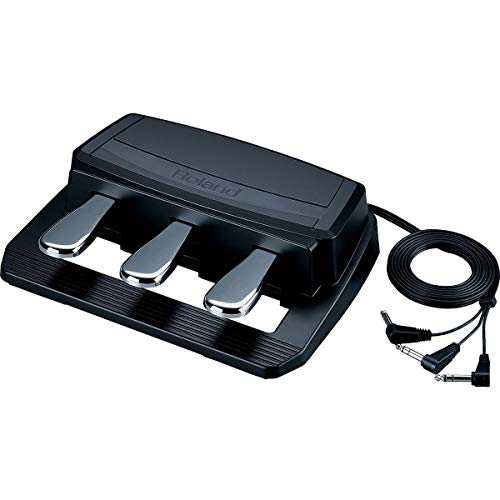
The Roland RPU-3 combines three pedals in one unit to keep the pedal area organized. Unlike a single combined connection, it has a separate 1/4-inch output for each pedal. The listed compatible keyboards include the Roland FP-90, FP-60, and RD-2000.
Best for: Players using a compatible keyboard that accepts the RPU-3’s three separate pedal outputs. It is selected for its integrated design and independent connections, which can suit setups that need more than a single sustain pedal.
Check before buying: Three 1/4-inch outputs do not guarantee compatibility with every keyboard. Confirm that your instrument supports the connection arrangement and functions before ordering. Choose another option if your piano requires a proprietary pedal unit or a single specific connector.
Casio SP-34 Portable Three-Pedal Unit

The Casio SP-34 is a portable three-pedal accessory listed for the Casio PX-S1000 series and PX-S3000. Its compact product dimensions are listed as 11.6 centimeters long, 41.7 centimeters high, and 19.4 centimeters wide. The supplied information identifies it as a three-pedal unit but does not specify individual pedal functions.
Best for: Owners of the listed Casio PX-S models who want a branded three-pedal accessory. It is selected because its stated use is tied to a clear group of Casio digital pianos.
Check before buying: The provided compatibility details name the PX-S1000 series and PX-S3000. Do not assume that the SP-34 works with every Casio CDP-S or Privia model based only on the product title. Confirm your precise piano model before purchase.
Yamaha FC35 Pedal Unit

The Yamaha FC35 is a three-pedal unit listed for the Yamaha P-525 and P-225. Its stated distinction is that it does not require a dedicated stand. That makes it a different setup choice from the LP1B, whose listed instructions require a compatible furniture stand.
Best for: Yamaha P-525 or P-225 owners seeking three pedals without buying or using a dedicated stand. It is selected for its clearly stated model fit and stand-free requirement.
Check before buying: The available product details do not list other compatible models or describe the individual pedal functions. Avoid assuming that it fits other Yamaha pianos simply because the connector or appearance seems similar.
ATNEDCVH Three-Pedal Unit for Select Yamaha Pianos

This ATNEDCVH unit has a soft pedal on the left, sostenuto pedal in the middle, and sustain pedal on the right. The listed compatible models are Yamaha P85, P95, P48, P105, and P115. Its construction is described as all metal with a wooden protective shell. The unit weighs about 3.75 pounds and includes a 1.45-meter connecting cable.
Best for: Owners of one of the specifically named Yamaha models who want the conventional three-function pedal arrangement. It is selected for the explicit pedal layout and model list.
Check before buying: The listing states that other keyboards are not compatible, even if they have the same plug. Do not choose it based on connector appearance alone; verify the exact piano model.
Buying Guide: How to Choose a Digital Piano 3-Pedal Unit
Does the pedal unit fit your exact piano model?
Compatibility should be the first filter. A three-pedal unit may use a proprietary connector, a particular mounting arrangement, or a specific wiring configuration. Even products with standard-looking plugs may not work with every keyboard. Compare the accessory’s stated model list with the exact model number printed on your piano, not just its brand or series name.
When product information names only a few models, treat that as the supported list unless the manufacturer confirms otherwise. This is especially important for third-party accessories. A connector that physically fits does not establish that all three pedals will function correctly.
Do you need sustain only or three different pedal functions?
A traditional three-pedal piano arrangement has a sustain or damper pedal on the right, a sostenuto pedal in the middle, and a soft pedal on the left. These functions provide different kinds of musical control. Before purchasing, check whether the accessory supplies those distinct functions.
Not every product described as a three-pedal unit provides three different functions. The ATNEDCVH universal unit in the supplied product information is an example of a different design: all three pedals function as sustain pedals. That arrangement may serve a particular playing preference, but it is not equivalent to a conventional soft-sostenuto-sustain layout.
Will the unit attach to your stand or sit independently?
Some pedal units are designed to be used with a compatible furniture stand. The Yamaha LP1B listing specifies a required stand, while the Yamaha FC35 is described as not requiring a dedicated stand. These differences affect both setup and placement, so check the stand requirement before selecting an accessory.
If you play on a portable keyboard stand, verify how the pedal unit is intended to sit and whether it can be positioned securely. Do not assume that a unit designed for a furniture stand will attach to a different stand or remain in place on a hard floor.
How are the pedals connected?
Connection details help determine whether a unit suits your instrument. The Roland RPU-3 has three separate 1/4-inch outputs. Other products may use a model-specific connection or a single cable. Check the piano’s pedal inputs and its instructions to determine which type of accessory it supports.
A polarity switch can be useful on some single sustain pedals, but it does not make every pedal unit universally compatible. Likewise, a standard 1/4-inch plug alone does not confirm support for three separate pedal functions.
Is half-damper control important?
Half-damper functionality allows the sustain effect to respond across a range of pedal movement rather than only switching fully on or off, when supported by both the piano and pedal unit. The Yamaha LP1B product information specifically lists half-damper functionality. If you want this type of control, verify that your piano supports it and that the chosen accessory is compatible.
Do not infer half-damper support from a three-pedal design alone. Product listings may describe the pedal layout without specifying how the sustain pedal responds.
What should you compare before ordering?
- Model compatibility: Match the piano’s full model number to the accessory’s stated compatible models.
- Pedal functions: Check whether the unit has soft, sostenuto, and sustain pedals or a different arrangement.
- Stand requirements: Confirm whether the accessory needs a particular furniture stand or can be used without one.
- Connection type: Compare the accessory outputs with the inputs and setup instructions for your piano.
- Portability: Consider listed dimensions, weight, and cable length if you move the instrument or pedal unit often.
- Feature support: Look for explicit details such as half-damper operation rather than assuming it is included.
Frequently Asked Questions
Can I use any three-pedal unit with any digital piano?
No. Three-pedal units are not universally interchangeable. Check the exact piano model, connector requirements, pedal functions, and any stand requirements before buying.
What are the three traditional piano pedal functions?
The traditional layout is soft on the left, sostenuto in the middle, and sustain or damper on the right. Some products use a different arrangement, so confirm the functions in the product details.
Does the Yamaha LP1B require a stand?
Yes. Its listed product information says that a compatible Yamaha L125, L121, or L515 furniture stand is required for use. Verify the correct stand for your specific piano.
Which option is listed for the Yamaha P-225?
The Yamaha FC35 is listed for the P-225 and is described as not requiring a dedicated stand. The LP1B listing also references the P-225 in its product name, but its stated stand requirement should be checked before choosing it.
Does a three-pedal unit always include half-damper control?
No. Half-damper functionality is not guaranteed by a three-pedal design. The Yamaha LP1B listing specifically mentions it; check the piano and accessory specifications for other combinations.
Is a standard 1/4-inch plug enough to confirm compatibility?
No. A matching plug does not necessarily mean that the piano supports the accessory’s wiring or pedal functions. Confirm compatibility using the instrument’s model-specific documentation.