
The best rack mount sound system depends on whether you need multi-zone amplification, a rack-mounted speaker monitor, or organized equipment storage. The Rockville RCS650-6 is best for commercial spaces that need independent volume control across six zones, while the Pyle PT8000CH is better suited to wired multi-room speaker setups. For monitoring, consider the Fostex AMS-RM-3 or Rolls HR155; for holding two Sonos Amps, choose the ynVISION.DESIGN shelf.
| Product | Best For | Type |
|---|---|---|
| Rockville RCS650-6 | Six-zone commercial audio | 70V amplifier |
| Pyle PT8000CH | Multi-room wired speaker systems | Rack-mount amplifier |
| Fostex AMS-RM-3 | Stereo monitoring with analog or digital inputs | 1U monitor |
| Rolls HR155 | Basic rack-mounted speaker monitoring | Speaker monitor |
| ynVISION.DESIGN 2U Shelf | Rack storage for two Sonos Amps | Equipment shelf |
Rockville RCS650-6 6-Zone Amplifier
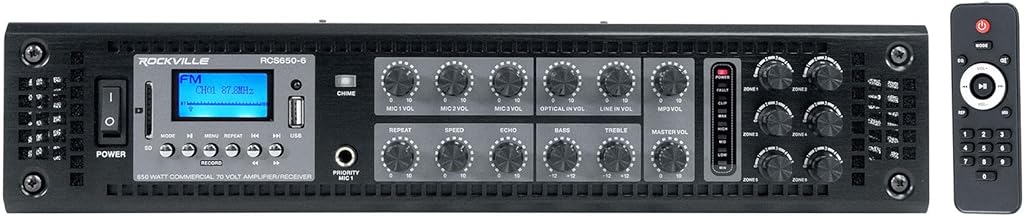
The Rockville RCS650-6 is a rack-system option for commercial installations that need separate volume adjustment in several areas. Its listed output is 650 watts RMS at 70 volts or 780 watts at 100 volts, and it supports 70V, 100V, 8-ohm, and 4-ohm setups.
Six dedicated volume knobs let an operator adjust each zone independently. This makes the amplifier a practical match for spaces such as restaurants, offices, retail locations, and schools where different areas may need different sound levels. Bluetooth, USB and SD playback, and a built-in FM tuner provide several listed playback options.
- Best for: Commercial or multi-room systems needing up to six individually controlled zones.
- Why it stands out: It combines multiple speaker-system formats with per-zone controls and built-in playback options.
- Limitation: Choose another type of system if you do not need multiple zones or the listed 70V/100V functionality.
Pyle PT8000CH Multi-Zone Amplifier

The Pyle PT8000CH is a 19-inch rack-mount amplifier described for multi-room wired audio. Its listing specifies eight channels at 100 watts per channel, five-way speaker binding-post outputs, pass-through output for linking an external amplifier, and four-channel bridgeable switches.
Speaker selectors with volume control allow adjustment of multiple speakers, while an LED audio-level display provides a visual indication of output level. The product description emphasizes playing audio through speakers in multiple rooms from a wired system. Check the system’s speaker layout and amplifier requirements against the full product specifications before choosing it.
- Best for: Buyers building a multi-room wired speaker setup with channel and speaker-selection controls.
- Why it was selected: It is explicitly described as a 19-inch rack-mount, multi-zone amplifier with speaker outputs and level display.
- Limitation: The supplied features do not list wireless streaming or a built-in music source, so plan on providing an appropriate audio source.
Fostex AMS-RM-3 1U Stereo Monitor

The Fostex AMS-RM-3 is a 1U rack-mount stereo monitor system with a built-in 10-watt-per-channel Class D amplifier and elongated speaker units. It accepts analog input through XLR and 1/4-inch TS phone connections, as well as digital AES/EBU input.
A headphone output supports headphone monitoring. The listed fade behavior when switching between headphone and speaker output is intended to avoid an unexpected level difference during the change. This unit is a monitoring component, not a multi-zone speaker amplifier for distributing sound around a building.
- Best for: Rack users who need an onboard stereo monitor with both listed analog and AES/EBU inputs.
- Why it was selected: Its 1U format and multiple input types make it a compact monitoring choice for an equipment rack.
- Limitation: Its built-in amplifier is specified at 10 watts per channel, so it serves monitoring rather than high-output, multi-room amplification.
Rolls HR155 Rack-Mount Speaker Monitor

The Rolls HR155 is listed as a rack-mount speaker monitor. The provided product information also gives a package weight of 2.4 pounds and package dimensions of 35.56 centimeters long by 22.098 centimeters wide by 9.906 centimeters high. Those details can help when planning space for delivery or storage, but they are package measurements rather than confirmed installed dimensions.
Unlike the products with more detailed feature lists, the supplied information does not describe the HR155’s inputs, output power, controls, or monitoring functions. Treat it as a candidate for a basic rack-monitoring role, then verify the complete specifications and connections before integrating it into a system.
- Best for: Buyers looking specifically for a rack-mount speaker monitor and willing to confirm detailed specifications.
- Why it was selected: It directly fits the rack-mounted speaker-monitor category.
- Limitation: Available feature information is sparse; do not assume particular inputs, power, or controls from the product name alone.
ynVISION.DESIGN 2U Shelf For Two Sonos Amps

This ynVISION.DESIGN product is a rack shelf, not an amplifier or complete sound system. It is described as a 2U, 11-inch-deep shelf for two compatible Sonos Amps, designed for 19-inch AV, audio, and server racks. Custom front cutouts are intended to keep the amplifiers accessible, and the shelf includes a rear support bar and cable management.
The rear clamping bar helps keep the listed amplifiers from sliding backward when their front buttons are pressed. This can be useful in a fixed rack installation where equipment stability and a tidy layout matter. Confirm that your equipment matches the shelf’s intended fit before purchasing.
- Best for: Owners organizing two compatible Sonos Amps in a 19-inch rack.
- Why it was selected: It addresses equipment mounting, rack organization, and rear support rather than audio amplification.
- Limitation: It provides storage and cable management, not sound processing, playback, or speaker power.
Buying Guide: How To Choose Rack-Mount Audio Equipment
A rack-mount sound system can refer to several different components. An amplifier powers passive speakers; a monitor lets an operator hear audio near the rack; and a shelf holds equipment in position. Decide which function you need before comparing products. A rack shelf does not replace an amplifier, and a monitor is not automatically suitable for distributing audio to rooms.
Do you need a zone amplifier or a stereo monitor?
Choose a zone amplifier when the main goal is sending audio to speakers in one or more rooms. The Rockville RCS650-6 lists six independently adjustable zones and compatibility with several speaker-system formats. The Pyle PT8000CH is described as an eight-channel amplifier with speaker selectors and volume control. Compare the listed channel and zone arrangements with the number of areas and speakers in your installation.
Choose a rack monitor when you need sound at the equipment location for checking or monitoring audio. The Fostex AMS-RM-3 has a specified stereo monitor system, 1U format, analog connections, and AES/EBU input. The Rolls HR155 is also listed as a speaker monitor, but its supplied feature details are limited. Verify the connections and functions needed for your workflow before selecting it.
How many zones and channels are required?
Count the distinct areas that need sound, then determine whether they need separate volume settings or separate program sources. The Rockville’s six volume knobs indicate individual volume adjustment by zone. The Pyle description focuses on multi-room playback, multiple channels, and speaker selectors with volume control. The supplied information does not establish every routing option for either product, so check the manufacturer’s detailed specifications if separate source selection is essential.
Also distinguish a channel from a zone. A channel is an amplifier output path, while a zone is generally an area whose audio is managed as a group. Product listings may use these terms differently. Match the actual output arrangement, speaker wiring, and control method to your system plan instead of relying on a headline wattage figure alone.
Which speaker system format and output should you check?
For the Rockville, the listed supported formats are 70V, 100V, 8 ohms, and 4 ohms. Confirm which format your installed speakers require and whether the amplifier’s specified output suits the planned configuration. The feature list gives 650 watts RMS at 70 volts and 780 watts at 100 volts; those figures should be considered in the context of the intended setup rather than treated as interchangeable with other products’ ratings.
The Pyle listing describes 100 watts per channel and five-way speaker binding-post outputs. Before connecting speakers, check the complete specifications for supported speaker loads and installation instructions. Do not assume compatibility based only on a product’s rack format, number of channels, or advertised power wording.
What inputs and playback sources do you need?
List the sources you expect to use, such as a wired audio feed, a digital signal, or stored media. The Rockville lists Bluetooth, USB and SD playback up to 32GB per device, and an FM tuner. The Fostex lists XLR and 1/4-inch TS analog inputs along with AES/EBU digital input. The Pyle feature information describes audio from sources or devices but does not specify the same built-in playback options.
If a particular connector or wireless feature is essential, verify it in the full specifications. Do not assume a rack-mounted component includes streaming, a radio tuner, or a particular input just because it is described as an audio system.
How should you plan rack space and equipment fit?
Check rack width, height, depth, rear connections, ventilation needs, and access to controls. The ynVISION.DESIGN shelf is specified as 2U high and 11 inches deep for a 19-inch rack, with a rear support bar and cable management. The Fostex monitor is specified as 1U. The Rolls listing provides package dimensions, which should not be substituted for confirmed installed dimensions.
Leave enough room to connect cables and operate controls. The provided details do not state every product’s rack depth or ventilation requirements, so consult the manufacturer’s documentation when planning a tightly packed rack. For shelves, check the actual equipment dimensions and intended fit, particularly when a shelf is designed around a specific amplifier model.
Should you choose a complete rack system or separate components?
A single rack amplifier may suit buyers who already have speakers and need a central source of power and control. A separate monitor can support local listening, while shelves can secure amplifiers or other equipment. Combining these categories can make a functional rack, but each component serves a different purpose. Confirm that the amplifier, speakers, source equipment, and monitoring method work together before assembling a system.
For commercial or multi-room setups, prioritize zone count, speaker format, source selection, and control needs. For a compact production or equipment rack, prioritize monitoring inputs, rack height, and access to headphones or controls. For an installation centered on two Sonos Amps, evaluate the shelf as a mounting accessory rather than as an audio component.
Frequently Asked Questions
What does rack-mount sound system mean?
It usually describes audio equipment designed to fit an equipment rack, but the term can include amplifiers, monitors, and mounting shelves. Check the component’s role: an amplifier powers speakers, a monitor provides local listening, and a shelf holds equipment.
Which listed product is best for six audio zones?
The Rockville RCS650-6 is the listed option with six zones and dedicated volume knobs for each zone. Its feature information also lists 70V and 100V operation, plus 8-ohm and 4-ohm setups.
Can a rack monitor power speakers throughout a building?
Do not assume so. The Fostex and Rolls products are described as rack-mounted monitors, while the Rockville and Pyle are described as amplifiers. Check the specifications for speaker outputs and intended use before connecting a distributed speaker system.
Does the ynVISION.DESIGN shelf include an amplifier?
No amplifier function is listed. The product is a 2U, 11-inch-deep rack shelf designed to hold two compatible Sonos Amps, with cable management and a rear support bar.
What should I verify before buying a rack amplifier?
Confirm speaker impedance or system format, channel and zone needs, available source inputs, rack fit, and the required output. Compare the manufacturer’s full specifications with the speakers and wiring in your planned installation.
Is package size the same as rack installation size?
No. Package dimensions describe the packaged product and may not equal its installed dimensions. The Rolls listing provides package measurements, so verify the product’s actual rack dimensions before planning fit.