
The best vehicle-mounted solar panel depends on roof space, surface shape, and whether you need a panel alone or a charging kit. The Renogy ShadowFlux 200W is best for vehicle roofs that may receive partial shade, while the ECO-WORTHY 200W kit suits buyers who want a panel and charge controller together. For curved surfaces, consider Renogy’s 100W flexible panel or the lightweight Topunive 100W model. The Eving solar sunshade is a different option for windshield placement and device charging.
| Product | Best For | Listed Output |
|---|---|---|
| Renogy ShadowFlux 200W | Partial-shade-prone roofs | 200W |
| ECO-WORTHY 200W Kit | A panel and controller in one kit | 200W |
| Renogy Flexible 100W | Curved vehicle surfaces | 100W |
| Eving 70W Solar Sunshade | Windshield use and device ports | 70W |
| Topunive Flexible 100W | Lightweight, irregular mounting areas | 100W |
Renogy ShadowFlux 200W Solar Panel

Best for: RV, van, and marine owners who have limited roof space and may encounter partial shade. This 200W rigid panel uses N-Type cells and Renogy’s ShadowFlux technology, which the product description says is designed to improve generation in shaded conditions and reduce hot-spot risks.
The panel’s listed cell efficiency is 25%, and its 16BB cell design is intended to support conversion performance while reducing hot spots and micro-cracks. Renogy also describes the panel as 7% smaller and 10% more compact than PERC panels, making it a space-conscious option when roof layout matters.
Choose this panel if you want a higher-output rigid module and shade management is a priority. It is a panel rather than a complete charging kit, so buyers should confirm what additional system components they need. Its rigid format may be less suitable than a flexible panel for a strongly curved mounting surface.
ECO-WORTHY 200W Solar Panel Kit
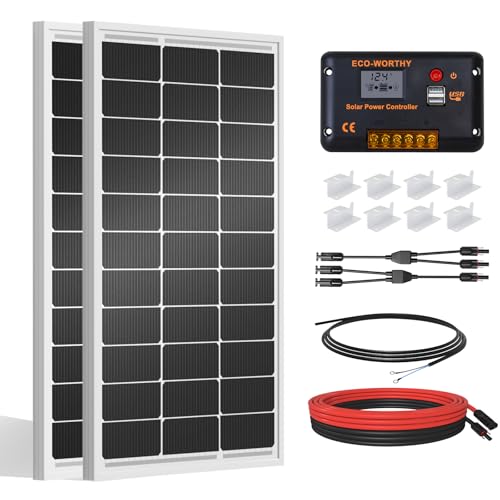
Best for: Buyers who want a 200W panel kit with a charge controller for an RV, camper, caravan, or other off-grid application. The listed kit includes a 30A PWM charge controller, and the monocrystalline panel is described as suitable for 12V or 24V systems.
The product listing estimates daily output of 800Wh under four hours of full sunshine. Treat that as a stated estimate rather than a guaranteed vehicle output; sunlight, panel angle, shading, and system setup affect production. The panel measures 35.2 by 23.1 inches, according to the listing, and has a corrosion-resistant aluminum alloy frame. Its junction box is listed as IP65-rated.
Choose this option if you want a panel and controller together and have room for a rigid module. The controller type is PWM, so compare it with the requirements of your battery and system before buying. The rigid panel also needs a suitable mounting area rather than a flexible curved surface.
Renogy Flexible 100W Solar Panel
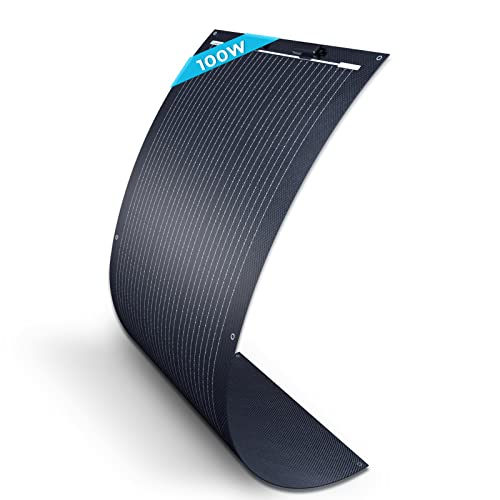
Best for: Vehicle owners who need a low-profile panel for a curved roof or other suitable non-flat surface. Renogy says this 100W panel can bend within 240 degrees and is designed for applications such as vans, RVs, boats, and cabins. Its listed thickness is 0.1 inch.
The product description says the panel weighs one-third as much as a rigid panel and has an all-black, glare-free appearance. It uses half-cut PERC cells, and the stated average daily electricity generation is 500Wh, depending on sun availability. Actual energy depends on weather, position, and how the panel is connected to the rest of the system.
Choose this panel when low weight and flexibility are more important than the rigid construction of a standard framed panel. It is a 100W panel, so buyers seeking greater listed output may need to compare higher-wattage options. Confirm the intended mounting method and surface suitability before installation.
Eving 70W Solar Windshield Sunshade
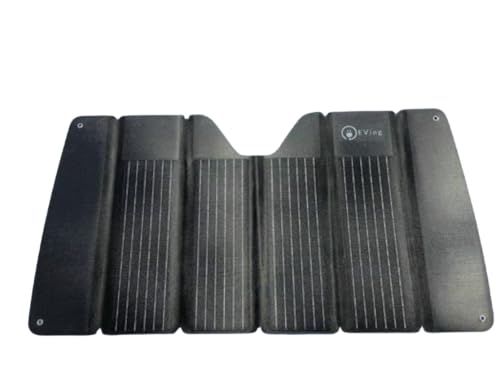
Best for: Drivers seeking a windshield-mounted solar accessory that also functions as a sunshade. The Eving product combines a sunshade with a 70W solar panel and lists one DC port, one USB-C port, and two USB-A ports.
The product description says the sunshade uses leg stands and has a universal fit for most car windshields. That makes it distinct from roof-mounted panels: it is designed for windshield placement and can provide accessible ports for charging compatible devices. Check the connection and charging requirements of the devices you plan to use.
Choose this product if you value the dual purpose of blocking sunlight and generating power, particularly for occasional outdoor or camping use. Avoid assuming it replaces a roof-mounted battery-charging system; the listing does not specify battery storage or a complete vehicle charging setup. Windshield dimensions and placement can also affect fit.
Topunive Flexible 100W Solar Panel

Best for: Buyers who need a lightweight panel for an uneven or curved vehicle surface. Topunive lists a 100W rating, a weight of 4.4 pounds, a thickness of 0.1 inch, and a minimum bending radius of 17.7 inches. The panel measures 36.22 by 23.22 inches.
The product uses monocrystalline cells with nine busbars and lists conversion efficiency up to 23%. Its pre-drilled metal holes and PV solar connectors are described as installation features. The manufacturer lists applications including cars, trucks, boats, RVs, trailers, and campervans.
Choose this model if low weight, a thin profile, and flexible placement are key requirements. It is listed as a 100W panel, so it offers less nominal output than the 200W options in this guide. Before mounting, make sure the surface curve is compatible with the stated bending limit and check how the panel will be secured.
Buying Guide: How To Choose Vehicle-Mounted Solar Panels
What type of vehicle solar panel should you choose?
Start with the mounting surface. Rigid panels are a practical match for a flat, structurally suitable roof with room for a framed module. Flexible panels can suit certain curved surfaces and can have a thinner profile, but their bend limits and mounting requirements still matter. A windshield solar sunshade is a separate category: it is positioned at the windshield rather than permanently installed as a roof panel.
Think about how you use the vehicle as well. An RV with a dedicated roof area may accommodate a rigid panel or multiple modules. A van with limited roof clearance may benefit from a low-profile design. A boat or vehicle with an irregular surface may call for a flexible panel, provided the surface and installation method are appropriate.
How much solar output do you need?
Estimate daily electricity use before choosing a wattage. List the devices you expect to power, how long each will run, and whether the panel is intended to charge a battery or supply power through another system component. Compare that daily demand with realistic sunlight exposure, not only the panel’s wattage label.
A 200W panel has a higher listed rated output than a 100W panel, but it does not guarantee twice the real-world daily energy in every installation. Shade, season, panel angle, roof direction, dirt, and electrical system design can change production. Product output estimates are conditional; for example, the ECO-WORTHY listing ties its 800Wh daily estimate to four hours of full sunshine.
Will the vehicle roof have shade?
Check the parking locations and travel conditions where the vehicle will spend time. Trees, buildings, roof equipment, and nearby structures can cast shade over a panel. If partial shade is common, compare products that specifically describe shade-related technology, such as the Renogy ShadowFlux panel in this guide. No panel should be treated as immune to reduced sunlight.
Consider roof obstructions, too. Air conditioners, vents, racks, and antennas can affect both usable mounting space and sun exposure. Measure the available area and account for clearance before selecting a panel. A compact panel may make layout easier, but its dimensions still need to fit the intended location.
Does a solar panel kit include the parts you need?
A solar panel alone is not necessarily a complete vehicle power system. Depending on your setup, you may need a charge controller, suitable wiring, mounting hardware, and a compatible battery or power station. Review the included components carefully instead of assuming they come with the panel.
The ECO-WORTHY product listed here includes a 30A PWM charge controller. The Renogy 100W starter kit from the product list also includes a panel, a 30A PWM controller, cables, and Z-brackets, though it is not one of the five selected products. Confirm system voltage, controller requirements, and battery compatibility with the product documentation before connecting components.
What should you check before mounting a flexible panel?
Flexible does not mean bendable without limits. Compare the panel’s stated bending allowance or minimum radius with the vehicle surface. Avoid making assumptions about whether a panel can be walked on, permanently adhered, or mounted using a particular adhesive unless the product instructions explicitly say so.
Also consider access for inspection and maintenance. A panel that sits close to a surface may be difficult to remove or clean. The mounting method should hold the panel securely under the conditions the vehicle encounters, while following the panel maker’s instructions and any vehicle-specific requirements.
How should you compare panel efficiency claims?
Efficiency describes how effectively a panel converts available sunlight into electricity under specified conditions. It does not, by itself, tell you how much energy your vehicle will generate in a day. Panel area, rated wattage, sunlight, temperature, shading, and installation all affect actual output.
Use efficiency as one comparison point, especially when roof space is limited. Then compare dimensions, rated wattage, cell type, weight, and mounting format. Treat manufacturer estimates and technical claims as product specifications, not promises of identical results on every vehicle.
Should you choose a roof panel or a windshield sunshade?
Choose a roof panel when your goal is to integrate solar generation into a vehicle power setup and you have a suitable mounting surface. A windshield sunshade may suit drivers who want a removable accessory that combines shade with listed charging ports. These options serve different use cases, so compare placement, connection type, and intended devices rather than wattage alone.
Frequently Asked Questions
Can vehicle-mounted solar panels charge a battery?
They can be used as part of a battery-charging system, but the panel alone may not be enough. Check whether your setup requires a charge controller, compatible wiring, and a battery. Follow the panel and battery manufacturers’ instructions.
Are flexible solar panels better for a curved vehicle roof?
They can be a suitable option when the panel’s stated bend limit matches the surface. Check the product’s dimensions, flexibility specifications, and mounting instructions before buying. A flexible panel is not automatically appropriate for every curved roof.
Does a 200W panel always produce more power than a 100W panel?
A 200W panel has a higher rated wattage, but real-world production depends on sunlight, shade, installation, and system components. Compare expected conditions and daily energy needs rather than relying on wattage alone.
Do I need a charge controller for a vehicle solar panel?
A charge controller may be needed when connecting a panel to a battery. Requirements depend on the panel, battery, and system design. Check whether a controller is included and confirm that its specifications suit the complete setup.
Can I mount a solar panel on a car windshield?
Some products are designed for windshield use, including the Eving solar sunshade listed above. Its listing describes leg stands and multiple charging ports. Confirm that its size and connection options suit your vehicle and intended use.