
The best 4-channel Class D amplifier depends on the power, inputs, and installation flexibility your car audio system needs. The ORION CEA400.4D is best for buyers who want variable high- and low-pass filters; the Taramps TS 1200 is better suited to systems seeking a higher advertised wattage; and the Recoil DI550.4 offers bridgeable channels. The two Taramps TS 400X4 listings are compact, lower-power options with different listed input details. Compare the stated specifications below, then confirm the full power ratings and wiring requirements for your setup.
| Product | Best For | Notable Listed Features |
|---|---|---|
| ORION CEA400.4D | Adjustable crossover control | 400W RMS, variable high- and low-pass filters |
| Taramps TS 1200 | Buyers considering a higher advertised wattage | Full-range crossover, RCA and wire input |
| Recoil DI550.4 | Bridgeable-channel flexibility | Full-range, bridgeable, 2–4 ohm stable |
| Taramps TS 400X4 Black | Compact installation with input options | 400W RMS, high-level and RCA inputs |
| Taramps TS 400X4 | Compact full-range systems | 400 watts RMS, RCA input, two bridged channels |
ORION CEA400.4D: Best for Adjustable Filters

The ORION CEA400.4D is a compact, full-range, four-channel Class D amplifier listed at 400 watts RMS. Its stated features include variable high- and low-pass filters, a MOSFET power supply, and stability at 2 or 4 ohms. Those details make it a useful candidate for buyers who want to adjust crossover behavior rather than rely only on a fixed crossover setting.
Best for: Drivers building a multi-speaker system who want adjustable high- and low-pass filtering and a stated RMS power figure. Its listed 2- and 4-ohm stability also gives buyers specific load information to compare with their speakers.
Why it was selected: It combines a stated 400W RMS rating with variable filters and a compact Class D design, making its key specifications easy to evaluate against system needs.
Limitation: The supplied product details do not give the per-channel power at each impedance or filter adjustment ranges. Check the complete listing and manual before matching speakers or setting crossovers.
Taramps TS 1200: Best for Higher Advertised Wattage
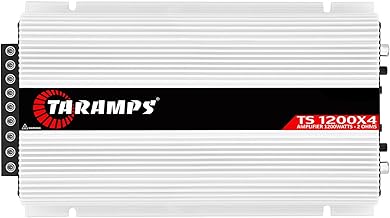
The Taramps TS 1200 is a multichannel Class D car amplifier described with a 1200-watt figure in its product name. The listing identifies it as full range and specifies a fixed crossover with RCA and wire inputs. It also says professional installation is recommended. The supplied information does not identify the 1200-watt figure as RMS, so buyers should not compare it directly with products whose RMS output is explicitly stated.
Best for: Buyers evaluating a four-channel amplifier with a higher advertised wattage and both RCA and wire-input options. The input choices may be relevant when planning how to connect the amplifier to the existing audio system.
Why it was selected: It provides a different power and connection profile from the 400-watt RMS options in this guide, while its full-range design targets a broad range of car audio arrangements.
Limitation: The listed crossover is fixed, not variable, and the supplied details do not clarify RMS output or channel-by-channel power. Confirm those figures and installation requirements before purchase.
Recoil DI550.4: Best for Bridged Channels

The Recoil DI550.4 is described as a full-range Class D four-channel car audio amplifier with a 1040-watt figure in its name. Its listed features include a MOSFET power supply, bridgeable channels, and stability at 2–4 ohms. Bridgeability can give a system designer more configuration options, but it is important to verify the load and power limits for the chosen bridged setup.
Best for: Buyers who want the option to bridge channels as part of their speaker-system plan. Its stated 2–4 ohm stability is another useful specification for comparing against the impedance of connected speakers.
Why it was selected: The combination of full-range operation, bridgeable channels, and a stated impedance range makes it a flexible option to consider alongside fixed-layout four-channel amps.
Limitation: The supplied product name does not say that 1040 watts is an RMS rating, nor does it specify power for each channel or bridged configuration. Verify those details before sizing the system.
Taramps TS 400X4 Black: Best for Input Flexibility

The Taramps TS 400X4 Black is listed as a 400W RMS, 2-ohm, four-channel car amplifier with a compact Class D design. Its stated features include high-level and RCA inputs, bridgeable channels, and a built-in crossover. Having both high-level and RCA input types gives buyers options to investigate when choosing a connection method for the rest of the system.
Best for: Buyers who need to compare high-level and RCA input options, want a compact amplifier, and may use bridged channels. The listed 400W RMS figure also provides a stated rating for comparison with the other products.
Why it was selected: It stands out among the lower-wattage options through the combination of input choices, a built-in crossover, and bridgeable channels.
Limitation: The supplied details do not state output per channel, crossover settings, or bridged power. Confirm that the amplifier’s limits match the intended speakers and wiring configuration.
Taramps TS 400X4: Best for a Simple RCA Setup

This Taramps TS 400X4 listing describes a 400-watt RMS, four-channel, full-range Class D amplifier. It specifies RCA input and two bridged channels, and its product name describes the unit as small. The supplied information does not list high-level inputs, so buyers comparing it with the TS 400X4 Black should check the current full listing to confirm the connection options.
Best for: Buyers seeking a compact, full-range amplifier with a stated RMS figure and RCA input. Its two bridged channels may suit a system plan that calls for bridging, provided the intended wiring meets the amplifier’s limits.
Why it was selected: It offers a clear alternative to the Black listing for buyers prioritizing the stated RCA input and 400W RMS rating.
Limitation: The provided product details do not specify impedance stability, high-level input support, or channel-by-channel output. Do not assume those specifications from the similar model name.
Buying Guide: How to Choose a 4-Channel Class D Amplifier
A four-channel Class D amplifier can power multiple speakers or support a system that uses bridged channels, depending on the amplifier’s design and the speaker load. Compare the specifications that affect your actual installation rather than choosing by the largest number in a product name. RMS power, impedance, inputs, crossover controls, and installation requirements all matter.
How much RMS power do your speakers need?
Start by checking each speaker’s recommended power range and nominal impedance. Then compare those figures with the amplifier’s output ratings at the matching load. RMS ratings are generally more useful for system matching than a headline wattage that is not clearly identified as RMS. In this selection, the ORION and two TS 400X4 descriptions state RMS figures; the Taramps TS 1200 and Recoil DI550.4 names include wattage figures without identifying them as RMS in the supplied details.
Do not infer per-channel output from a total-power figure. Ask how much power the amplifier supplies to each channel at the impedance you plan to use. If you intend to bridge channels, check the bridged output rating and minimum allowed load as well.
Do you need RCA inputs, high-level inputs, or both?
Input type affects how the amplifier connects to the audio source. RCA connections are listed for the TS 1200 and the two TS 400X4 models. The TS 400X4 Black specifically lists both RCA and high-level inputs, while the TS 1200 description lists RCA and wire input. Product wording can differ, so verify the exact input type and connection method in the full specifications before buying.
If the connection details are unclear, consult the vehicle audio system documentation or ask a qualified installer to confirm the appropriate signal path. Do not assume an amplifier supports a particular input merely because a related model does.
When are adjustable or built-in crossovers useful?
A crossover directs or limits frequency ranges sent to connected speakers. The ORION is listed with variable high- and low-pass filters, which gives buyers adjustable filter options. The TS 1200 is described with a fixed crossover, while the TS 400X4 Black lists a built-in crossover. These phrases do not provide the adjustment ranges or exact settings, so check the manual if crossover control is central to your setup.
Choose adjustable filtering when you need to tailor the signal to the speakers and the amplifier offers the required range. If your system plan does not require that adjustment, a fixed or built-in crossover may still be worth considering, provided its operation matches the installation.
What does bridgeable mean for your system?
A bridgeable amplifier can combine two channels for a different output configuration, subject to its rated wiring and load limits. The Recoil DI550.4, TS 400X4 Black, and TS 400X4 descriptions mention bridgeable channels or bridged channels. Bridging does not automatically mean more usable power for every speaker: the connected load must be within the amplifier’s permitted range.
Before bridging, confirm which channel pairs can be combined, the minimum impedance, and the resulting power rating. Follow the product manual’s wiring diagram. If those details are unavailable, have a qualified installer assess the configuration rather than relying on the product name alone.
How should you compare impedance ratings?
Impedance is a key part of matching an amplifier to speakers. The ORION is listed as stable at 2 and 4 ohms, and the Recoil is described as stable at 2–4 ohms. The TS 400X4 Black is identified as a 2-ohm amplifier, but the supplied details do not give a complete stability range. The other supplied descriptions do not provide enough information to establish their full impedance limits.
Check the impedance of every connected speaker and how speakers will be wired together. Series and parallel wiring can change the total load seen by an amplifier. Use the product’s documented minimum impedance for the relevant channel arrangement, especially if bridging.
Should you install the amplifier yourself?
The Taramps TS 1200 listing recommends professional installation. The other supplied product details do not establish whether professional installation is required. Installation involves electrical connections, secure mounting, signal wiring, and speaker-load matching; mistakes can affect performance or damage equipment. Consider an experienced installer if you are unfamiliar with automotive electrical work or amplifier setup.
Before purchasing, also check the amplifier’s physical dimensions, power and ground wiring requirements, ventilation needs, and included accessories in the full listing. Those details were not provided for every product here, so they should not be assumed from the model name or general Class D design.
Frequently Asked Questions
What does a 4-channel car amplifier do?
A four-channel amplifier provides four amplified output channels for a car audio system. Depending on the model and wiring limits, channels may power separate speakers or be bridged into a different configuration.
Is a higher wattage number always better?
No. Compare verified RMS output at the intended impedance with the speakers’ power requirements. A wattage figure that is not identified as RMS should not be treated as an RMS rating.
What is the difference between RCA and high-level inputs?
They are different ways to provide an audio signal to an amplifier. The TS 400X4 Black lists both RCA and high-level inputs. Check the exact product specifications to confirm the input types available on any model.
Can I bridge any four-channel amplifier?
No. Only bridge an amplifier if its documentation says bridging is supported, and follow the specified channel pairing, impedance, and power limits. Several products in this guide are described as bridgeable, but the supplied details do not include every wiring limit.
Which amplifier in this guide has variable filters?
The ORION CEA400.4D is the product listing that specifically states it has variable high- and low-pass filters. The other filter descriptions provided are fixed or built-in and do not specify variable adjustment.
Which product lists both high-level and RCA inputs?
The Taramps TS 400X4 Black listing specifies both high-level and RCA inputs. Confirm the input details in the complete listing before purchase.