
The best resources for jazz on electric guitar depend on whether you need an instrument, study material, or a pick. The REDID semi-hollow guitar is the instrument option, while the Jim Hall and Wes Montgomery books offer artist-focused study material. For chord practice, consider Jazz Guitar Chord Creativity; for trying different pick shapes and materials, the Jim Dunlop Jazz III Variety Pack is the most flexible choice. The comparison below summarizes what each listing specifies and where its details are limited.
| Product | Best suited to | What the listing specifies |
|---|---|---|
| REDID RD-100 Semi-Hollow Electric Guitar | Players looking for a jazz-oriented guitar | Semi-hollow body, maple neck, rosewood fretboard, humbucker pickups |
| Jim Hall: Exploring Jazz Guitar | Players studying Jim Hall’s recorded work | Songbook listing describes transcriptions of 10 songs |
| Wes Montgomery Guitar Recorded Versions | Players studying Wes Montgomery solos | Songbook listing describes 20 note-for-note solo transcriptions |
| Jazz Guitar Chord Creativity | Players focused on chord vocabulary | Guide is described as covering jazz chords across the fretboard |
| Jim Dunlop Jazz III Variety Pack | Players comparing pick options | Six listed Jazz III variations in different materials and formats |
REDID RD-100 Semi-Hollow Electric Guitar

Best for: Guitarists looking for a semi-hollow electric guitar whose listed design is suited to jazz as well as blues and rock. The product description identifies it as a 335-style, semi-hollow instrument with F-holes and humbucker pickups.
The listing specifies a Canadian hard maple neck and a rosewood fretboard. Those details make this a useful option to compare if you are choosing by body construction and neck or fretboard materials. Its semi-hollow design is the clearest reason to consider it for jazz: the listing explicitly presents the guitar for jazz, blues, and rock use.
Why it was selected: It is the only instrument among these five products. The other listings are books or picks, so this guitar addresses the practical need for an electric instrument rather than study material or accessories.
Limitation: The supplied product details do not state scale length, neck profile, control layout, weight, or setup. Review the full listing and confirm those specifications fit your preferences before choosing it.
Jim Hall: Exploring Jazz Guitar

Best for: Guitarists who want a Jim Hall-focused songbook for exploring jazz guitar. The product title identifies it as a sheet music book with transcriptions of 10 songs and places it in the Guitar Recorded Versions series.
A transcription-based book can give a player a written reference for studying recorded music. This listing is a fit for shoppers specifically seeking Jim Hall material, rather than a general chord manual or an instrument. The supplied information identifies the artist and the number of songs, but does not name the individual selections or describe their difficulty.
Why it was selected: It directly addresses jazz guitar study through named artist material and song transcriptions. It provides a distinct alternative to the Wes Montgomery collection, so readers can compare two artist-specific study directions.
Limitation: The available product information does not specify whether the book includes audio, accompaniment, or a particular notation format beyond sheet music and transcriptions. Check the listing details if those features matter to your practice routine.
Wes Montgomery Guitar Recorded Versions

Best for: Guitarists seeking a collection centered on Wes Montgomery’s solos. The product title describes 20 iconic jazz solos for electric guitar and identifies the book as note-for-note transcriptions in a Hal Leonard music book.
The stated focus makes this option more specific than a general jazz guitar method. It is intended for readers interested in working from written versions of Montgomery’s solo material. Players can compare its 20-solo scope with the Jim Hall book, which is listed as containing 10 song transcriptions.
Why it was selected: It supplies a second artist-focused path for learning jazz guitar material. The named artist, electric-guitar focus, and stated number of solos make its subject clear for shoppers choosing study material by repertoire.
Limitation: The supplied details do not identify the song titles, skill level, or whether recordings or play-along materials are included. If you need a particular solo or a specific learning format, verify those details before purchasing.
Jazz Guitar Chord Creativity

Best for: Guitarists whose main study goal is jazz chord vocabulary and fretboard application. The title describes the book as a complete guide to mastering jazz guitar chords anywhere on the fretboard.
Unlike the two artist-specific songbooks, this book is framed around chords rather than a named performer’s repertoire. That makes it a relevant comparison for players who want a resource with a broad chord-focused theme. The product listing names Tim Pettingale and Joseph Alexander as authors and identifies the format as paperback.
Why it was selected: Jazz guitar study includes more than solo transcription. A chord-centered resource gives shoppers a separate option when their priority is exploring chord shapes and placement across the neck.
Limitation: The supplied product information does not describe the book’s chapter structure, included exercises, notation, or target skill level. Check the detailed listing if you need to confirm how the material is presented.
Jim Dunlop Jazz III Pick Variety Pack
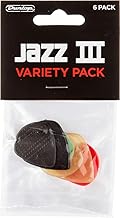
Best for: Players who want to compare several Jazz III pick variations instead of committing to one type based on its name alone. The six-pack includes Nylon Jazz III in red, Nylon Max Grip Jazz III, Carbon Fiber Nylon Jazz III XL, Black Tortex Jazz M3, Ultex Jazz III, and Ultex Jazz III XL.
The variety is the product’s main practical advantage. It lets players compare the listed materials, sizes, and grip style while using a consistent Jazz III family as a starting point. It can also suit a guitarist who wants more than one option available for different playing preferences.
Why it was selected: It is the only pick-focused product in the list and offers six named variations. That makes it more useful for comparing pick options than a single-variant listing would be.
Limitation: A variety pack does not guarantee that every included pick will suit your hand or technique. Choose it if experimentation is useful; avoid it if you already know the exact Jazz III model you prefer and want only that version.
Buying Guide: Choosing Jazz Guitar Resources
Do you need a guitar, a book, or an accessory?
Start by identifying the gap in your setup. The REDID RD-100 is the only guitar in this selection. The Jim Hall and Wes Montgomery books are artist-focused study options, while Jazz Guitar Chord Creativity is centered on chords. The Dunlop pack is an accessory for comparing picks. These products serve different purposes, so a book or pick cannot substitute for an instrument, and a guitar does not provide structured study material.
What should you compare in a semi-hollow guitar?
The REDID listing describes a semi-hollow body, F-holes, humbucker pickups, a maple neck, and a rosewood fretboard. These are the stated features to use when comparing it with other electric guitars. Also check the full listing for specifications that are not provided here, such as scale length, controls, bridge details, and dimensions. Do not assume those details from the body style or product name.
Which kind of jazz guitar book fits your goal?
Choose an artist-focused songbook if you want to study material associated with a particular guitarist. The Jim Hall listing describes 10 song transcriptions; the Wes Montgomery listing describes 20 note-for-note solo transcriptions. Choose Jazz Guitar Chord Creativity if your priority is chord study across the fretboard. The supplied descriptions do not establish difficulty levels or list all lesson contents, so check those points before selecting a book for a specific course or practice plan.
How can you choose between the Jim Hall and Wes Montgomery books?
Compare the artist and the stated scope. The Jim Hall book is described as a 10-song collection, while the Wes Montgomery book is described as containing 20 jazz solos for electric guitar. The larger number alone does not establish that one is more suitable or more advanced. If repertoire matters, confirm the individual titles in the product details; the information provided here does not list them.
When is a pick variety pack useful?
A variety pack is useful when you want to test different versions before settling on a preferred pick. This Dunlop set lists six options across nylon, carbon fiber nylon, Tortex, and Ultex, including standard and XL versions and one Max Grip option. If you already prefer a particular material, size, or grip, a pack with several alternatives may include options you will not use.
What information should you verify before buying?
For the guitar, confirm the specifications and included items in the complete listing. For books, verify the contents, notation, difficulty, and whether any audio or supplementary material is included. For picks, check the exact models and quantities in the pack. Product titles help identify the intended use, but details that are not stated should not be assumed.
Frequently Asked Questions
Which product in this list is an electric guitar?
The REDID RD-100 is the electric guitar. Its listing describes a semi-hollow body, F-holes, humbucker pickups, a maple neck, and a rosewood fretboard.
Which book focuses on jazz guitar chords?
Jazz Guitar Chord Creativity is described as a guide to mastering jazz guitar chords across the fretboard.
Which songbook lists more transcribed material?
The Wes Montgomery book lists 20 solo transcriptions. The Jim Hall book lists transcriptions of 10 songs.
Does the Jim Dunlop pack include different pick types?
Yes. The listed six-pack includes Nylon, Nylon Max Grip, Carbon Fiber Nylon, Tortex, and Ultex Jazz III variations, including XL versions.
Do the supplied book details confirm that audio is included?
No. The available product descriptions identify the books and their transcription or chord focus, but do not confirm that audio or play-along materials are included.