
The best 70-volt audio amplifier depends on how much power, zone control, and source connectivity your installation needs. The Rockville RCS650-6 is best for larger multi-zone systems, while the RCS180-6 suits smaller installations that still need independent zone controls. For a simpler two-zone setup, consider the Sound Town PAC80-2; for a compact, lower-output system, the Rockville RCS80-1 is a practical option. The Pyle PMSA126BU adds several speaker-output options and multiple playback inputs.
| Amplifier | Best For | Standout Feature |
|---|---|---|
| Rockville RCS650-6 | Higher-output, multi-zone systems | Six zone controls and 650W RMS at 70V |
| Rockville RCS180-6 | Smaller six-zone installations | Independent volume knobs and varied inputs |
| Sound Town PAC80-2 | Two-zone distributed audio | Independent zone control |
| Rockville RCS80-1 | Compact, modest-output systems | Bluetooth and several playback inputs |
| Pyle PMSA126BU | Installations needing flexible speaker outputs | 70V, 100V, and low-impedance outputs |
Rockville RCS650-6

The Rockville RCS650-6 is best for commercial installations that need substantial output and independent level control across several spaces. Its listed output is 650 watts RMS at 70V and 780 watts at 100V, with support for 70V, 100V, 8-ohm, and 4-ohm setups.
Six dedicated zone volume knobs let an operator adjust areas such as a dining room, patio, or retail floor separately. Bluetooth, USB and SD playback, and an FM tuner provide multiple ways to supply audio. The listed USB and SD support is for media up to 32GB each.
- Best for: Larger restaurants, schools, offices, and retail environments with multiple audio zones.
- Why it stands out: It combines the highest stated 70V RMS output among these picks with six-zone control.
- Consider: Its higher output and multi-zone features may be more than a small, single-area installation requires.
Rockville RCS180-6

The Rockville RCS180-6 is best for businesses that want six independently adjustable zones without choosing the highest-output model in this group. It delivers 180 watts across six zones, with an individual volume knob for each zone.
Its input selection is a notable advantage for mixed-use spaces. The amplifier supports Bluetooth, USB, SD card, RCA, optical, and three microphone inputs. An FM tuner and optical input provide additional options for radio or digital audio sources such as TVs and projectors.
- Best for: Cafes, offices, and retail spaces that need separate volume control and several source options.
- Why it stands out: It pairs six-zone control with a broad range of wired, wireless, and microphone inputs.
- Consider: Its listed 180-watt output is lower than the RCS650-6, so compare system power needs before selecting it for a larger installation.
Sound Town PAC80-2
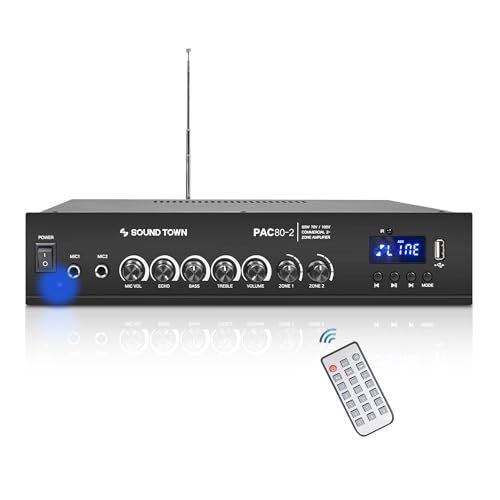
The Sound Town PAC80-2 is best for installations that need two separately controlled zones. Its listed features include two 70V speaker outputs with individual controls. It also supports 100V distributed audio and 4-to-16-ohm systems, according to the product information.
For announcements or background music, the PAC80-2 offers two microphone inputs, each with echo control, as well as two sets of RCA inputs. Bluetooth, a USB input, and an FM tuner add playback choices, and an LED display is included.
- Best for: A small commercial system that needs two independently managed areas and microphone inputs.
- Why it stands out: Its two-zone layout offers more area control than a basic single-zone amplifier.
- Consider: The listed features do not state a wattage figure, so verify the amplifier’s output specification against the planned speaker load before choosing it.
Rockville RCS80-1
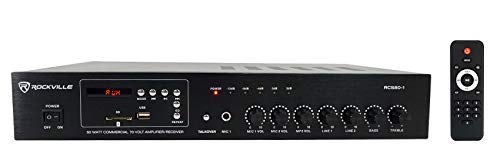
The Rockville RCS80-1 is best for a compact installation that needs 70V or 100V operation, Bluetooth, and basic microphone support. The product listing describes it as a 60-watt amplifier and also lists support for 4-ohm, 8-ohm, and 16-ohm speakers.
Bluetooth 5.0 supports wireless streaming from a phone or tablet. Other listed inputs and sources include RCA, USB, SD card, FM radio, and two 1/4-inch microphone inputs with separate volume controls. These options make it useful when an installation needs both music playback and announcements.
- Best for: Smaller offices, paging setups, or other spaces where a compact amplifier and varied inputs are priorities.
- Why it stands out: It combines several playback choices with multiple supported speaker impedances.
- Consider: Its listed 60-watt output makes it a lower-output choice than the two Rockville multi-zone models above.
Pyle PMSA126BU
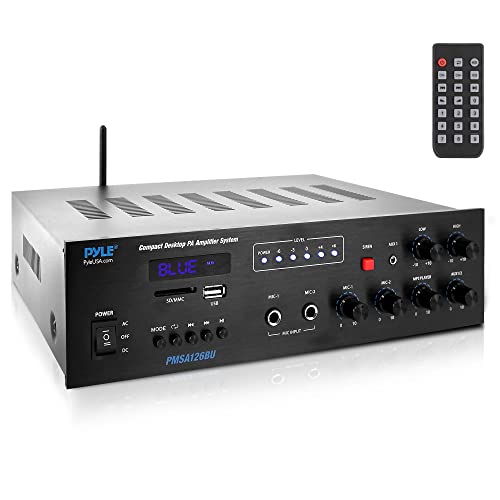
The Pyle PMSA126BU is best for buyers who want one amplifier with both distributed-audio and conventional speaker output options. Its listed speaker outputs include 70V, 100V, 16 ohms, 8 ohms, 4 ohms, and common connections. The product listing describes it as a 500-watt amplifier.
For playback and system connections, it includes Bluetooth, a USB port, an SD card slot, AUX and RCA inputs, microphone inputs, FM input, and a 12V DC power input. That range can help when the system needs to handle both music and public-address duties.
- Best for: Buyers who need multiple speaker-output formats and several ways to connect audio sources.
- Why it stands out: Its listed output options cover 70V and 100V systems as well as 4-to-16-ohm speakers.
- Consider: The listing specifies 500 watts but does not clarify the power rating in the supplied feature details. Confirm the relevant output rating for the intended setup.
Buying Guide: How To Choose A 70V Amplifier
What does a 70V audio amplifier do?
A 70V amplifier is designed for distributed speaker systems, often used in commercial spaces with multiple speakers spread across a larger area. In a compatible installation, speakers use transformer taps to set their power draw. This approach can make it practical to connect many speakers over longer cable runs than a typical low-impedance setup, but the amplifier and speakers must be configured for the same system.
How much amplifier power do I need?
Start by checking the power tap selected on each connected speaker. Add the speaker tap ratings together, then leave an appropriate margin rather than planning to run the amplifier at its limit. The amplifier’s usable output must be sufficient for the total load. Check the manufacturer’s specifications for the exact model, because product listings may state power in different ways, such as RMS or peak.
For example, the RCS650-6 lists 650 watts RMS at 70V, while the RCS180-6 lists 180 watts across six zones. Those figures describe different output levels; they do not by themselves determine how many speakers an installation can support. Speaker tap settings and the planned system load matter too.
Do you need one zone or several?
A single-zone amplifier can be suitable when the same program and volume level are wanted throughout one area. Choose a multi-zone model when separate rooms or sections need independent volume adjustment. The RCS650-6 and RCS180-6 each offer six zone controls, while the Sound Town PAC80-2 is specified for two zones.
Zone controls affect how the audio is adjusted between areas. Before buying, confirm that the amplifier’s zone arrangement matches the actual wiring plan and the way staff need to operate the system.
Which audio inputs and playback features matter?
List every source the system needs to accept. Bluetooth can support convenient wireless playback, while RCA and AUX connections can serve wired devices. USB and SD inputs are useful when local media playback is required. An optical input may be relevant when connecting a compatible digital audio source, and microphone inputs matter for paging or announcements.
Do not assume that every input supports every source or format. Check the model’s connection details and operating instructions, particularly when the installation depends on a TV, media player, or microphone.
Can a 70V amplifier also run regular speakers?
Some models list both 70V or 100V outputs and low-impedance options. For example, the Pyle PMSA126BU lists 4-to-16-ohm outputs, and the Rockville RCS650-6 lists 4-ohm and 8-ohm support. Verify the exact output terminals and setup instructions before connecting speakers. Do not combine speaker types or output connections unless the amplifier documentation explicitly supports that configuration.
What should you check before installation?
- Confirm that the amplifier supports the speaker system’s voltage, such as 70V or 100V.
- Calculate the total speaker tap load and compare it with the amplifier’s specified output.
- Check how many zones are needed and whether each requires independent volume control.
- Verify that required inputs are present, including microphone, RCA, USB, optical, or Bluetooth.
- Review the speaker wiring plan and amplifier instructions before connecting equipment.
- Choose based on the system’s needs rather than wattage alone; source options, controls, and output type also matter.
Frequently Asked Questions
Is a 70V amplifier the same as a 100V amplifier?
No. They are different constant-voltage system formats. Some amplifiers support both, but the connected speakers and system configuration must match the selected output.
How many speakers can I connect to a 70V amplifier?
The number depends on the amplifier’s usable output and the power tap selected on each speaker. Add the speaker tap ratings and make sure the combined load is within the amplifier’s specifications.
Do all 70V amplifiers have Bluetooth?
No. Bluetooth is a model-specific feature. Check the product specifications if wireless playback is required.
Is a higher-wattage amplifier always the better choice?
No. The right output depends on the total speaker load and the coverage required. A higher-output model may be unnecessary for a small system, while a low-output model may not suit a large installation.
Can I use a 70V amplifier for announcements?
Yes, if the model has a suitable microphone input and supports the connected speaker system. Check the listed microphone features and the amplifier’s instructions before installation.