
The best piano for a 7-year-old depends on whether the child wants a playful first keyboard or a more structured introduction to notes and rhythm. For singing and creative play, the M SANMERSEN, Drmukie, and Raimy keyboards offer microphones and recording features. The Xelabrion stands out for light-up keys and guided play modes, while EKKBHKI offers 32 keys and a large set of demo songs. These are compact children’s keyboards, not full-size piano instruments.
| Product | Best For | Standout Features |
|---|---|---|
| M SANMERSEN 37-Key Keyboard | Creative play and portability | Microphone, recording, USB or battery power |
| Drmukie 37-Key Keyboard | Varied sounds and pretend performances | 19 demos, rhythms, microphone |
| Raimy 37-Key Keyboard | Simple beginner exploration | Clear labels, dual speakers, recording |
| EKKBHKI 32-Key Keyboard | Demo songs and family play | 22 demos, detachable microphone |
| Xelabrion Light-Up Piano | Guided, game-like learning | Seven modes and illuminated keys |
M SANMERSEN 37-Key Keyboard

This compact keyboard is best for a 7-year-old who wants to experiment with sounds, invent short melodies, and sing along. Its 37 keys provide more room to explore than the 32-key option in this guide, while built-in play features make it suitable for informal music time.
Features include eight tones, eight rhythms, 20 demo songs, two percussion instruments, two animal sounds, chord functionality, a keyboard drum function, and record-and-playback. Dual speakers provide sound from the keyboard, and volume and tempo controls let families adjust playback. The included microphone adds a performance element.
Choose this model if flexible power options matter: it can run on three AA batteries or connect through the included USB cable. Its listed size is approximately 16.9 by 6.3 by 2.1 inches, which may suit a child who wants to move the keyboard between play areas.
Limitation: The three AA batteries are not included. Its 37 keys and toy-oriented functions are intended for exploration rather than a full piano-keyboard layout.
Drmukie 37-Key Keyboard

The Drmukie is best for a child who likes switching between sounds, rhythms, and pretend concerts. It is a 37-key toy keyboard with dual speakers and wood-grain-style keys, described as being designed for young children. The listing highlights simple chord play and record-and-playback for trying out melodies.
Its feature set includes eight tones, eight rhythms, 19 demo songs, four percussion sounds, four animal sounds, and volume and tempo controls. The included microphone supports sing-along play. These options give a beginner several ways to explore music without requiring a lesson plan or prior keyboard experience.
Choose this model if variety is more important than guided, light-based instruction. A child can listen to demos, select different sounds, and record a simple musical idea. The manufacturer positions it as an early music-learning toy, with activities that may encourage coordination and finger dexterity.
Limitation: The provided product details do not specify power options or the keyboard’s dimensions. Check the current listing if those details are important before choosing it.
Raimy 37-Key Beginner Keyboard
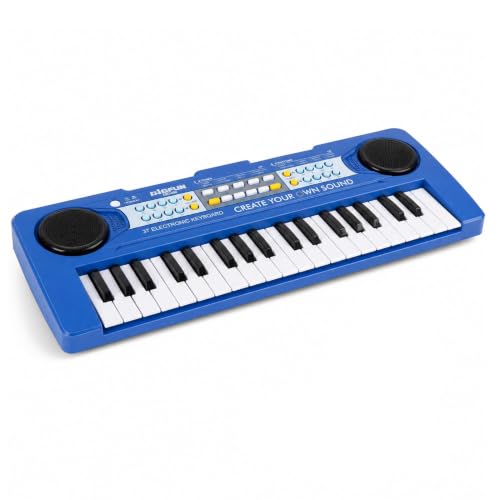
The Raimy is best for a 7-year-old who wants a straightforward keyboard for exploring tones, beats, and simple musical ideas. It has 37 keys, clear function labels, and a smooth keyboard design described as sized for small fingers. These details may make the controls easier for a young beginner to explore independently.
It includes eight tones, eight rhythms, and six demo songs. A microphone and record-and-playback function let children sing while playing or listen back to a short creation. The manufacturer also highlights dual speakers and sound effects, giving the keyboard a built-in listening experience without requiring a separate speaker in the product description.
Choose this model if a child will enjoy making and replaying short recordings, or if easy-to-read controls are a priority. Compared with options that list many demo songs, the Raimy has fewer built-in demos, but its advertised functions center on learning through sound exploration and performance.
Limitation: It lists six demo songs, fewer than the 19 or 20 demos offered by some alternatives here. The provided feature information does not state its power method or dimensions.
EKKBHKI 32-Key Music Keyboard
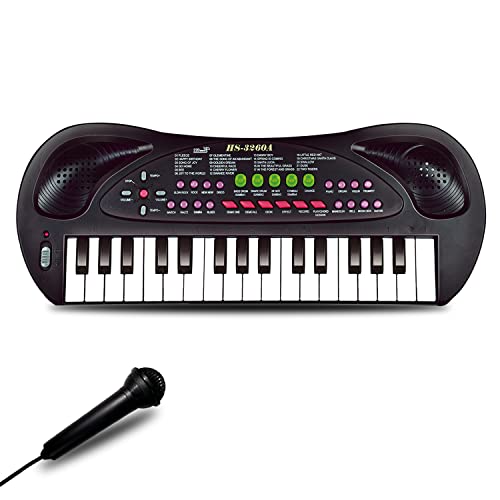
The EKKBHKI is best for a child who is drawn to built-in songs and shared music play. It has 32 keys, a single speaker, an ensemble mode, and a detachable microphone. Its feature list includes 22 demo songs, eight tones, eight rhythms, and four percussion instruments, making the demos a key distinction from the other keyboards in this selection.
Children can use the recording and playback function to make and listen to their own short pieces. The product also includes automatic standby sleep functionality. Its description presents the keyboard as an early-learning toy for exploring instrument sounds and practicing pressing individual keys.
Choose this model if a detachable microphone and a large collection of demos are more important than having 37 keys or dual speakers. The 32-key layout is a more compact choice among the listed keyboards, while the ensemble mode provides another way to engage with music.
Limitation: This model has a single speaker, unlike the dual-speaker options in this guide. The feature details do not provide dimensions or power requirements.
Xelabrion Light-Up Learning Piano

The Xelabrion is best for a 7-year-old who responds to visual cues and game-like activities. Unlike the 32- and 37-key keyboards above, its main selling point is a learning-machine format: it has seven modes, four function keys, built-in music tracks, and light-up keys that indicate a correct key press in the described game.
The keys have number and musical-scale labels, which may help a child connect visual markings with playing. The product also supports creating songs, and its modes are described as interactive activities for exploring music and rhythm. Its lightweight, portable design is intended for play at home or while traveling.
Choose this option if guided play and illuminated cues are more appealing than a microphone or a large selection of instrument tones. It is listed as battery-powered, making it a portable choice for play away from a power outlet.
Limitation: Batteries are not included. The provided product details do not specify the number of keys, so compare the layout directly with a child’s learning goals before purchasing.
Buying Guide: How To Choose A Piano For A 7-Year-Old
Start by deciding what “piano” means for the child. A compact keyboard toy can introduce sound, rhythm, and creative play. It is not automatically a substitute for a full-size piano or a conventional keyboard intended for formal lessons. If the child is beginning lessons, ask the instructor what key count and layout will suit the planned material.
Should You Choose 32 Or 37 Keys?
Key count can help narrow the options, but it does not determine whether a keyboard is a good fit by itself. The 37-key products in this group include M SANMERSEN, Drmukie, and Raimy. EKKBHKI has 32 keys. Choose a 37-key model if having more keys in a compact children’s keyboard is a priority; choose the 32-key option if its specific functions, such as 22 demos and a detachable microphone, better match the child’s interests.
Does Your Child Want Lessons Or Open-Ended Play?
For relaxed experimentation, compare the number of tones, rhythms, and percussion sounds. Those functions can make a keyboard more varied for a child who likes trying different noises and creating songs. For a more guided experience, the Xelabrion’s light-up keys, labeled notes, and seven modes are its distinguishing features. The product descriptions do not establish that any of these keyboards teach a complete piano curriculum.
Are A Microphone And Recording Function Useful?
A microphone can suit children who enjoy singing or putting on performances. All five selected products list a microphone, though the EKKBHKI describes its microphone as detachable. Recording and playback are useful for listening to a melody after playing it. Check the exact product listing for how recording works and whether the microphone’s design suits the child’s intended use.
How Important Are Speakers And Volume Controls?
Dual speakers are listed for M SANMERSEN, Drmukie, and Raimy. EKKBHKI lists a single speaker, while the supplied Xelabrion details do not identify a speaker configuration. M SANMERSEN and Drmukie list volume control; Raimy lists clear labels and dual speakers. If adjustable volume is important at home, verify that control on the specific model’s listing before buying.
What Power Details Should You Check?
Power requirements affect where a child can play. M SANMERSEN can use three AA batteries or the included USB cable; its batteries are not included. Xelabrion is described as battery-powered, with batteries not included. MusicForset, another listed option, specifies battery or USB-C power, but is not included in the five recommendations above. For products whose supplied details do not name a power method, confirm it on the current listing rather than assuming.
How Should You Match Features To The Child?
- For portable play: Compare the product’s listed dimensions, weight, and power method. M SANMERSEN and MusicForset provide compact dimensions in their descriptions.
- For singing: Prioritize a model with a microphone and check whether it is detachable or built in.
- For making music: Look for record-and-playback, which appears on several of these keyboards.
- For sound variety: Compare tones, rhythms, percussion, and demo-song counts rather than relying on the word “educational.”
- For formal lessons: Confirm the teacher’s requirements for key count, layout, and practice features before selecting a toy keyboard.
Frequently Asked Questions
Is a 37-key keyboard enough for a 7-year-old?
A 37-key keyboard can be suitable for beginning musical exploration and simple play. Whether it is enough for lessons depends on the teacher’s requirements and the music the child is learning.
Can a toy piano teach a child to play piano?
A toy keyboard can help a child explore keys, sounds, rhythm, and simple melodies. The product features listed here do not show that any model teaches a complete piano course or replaces instruction.
Which keyboard is best for a child who likes singing?
All five recommendations list a microphone. The EKKBHKI specifically describes its microphone as detachable; choose based on the child’s preferred play style and the other features that matter most.
Which option has light-up keys?
The Xelabrion product description lists light-up keys and seven modes. It is the clearest fit in this selection for children who prefer visual prompts and game-like play.
Do these keyboards include batteries?
Not necessarily. M SANMERSEN and Xelabrion explicitly state that batteries are not included. Check the current listing for the other models because their supplied feature details do not specify battery inclusion.