
The best car charger converter plug depends on whether you need a standard AC outlet, USB charging, or both. For multiple devices, the PiSFAU 200W inverter offers two AC outlets and four USB ports; the BESTEK is better for buyers prioritizing a stated 300W continuous output; and the compact FOVAL 150W is a simpler choice for one AC-powered device and USB accessories. Compare the stated output with your device’s power requirements before plugging it in.
| Product | Best For | Stated Power And Connections |
|---|---|---|
| PiSFAU 200W | Charging several device types | Two AC outlets, four USB ports |
| BESTEK 300W | Higher stated continuous output | Two AC outlets, two USB ports |
| FOVAL 150W | Compact, basic charging | One AC outlet, two USB ports |
| PiSFAU 150W | Simple AC and USB charging | AC outlets, two USB ports |
| FOVAL 200W | Several USB devices and AC equipment | Two AC sockets, four USB ports |
PiSFAU 200W Car Power Inverter

Best for: Drivers who want to power several kinds of devices at once from a compact car inverter. It converts 12V DC vehicle power to 110V AC and lists two standard AC outlets plus four USB charging ports.
The product details describe the USB output as 4.8A and 24W, and identify USB-A/C charging. Its compact, lightweight design is listed at 2.7 by 1.4 by 5 inches and 8.5 ounces or more. The manufacturer also describes an efficient circuit and heat-dissipation design intended to reduce energy use and operating noise.
Why it was selected: The combination of two AC outlets and four USB ports gives it a flexible connection layout for road trips, camping, and device charging. Limitation: The listed 200W rating does not mean every device can be powered simultaneously at its full rated load. Check total device draw and the vehicle socket’s limits.
BESTEK 300W Power Inverter

Best for: Buyers who need a higher stated continuous AC output than the 150W options in this group. BESTEK lists 300W continuous power and 700W instantaneous power, with two AC outlets and two USB ports.
The manufacturer describes the input range as 11–17V and says the inverter is designed for use with a 12V vehicle supply. Its two USB ports are listed at 4.8A. The product has an iPhone-sized design and a 32-inch cigarette-lighter plug cord, which can give drivers flexibility in where they position the inverter within the vehicle.
Why it was selected: Its stated continuous rating makes it a stronger candidate for buyers comparing inverters by output capacity, while the two AC outlets support more than one plug-in device. Limitation: The 700W figure is instantaneous, not continuous. Choose connected equipment based on the 300W continuous rating and verify vehicle compatibility.
FOVAL 150W Compact Car Inverter

Best for: Drivers who want a small adapter for a lower-power AC device plus USB charging. The inverter provides 150W of stated continuous 12V DC-to-110V AC power through one AC outlet, alongside two USB ports with a combined maximum output of 3.1A.
FOVAL describes the product as credit-card-sized, measuring 3.2 by 2.5 by 1.5 inches, and lists its weight as 8 ounces or more. The stated uses include laptops, tablets, phones, and other electronic equipment, but each device’s power demand should be checked before use.
Why it was selected: Its compact format and straightforward one-outlet, two-USB layout suit buyers who do not need multiple AC sockets. Limitation: The 150W continuous rating is lower than the 200W and 300W options here, so it is not the right pick when the connected equipment exceeds that output.
PiSFAU 150W Vehicle Power Inverter
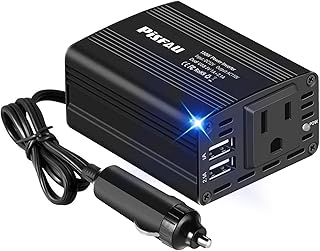
Best for: Drivers seeking a 150W inverter with AC power, USB charging, and an automatic fault response. PiSFAU lists 150W continuous output and 300W peak output, plus AC outlets and two USB charging ports.
The product description mentions charging laptops, tablets, string lights, game consoles, and other electronics. It also describes a smart-chip and built-in-fuse protection setup. If the inverter detects a fault, it is stated to shut off current output and display a red warning light.
Why it was selected: It provides a useful comparison with the compact FOVAL 150W model for buyers who value the described fault shutoff and warning feature. Limitation: Peak output is not the same as continuous output. Use the 150W continuous rating when checking whether a device is appropriate.
FOVAL 200W Car Power Inverter
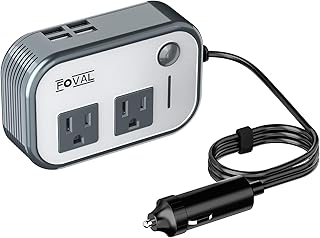
Best for: Travelers who need several USB connections alongside AC outlets. The product title identifies it as a 200W inverter, while its feature description says it provides power up to 180W. It lists two U.S. standard AC sockets and four USB charging ports.
The product is described as credit-card-sized, measuring about 3.2 by 2.5 by 1.5 inches, and weighing 8 ounces or more. Its listed protection features include short-circuit, low-voltage, overcharge, overvoltage, overload, and over-temperature protection, along with a built-in fuse. A smart cooling fan is described as adjusting speed as the inverter warms.
Why it was selected: The four USB ports make it a practical comparison option for passengers charging multiple USB devices. Limitation: The feature data says output is up to 180W, so use that figure when sizing connected equipment rather than assuming the full 200W title rating.
Buying Guide: How To Choose A Car Charger Converter Plug
A car charger converter plug, often called a car power inverter, uses a vehicle’s DC power to provide AC power for compatible plug-in devices. Many models also include USB ports for phones, tablets, and other USB-powered electronics. The right option depends on the equipment you plan to power, the total wattage, the vehicle’s power connection, and how many devices need charging at once.
Do You Need AC Power, USB, Or Both?
Choose an inverter with an AC outlet when your device uses a standard wall-style plug and cannot charge through USB. A laptop power adapter, for example, may need an AC outlet depending on its connection. If your devices charge by USB, count the number of USB ports and check their stated output. A model with several USB ports can reduce the need for separate car chargers, but port count alone does not tell you how quickly each device will charge.
How Much Wattage Should The Inverter Provide?
Check the power requirements printed on the device or its power adapter, then compare them with the inverter’s continuous output rating. Do not choose by peak or instantaneous output alone: those figures describe short-duration capacity, not ongoing power. When running more than one device, consider the combined demand. The FOVAL 200W listing, for example, states up to 180W in its feature description, so that stated output is the more conservative comparison point.
Some appliances and medical equipment may have specific power or operating requirements. Do not assume that an inverter is suitable simply because a product description lists a device category. Confirm the equipment maker’s requirements and the inverter’s output specifications before use.
How Many Outlets And Ports Do You Need?
Count the devices you expect to charge together. Two AC outlets can accommodate more than one AC plug, while four USB ports may suit a group traveling with several phones or tablets. However, the total available power still matters: several connected devices share the inverter’s capacity. For a single AC device and a couple of USB devices, a one-outlet, two-USB model may be sufficient and easier to store.
Will It Work With Your Vehicle?
Check the inverter’s stated input voltage and the power connection before buying. The products here are described as 12V vehicle inverters, but BESTEK lists an 11–17V input range. Confirm that the vehicle outlet and its circuit can support the load. A cigarette-lighter-style plug is convenient, but the car’s outlet rating can limit the power available even when the inverter’s own rating is higher.
Should Size, Cord Length, Or Cooling Affect Your Choice?
Compact designs are easier to store in a glove box or travel kit, while a longer plug cord can help position an inverter away from the vehicle’s socket. Consider whether the inverter’s outlets will remain accessible and whether its placement allows ventilation. Products may use heat-dissipation designs or cooling fans; these features do not remove the need to follow the manufacturer’s instructions about use and placement.
For frequent travel, compare the overall layout as well as dimensions. A small unit may have fewer outlets, while a model with multiple connections may take up more room or need more careful positioning. Choose the arrangement that fits your passengers’ charging needs without obstructing vehicle controls or creating tangled cables.
Frequently Asked Questions
What Does A Car Charger Converter Plug Do?
It converts a vehicle’s DC power into AC power for compatible plug-in devices. Many models also provide USB ports for charging USB-powered electronics. The specific output, port count, and supported load vary by product.
Can I Run A Laptop From A Car Inverter?
A laptop may be powered through an inverter if its power demand is within the inverter’s continuous output and the vehicle connection can supply the load. Check the laptop adapter’s wattage and the inverter specifications before connecting it.
Is Peak Wattage The Same As Continuous Wattage?
No. Continuous wattage is the stated ongoing output, while peak or instantaneous wattage refers to a higher short-duration output. Choose equipment based on continuous capacity unless the manufacturer provides specific guidance for the device’s startup demand.
Can Several Devices Be Connected At Once?
Yes, if the inverter has enough outlets and ports and the combined power demand stays within its limits. Check the output allocation for AC and USB connections, and do not assume every port can provide its maximum output at the same time unless the product information confirms it.
Can I Use A Car Inverter With Medical Equipment?
Do not assume that a general-purpose car inverter is suitable for medical equipment. Confirm the equipment maker’s power and operating requirements, then verify that the inverter provides the required output. Follow the instructions from both manufacturers.